How to Automate Equipment Cost Tracking
Automating equipment cost tracking helps you save time, reduce errors, and make better financial decisions. Manual methods, like paper logs and estimates, often miss critical details, leading to inaccurate cost calculations and lost profits. By using automated systems, you can track real-time data for expenses like fuel, repairs, and depreciation, directly linking costs to specific fields or crops.
Key benefits include:
- Accurate cost allocation: Track ownership and operating costs (e.g., depreciation, fuel, repairs) with precision.
- Improved decision-making: Identify underperforming equipment or high-cost operations.
- Streamlined management: Real-time tracking eliminates paperwork and reduces errors.
- Maintenance reminders: Prevent costly breakdowns with automated service alerts.
- Profitability insights: Understand cost-per-hour and cost-per-acre metrics for smarter planning.
For example, Steven Houlston of Houlston Contracting discovered inefficiencies in his manual tracking system after switching to automation. Tools like HarvestYield provide features like GPS tracking for farm equipment, centralized logbooks, and integration with accounting software, making cost management easier and more reliable.
Start by setting up detailed equipment profiles in your software, including purchase price, depreciation rates, and maintenance schedules. Use automated reminders for service tasks and track expenses in real-time for better cost control. With the right tools, you can reduce waste, improve profitability, and simplify farm management.
Equipment Cost Tracking Basics
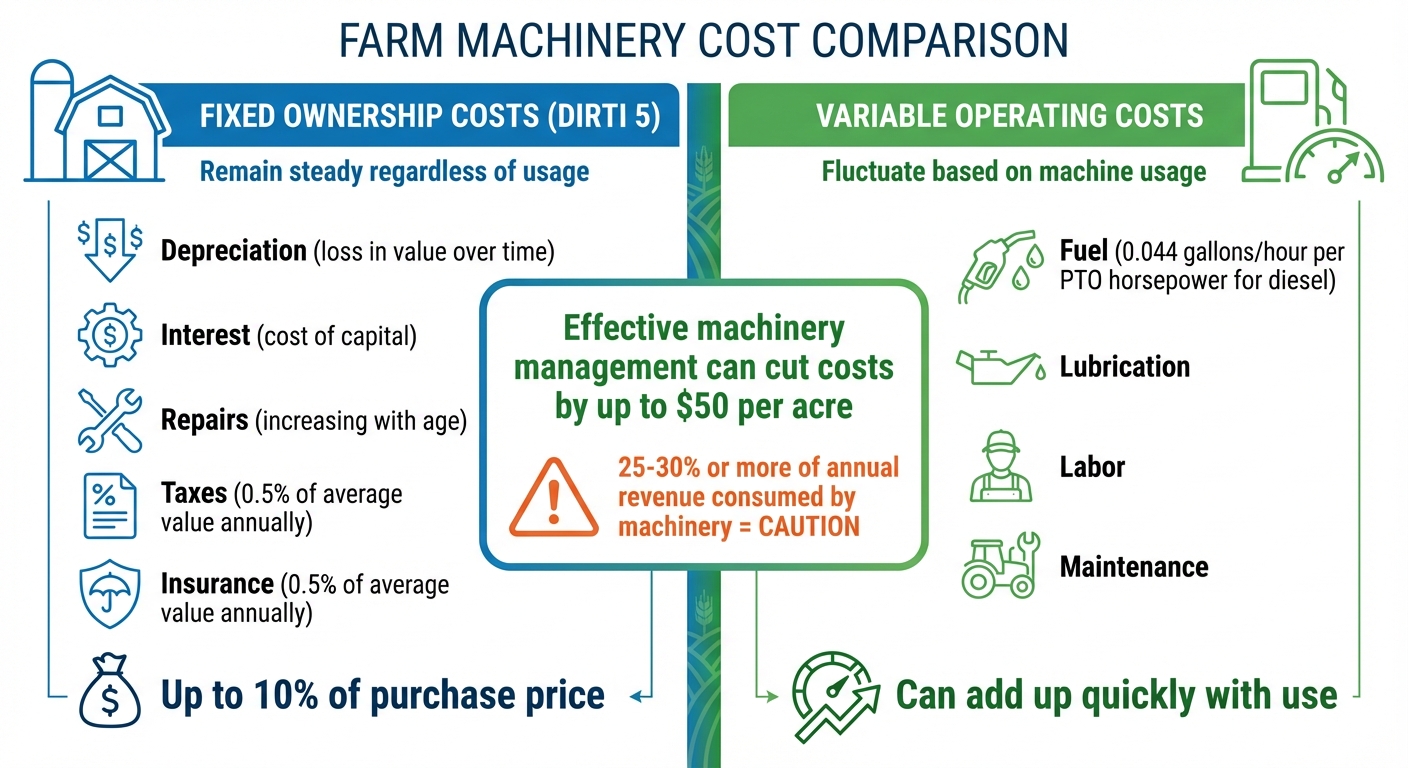
Equipment Cost Categories: Fixed Ownership vs Variable Operating Costs
Managing equipment costs effectively starts with understanding their two main categories: fixed ownership costs and variable operating costs. Fixed costs include depreciation, interest, taxes, insurance, and housing - expenses that remain steady regardless of how much the equipment is used. On the other hand, variable costs, such as fuel, lubrication, repairs, and labor, fluctuate based on machine usage. Ownership costs can account for up to 10% of the purchase price, while variable costs like lubrication and labor can quickly add up. Making informed decisions about machinery use and management can cut costs by as much as $50 per acre. These distinctions highlight the need for a structured approach to monitor and manage each expense category effectively.
Types of Equipment Costs to Monitor
A helpful way to remember the key ownership costs is the acronym DIRTI 5: Depreciation, Interest, Repairs, Taxes, and Insurance. Here's a quick breakdown:
- Depreciation: Represents the loss in value over time due to wear, aging, or obsolescence.
- Interest: The cost of capital tied up in owning machinery.
- Taxes and Insurance: Typically account for about 0.5% of a machine's average value annually.
On the operating side, fuel is a major factor. For example, diesel engines consume approximately 0.044 gallons per hour for each unit of maximum PTO horsepower. Repairs and maintenance are another critical area, with costs rising significantly as equipment ages and racks up hours. Keeping detailed records of these expenses is essential to avoid unexpected budget overruns. Tools like automated tracking systems - such as those from HarvestYield - can simplify this process by providing real-time insights into equipment costs.
Problems Caused by Poor Cost Visibility
Failing to track equipment costs can lead to serious financial consequences, as machinery expenses can quickly eat into profit margins. Agricultural economist David Widmar warns:
Anything between 25% to 30% or above that benchmark should throw up some caution as to what portion of your annual revenue is being consumed by machinery.
Without accurate data, it becomes nearly impossible to make sound decisions about whether to own equipment or hire custom services, when to replace machinery, or how to assess field profitability. Effective machinery management requires balancing the need for timely operations with the financial demands of ownership - a balance that's impossible to strike without clear visibility into costs.
Selecting Farm Management Software
Picking the right farm management software can be a game-changer for keeping track of equipment costs. The software you choose should cover both financial aspects - like depreciation schedules, repair logs, and fuel expenses - and operational needs, such as GPS-based job tracking and field navigation and real-time usage data. Without these features, you might end up manually entering data from paper logs, which defeats the purpose of automation. To make sure your software delivers maximum efficiency, here are some key features to consider.
Features to Look For
First, the software should allow you to input details like the machine's purchase price, depreciation rates, lease dates, and starting hours. This data helps create long-term cost analysis tables, giving you a clear view of ownership costs over 10, 15, or even 20 years. Real-time GPS tracking and mobile apps are also crucial for capturing accurate data on machine hours by job or field.
A centralized machinery logbook is another essential feature. It should consolidate records for refueling, repairs, and servicing. Being able to log expenses - such as fuel, consumables (like seed or wrap), and maintenance - right in the field saves time and minimizes errors. Push notifications for upcoming service needs or low fuel levels can help you avoid expensive breakdowns.
Integration is equally important. Your software should connect smoothly with machinery telematics platforms like the John Deere Operations Center and accounting systems such as QuickBooks, Sage, or Farmplan. Additionally, mobile offline access is a must for field operators working in areas with poor cell service. Lastly, ensure the platform supports field-level cost allocation so you can assign equipment expenses to specific crops or fields. This feature provides a clear picture of profitability. HarvestYield, for instance, includes all these features to simplify equipment cost tracking.
How HarvestYield Supports Equipment Cost Tracking
HarvestYield brings these crucial features together with its smart logbook functions, GPS tracking, and seamless data integration. Designed for agricultural contractors and farm teams, it offers a comprehensive machinery logbook that keeps track of refueling, repairs, and servicing in one place. The platform uses GPS-based job timers to automatically log machine hours per field, eliminating the need for paper job sheets and ensuring accurate cost allocation.
Between 2018 and 2020, Houlston Contracting in North Yorkshire used HarvestYield to manage up to 12 self-employed staff during silage season. By relying on the app's machinery logbook, they were able to track repairs and servicing with precision. Steven Houlston shared:
"The app made it easy to see when the last filter change was. On one machine, a set of filters had only done 189 hours."
This detailed record-keeping helped them quickly identify a diesel issue and maintain proper service intervals. The system also stored important details like access routes and gate codes for various farms, replacing messy paper records.
HarvestYield offers a free plan that covers up to 50 active acres - perfect for testing the platform. Paid plans are priced by active acreage rather than seats, starting at $49 per month for Starter (up to 250 acres), $149 for Pro (up to 1,000 acres), and $379 for Business (up to 5,000 acres). Every paid tier includes unlimited team members, and annual billing saves about two months. The platform also integrates with cloud accounting tools, allowing direct transfer of job sheets and invoices to ensure equipment costs are accurately reflected in your financial records. These features make HarvestYield a practical choice for streamlining farm management tasks.
Setting Up Equipment Profiles
Once you've chosen your software, the next step is creating detailed equipment profiles. These profiles are essential for accurate cost tracking, so it's worth investing time to input all the necessary details from the start. Each profile should include key identification information like Equipment ID, make, model, year, and VIN/Serial number. This is especially important when managing multiple machines of the same type to avoid confusion.
Financial details are just as important. Record the purchase or lease price, purchase date, and a specific depreciation rate to monitor ownership costs over time. You'll also need to log the "starting hours" (the meter reading at the time of purchase) and estimate the total annual hours of use. These numbers will serve as the baseline for calculating metrics like hourly wear and tear and cost-per-hour. Don’t forget to include a "Chargeout Rate" field, which automatically applies a default hourly rate to crop cost centers. Once profiles are set up, you can move on to entering detailed equipment data and linking assets to specific field activities.
| Profile Field Category | Essential Data Points | Purpose |
|---|---|---|
| Identification | Make, Model, Year, VIN/Serial #, License Plate | Asset tracking and insurance compliance |
| Financials | Purchase Price, Depreciation Rate, Lease Terms | Calculating overhead and hourly cost |
| Operational | Starting Hours, Chargeout Rate, Fuel Type | Usage tracking and automated billing |
| Maintenance | Last Service Date, Filter/Part Specs, Repair Logs | Preventive maintenance and TCO analysis |
Entering Equipment Details
Start with your most expensive assets - tractors, combines, self-propelled sprayers - since these typically have the highest depreciation and repair costs. By entering detailed information for these items, you can track costs with greater precision across your operation. Many software platforms allow you to use an "Import" feature, which connects to OEM portals like the John Deere Operations Center, reducing manual entry errors. To further simplify management, assign each machine a unique nickname or ID number to distinguish it from similar models.
Enable the "Active" checkbox for equipment currently in use. This feature allows you to hide retired or seasonal machinery from active searches without losing historical cost data. You can also create specialized profiles to limit job assignments, ensuring equipment is only used for its intended purpose. Some platforms even support QR code labels that link directly to a machine's digital profile, making it easy for operators to access maintenance history or log repairs on the spot.
Assigning Equipment to Specific Activities
Connecting equipment to specific fields or operations ensures every hour of use is accurately documented in your cost allocation. When operators start a job using a mobile device, they select the correct machine - and any attached implements - from a dropdown menu. For example, if a tractor is frequently paired with a specific plow, you can use the "Links" feature to automatically track usage and costs for both pieces of equipment together.
You can also streamline operations by creating templates for recurring tasks, such as "Spring Spraying." These templates predefine the required machinery, and when applied to a field, they automatically incorporate the associated equipment costs into the overhead for that area. This approach not only saves time but also ensures consistent and accurate cost tracking.
Transform Your Agricultural Team
Streamline job management, field mapping, and machine tracking with HarvestYield. Simplify your operations and eliminate paper job sheets.
ContinueTracking Maintenance and Repair Costs
Keeping tabs on maintenance and repair costs is crucial to managing your budget effectively. Unmonitored expenses can quickly add up. For instance, unplanned equipment breakdowns cost farmers an average of $3,348 per season, while repair and upkeep typically make up 10–15% of annual operating costs. However, sticking to a strict preventive maintenance schedule can reduce repair costs by around 25%. Using digital logbooks to track refueling, repairs, and servicing on mobile devices - with real-time cloud syncing - makes this process much easier. Below, we’ll explore strategies for automating maintenance schedules and efficiently recording repair details.
Automating Preventive Maintenance Schedules
Automating reminders for routine maintenance tasks, based on engine hours or calendar dates, ensures you stay ahead of potential issues. For example, you can set alerts for hydraulic oil changes every 500 hours or schedule tire inspections every two weeks during peak seasons. Farm management software can help you establish these intervals based on manufacturer guidelines, ensuring no maintenance window is overlooked. The software tracks engine hours starting from the baseline entered in the equipment profile and notifies you when service is due.
This approach works particularly well for high-use equipment like tractors and combines. For example, if maintaining a used tractor costs between $0.75 and $1.50 per hour, you can budget more accurately by monitoring accumulated hours. The software can also remind you to check engine oil quality weekly or clean radiators every two weeks, reducing the risk of overheating during busy planting or harvest periods. Staying proactive with maintenance helps avoid costly downtime when you need your equipment the most.
Once you’ve automated these reminders, the next step is to carefully document repair costs to improve cost management.
Recording Repairs and Maintenance Expenses
Detailed record-keeping is key to controlling repair expenses. For every repair, document the service date, total cost, and whether it was routine or an emergency. Break down the details - labor hours, parts (including part numbers and prices), vendor names, and payment references - to gain a clear understanding of where your money is going. This level of specificity can reveal trends, such as a machine that frequently breaks down, signaling it might be time for a replacement.
It’s also helpful to link maintenance records to specific jobs or fields. For instance, if a sprayer breaks down while treating a corn field, allocate the repair cost to your corn production overhead. This gives you a clearer picture of per-acre production costs. Many platforms also allow you to track fuel usage and engine fault codes via onboard sensors, which can help predict potential failures. Even simple measures, like checking tire pressure, can save money - underinflated tires waste about 1% of fuel for every 10 psi below the recommended level. These detailed records feed into cost analytics, enabling smarter budgeting and better decision-making.
Using Cost Reports and Analytics
Turn your maintenance data into meaningful cost insights. Cost reports can help you understand how each machine affects your overall expenses. Pay attention to metrics that highlight both financial and operational performance, like total costs, depreciation schedules, and profit or loss per machine. Operational usage metrics - such as total machine hours, job start and end times, and last used dates - are equally important to track. These insights create a foundation for monitoring essential metrics.
Key Metrics to Track
To get a clear picture of your equipment costs, start with metrics like cost per hour and cost per acre. Calculating cost per hour is straightforward: divide the total expenses by the total machine hours. For instance, if a tractor costs $15,000 a year to operate and runs for 1,000 hours, its cost per hour is $15. Comparing this figure to your chargeout rate - what you bill clients or allocate to crops - can reveal whether you're covering your expenses.
Utilization rates are another key indicator. If a sprayer is only used for 200 hours in a season but has the capacity for 400, you're likely paying for unused potential. Keep an eye on repair costs and service intervals, such as the hours since the last filter change, to spot machines that are becoming financial drains. Fuel consumption is another critical efficiency metric to monitor. Additionally, conducting a break-even analysis for each machine helps determine if it's generating enough revenue to justify keeping it.
Making Decisions Based on Cost Data
With these metrics in hand, you can make informed decisions about repairing, replacing, or adjusting how your equipment is used. Rising repair costs and depreciation trends are clear signals that it might be time to replace aging machinery. For long-term planning, project equipment costs over 10, 15, or even 20 years by factoring in the purchase price, depreciation, and repair expenses.
Break down equipment costs by crop or field to understand how machinery affects profitability. If one area shows unexpectedly high costs, it could point to a specific machine driving up repair expenses. Regularly comparing your chargeout rate to the actual cost per hour ensures you're not losing money. Additionally, tracking whether repairs are done in-house or outsourced can help identify the most cost-effective approach. By analyzing these insights, your cost reports evolve from simple records into a powerful tool for smarter financial decisions.
Conclusion
Switching to automated equipment cost tracking takes farm management from a guessing game to a precise, data-driven process. With real-time insights into cash flow and operations, you can quickly pinpoint financial inefficiencies and uncover opportunities that manual methods might miss.
By assigning costs like depreciation, fuel, and repairs to specific crops or fields, you can clearly see which parts of your operation are thriving and which ones might need adjustments. This level of detail helps you make informed decisions about profitability and resource allocation.
But it’s not just about crunching numbers - technology also simplifies your day-to-day tasks. Mobile tracking ensures accurate, in-field data entry, while automated billing and invoicing speeds up cash flow by enabling billing right after completing a job.
Take HarvestYield, for example. Its logbook feature keeps tabs on refueling, repairs, and service events, while GPS integration automatically links jobs to the correct equipment. Plus, its flexible pricing options are designed to fit your specific operational needs.
"Stop managing your farm based on gut feel and emotion. In today's volatile farm economy, professional management is essential."
Ultimately, automated tracking not only streamlines financial oversight but also sets the stage for smarter decisions about repairs, replacements, and resource use. It’s a practical way to strengthen your bottom line and make farm management more efficient and strategic.
FAQs
How can automating equipment cost tracking boost profitability?
Automating equipment cost tracking gives you up-to-the-minute, reliable data on expenses like depreciation and cost-per-hour. This data can be tied directly to specific jobs, fields, or crops, giving you a clear picture of your actual breakeven points and profit margins.
Armed with detailed cost information, you can set service prices more accurately, cut down on avoidable expenses, and make smarter decisions to boost profitability. Plus, by ditching manual tracking, you save time, reduce mistakes, and streamline operations for better financial results.
What features should I look for in farm management software?
When choosing farm management software, focus on tools that streamline your daily tasks and offer practical insights. Look for features that let you log jobs directly from your smartphone, automatically capture GPS data, and include details like timestamps, field measurements, and before-and-after photos. These capabilities ensure precise work documentation and help avoid misunderstandings or disputes.
An effective equipment cost tracking feature is also a must-have. It should allow you to record purchase prices, track depreciation, and monitor maintenance costs. Plus, it should generate detailed reports, such as cost-per-hour or profit-and-loss summaries for each piece of equipment. On top of that, invoicing and financial reporting tools are game-changers - think instant PDF invoices with field maps and dashboards that clearly outline revenue and expenses by field or crop. These features not only enhance cash flow visibility but also cut down on tedious paperwork.
How can automated systems simplify tracking maintenance and repair costs?
Automated farm management systems simplify the process of tracking maintenance and repair costs by centralizing all the relevant data in one place. These systems connect each piece of equipment to its service history, automatically creating preventive maintenance schedules based on either usage or set calendar dates. They also send reminders when tasks are due and record labor and parts costs as soon as jobs are logged. This reduces the need for manual data entry and minimizes the chances of errors.
With access to real-time data on total upkeep costs, managers can easily compare expenses to budgets, calculate equipment depreciation, and assign repair costs to specific fields or crops. Clear and concise reports - presenting details like cost-per-hour or cost-per-acre in U.S. dollars ($) - make it easier to spot trends, such as frequent repairs on a particular machine. These insights help managers make smarter decisions about whether to repair or replace equipment. Tools like HarvestYield take it a step further by integrating machine cost tracking into job management systems, ensuring that every logged job automatically updates the equipment’s expense record. This provides instant, actionable insights into profitability.