Top 5 Benefits of Automated Livestock Weighing
If I want better weight data without more chute work, automated weighing is one of the clearest ways to get it. It can cut cattle handling time by up to 45%, push individual-animal accuracy above 93%, and help me spot weight loss or slow gain days sooner.
Here’s the short version:
- It saves time by weighing animals during normal movement
- It improves data quality by cutting reading and typing mistakes
- It lowers animal stress by reducing chute work and extra handling
- It helps me catch health and performance problems earlier
- It supports better feed, sorting, and sale timing decisions
That’s the core idea: more weight data, less labor, and less stress on livestock.
Auto Weigher: Automated and remote weighing solution
Quick Comparison
| What changes | Manual weighing | Automated weighing |
|---|---|---|
| Labor | More people and more time on weigh day | Less hands-on work after setup |
| How often I get weights | Every so often | Daily or several times a week |
| Record errors | More room for paper and data-entry mistakes | Digital records cut those mistakes |
| Animal handling | Chute, sorting, and more movement | Weighing during normal travel |
| How fast I can act | After the next weigh day | Within days when trends shift |
If I need sale-day weights, manual checks still have a place. But if I want steady weight trends to guide day-to-day herd decisions, automated systems do more with less effort.
Why Automated Weighing Is Growing in U.S. Farms and Ranches
The main reason is pretty simple: operators want more weight data without adding more chute work. Labor is tight on U.S. cattle operations, and chute weighing pulls time away from other jobs that still need to get done. Automated systems cut most of that load. Walk-over scales and in-paddock setups can record weights during normal animal movement, with much less yarding and handling.
This lines up with the move toward precision livestock farming (PLF). In plain English, that means using sensors, cameras, and connected devices to turn a handful of weigh sessions each year into a steady flow of performance data. Instead of getting just a few snapshots, producers get a more regular read on how animals are doing.
The payoff is straightforward: more frequent weight data with less handling.
1. Time Savings in Daily Weighing
Automated weighing saves one of the clearest resources on a busy farm: time. Pulling animals together, running them through a chute, and writing down weights by hand can eat up a big part of the day. It also takes labor away from other jobs that still need attention.
Automated systems cut much of that extra work by recording weights during normal movement. So instead of stopping the flow of the day, the data comes in while people keep working.
Over a week or a month, those saved minutes add up in a big way. Managers also get weight data faster, which means they can respond sooner to feeding changes, sorting decisions, or health problems.
2. More Accurate Weight Data
Manual weighing sounds simple, but small mistakes creep in fast. Animals move on the scale. Two workers may read the same dial a bit differently. Then handwritten notes get entered into logs or spreadsheets, and another error slips in. Over time, those little misses stack up.
Automated systems cut down on that noise by filtering unstable readings before they’re saved. They use load cells and weight-averaging to smooth out movement and deliver more consistent numbers.
In a 2024 pig study, an automated weighing system closely matched manual weights, with r = 0.9410, R² = 0.8854, and a mean absolute error of 3.48 kg (about 7.7 lb) across pigs weighing 60 to 120 kg (about 132 to 265 lb). That kind of consistency is hard to match by hand.
It also helps to separate two ideas that often get lumped together. Accuracy means how close a reading is to the animal’s true weight. Precision means getting the same result again and again under the same conditions. Automated systems improve both, which matters when you’re tracking growth trends or trying to catch slowing gain before it turns into a bigger issue.
There’s another plus here: direct digital transfer removes transcription mistakes from handwritten logs and spreadsheets. No squinting at messy numbers. No typing errors. No one writing 186 when the scale showed 168.
That said, automation isn’t “set it and forget it.” The system still needs calibration and routine maintenance. Check it against known test weights, and keep an eye out for odd variation in repeated readings.
Cleaner weight data makes patterns easier to see. And when the numbers are more dependable, health or performance problems tend to stand out sooner.
Transform Your Agricultural Team
Streamline job management, field mapping, and machine tracking with HarvestYield. Simplify your operations and eliminate paper job sheets.
Continue3. Less Animal Stress and Handling
You can gather the same weight data with a lot less stress on the animals.
Every weigh day pushes cattle through alleys and into a chute. That alone adds pressure. Research summarized by animal behavior expert Temple Grandin shows that handling and restraint alone can sharply raise cortisol in cattle and sheep.
Automated systems cut out much of that strain. Walk-over scales and in-paddock units are set along paths cattle already use, like routes to water, feed, or mineral blocks. So animals step onto the scale during a normal part of the day, with no mustering, no sorting, and no chute involved.
That matters because less handling usually means less stress. And that can show up where producers care most: performance. Lower stress supports better average daily gain (ADG) and feed efficiency.
There’s also a plain, practical upside. Fewer trips through packed alleys can mean:
- fewer falls
- fewer injuries
- less mixing of unfamiliar animals, which can lower disease risk
Low-stress herd systems can also make cattle easier to move over time. That helps other jobs on the farm go more smoothly, from health checks to pen moves. It also makes weight data easier to trust when you’re trying to spot health problems.
For daily use, scale setup matters. Place scales on well-drained, non-slip lanes cattle already travel, and use solid sides with minimal distractions.
4. Earlier Detection of Health and Performance Issues
Less handling does more than cut stress. It also gives you more frequent weight readings, which makes early trouble easier to catch.
Weight changes often show up before you can see clear symptoms. That means automated scales can flag a problem days before a routine pen check would.
Manual weighing gives you occasional snapshots. Automated walk-over scales at water troughs or feed bunks can record weights daily, or even several times a day. That turns weight into a running health signal instead of a one-time check.
A slow, unexplained drop in weight over several days can point to illness. So can a stall in average daily gain (ADG), or one animal slipping behind the rest of the pen. In some cases, the issue may be parasites. In others, it may be poor feed access. Using 5- to 7-day averages helps smooth out day-to-day swings and makes the real pattern easier to see. From there, you can act with a health check, parasite test, or ration review.
There’s another upside here: earlier action usually means lower treatment costs, less feed waste, and fewer losses from disease that has had time to get worse. And when you connect weight data with feed records, animal moves, and weather, the reason behind a performance drop often becomes much easier to sort out.
5. Smarter Decisions on Growth, Feeding, and Market Timing
Steady weight data gives you a clear record for day-to-day management. When you can see how one animal or a whole group is tracking against growth targets, it gets much easier to adjust feed at the right time. If gains start to lag, you can change the ration sooner and deal with the problem before the gap gets bigger. That’s tough to do when weights are logged only once every few weeks.
The same trend data also helps with sorting groups and planning sale dates with less guesswork.
Market timing is where this often shows up most. Sending animals to market too soon can leave money on the table. Waiting too long can hurt feed efficiency and cut into returns. Automated records take some of the guesswork out, so marketing calls can be based on current weights and gain trends instead of rough estimates.
Those records also make the manual-vs.-automated comparison much easier to spot.
Manual vs. Automated Weighing: A Side-by-Side Look
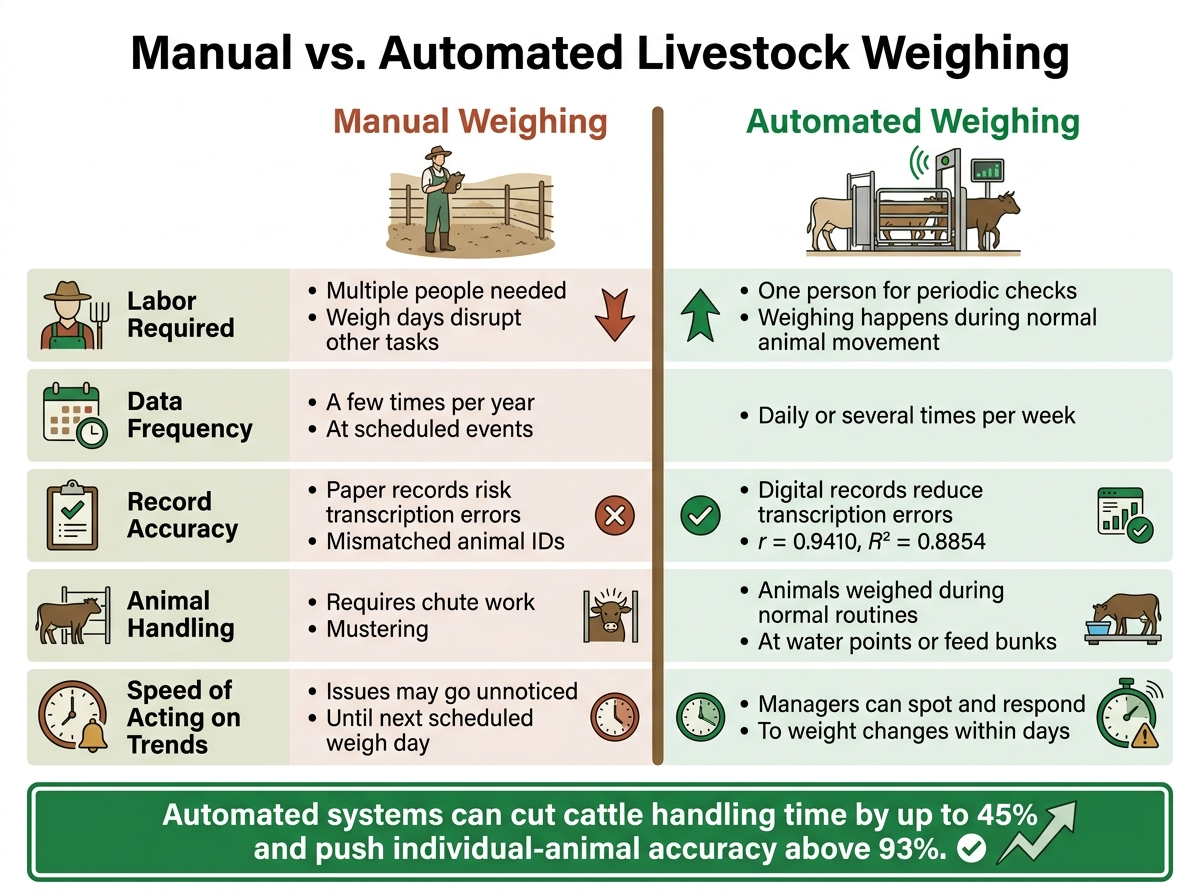
Manual vs. Automated Livestock Weighing: Key Differences at a Glance
Manual weighing usually means occasional weigh days that take a lot of labor. Automated systems, on the other hand, give you frequent weight data with very little animal handling.
That’s the day-to-day difference.
| Aspect | Manual Weighing | Automated Weighing |
|---|---|---|
| Labor required | Multiple people are often needed to sort, move, and record weights, and weigh days can disrupt other tasks | One person can usually handle periodic equipment checks while weighing happens during normal animal movement |
| Data frequency | A few times per year at scheduled events | Daily or several times a week |
| Record accuracy | Paper records can lead to transcription errors and mismatched animal IDs | Digital records reduce transcription errors |
| Animal handling | Requires chute work | Animals are weighed during normal routines at water points or feed bunks |
| Speed of acting on trends | Issues may go unnoticed until the next scheduled weigh day | Managers can spot and respond to weight changes within days |
In plain terms, manual weighing works when you need official sale-day weights or calibration checks. Automated weighing makes more sense for routine monitoring, where steady data helps managers react sooner.
Conclusion
Automated weighing turns occasional checks into a steady stream of weight data, so producers can step in sooner.
That matters for a simple reason: the gains show up where day-to-day work counts most - labor, animal welfare, and decision-making. The payoff is direct. Automated systems save hours of handling, cut stress for both animals and handlers, and give more dependable readings. Up-to-date weights also make market timing more precise, which helps avoid shipping animals that are too light or too finished and helps protect revenue.
For many operations, the next question is whether the return is worth the cost. The simplest way to look at ROI is to compare monthly weighing labor with the system’s upfront price. Farms that weigh often or are short on labor tend to see the clearest return. A smart place to start is with one pilot system for a high-value group, such as finishing cattle or replacement heifers, and then expand across the ranch if the numbers make sense.
Put simply, automated weighing gives farms faster, cleaner data with less handling.
FAQs
How much does automated livestock weighing cost?
The cost of automated livestock weighing depends on the size of your operation, what you need the system to do, and the setup you choose.
In most cases, you’re paying for two things:
- Upfront hardware
- Ongoing software and maintenance
Like other farm management tools, software subscriptions often fall between $500 and $2,000 per year.
It also helps to look past the sticker price. Total ownership cost can include calibration, system updates, and equipment maintenance.
What kind of setup does an automated scale need?
An automated livestock weighing system usually brings together on-site hardware - like load bars or platform scales built into handling chutes - with a digital management platform.
The setup records weights on its own, along with timestamps and each animal’s ID. When connected to HarvestYield, that weight data ties directly to livestock records, cuts down on manual logging, and helps keep data accurate and securely stored for analysis and compliance reporting.
How do I calculate ROI on an automated weighing system?
Track your actual operating data instead of relying on estimates. Start with a clear baseline for fixed and variable costs, including labor, fuel, and equipment maintenance.
Then compare the system’s total cost - including hardware and subscription fees - with the savings it can produce: lower labor costs, less downtime, fewer administrative errors, and better-informed decisions. Tools like HarvestYield can help tie those costs to measurable units, such as cost per head or per animal group.