Top 7 Tools for Weather-Based Farm Alerts
Weather-based tools can help farmers make smarter decisions by providing real-time, field-specific alerts for frost, storms, wind, rain, and more. These tools assist in protecting crops, managing irrigation, and timing fieldwork effectively. Here's a quick overview of the top 7 tools covered:
- HarvestYield: Automatically logs weather conditions during tasks and integrates with payroll and reporting tools. Offline functionality ensures reliability in remote areas.
- CropX: Combines soil sensors and weather data to optimize irrigation, prevent diseases, and reduce water usage.
- FarmRoad: Focuses on rain tracking, temperature alerts, and wind conditions but requires more research for detailed features.
- Fieldmargin: Tracks rainfall and uses satellite imagery to monitor crop health, integrating with John Deere equipment.
- Croptracker: Links weather data with farm records, offering frost alerts, wind monitoring, and disease risk predictions.
- John Deere Operations Center: Provides customizable weather alerts and integrates with machinery for real-time field-level insights.
- Webfleet Tractor Tracking: Monitors rainfall, hail, and soil trafficability to manage equipment deployment efficiently.
These tools vary in features, pricing, and compatibility. Below is a quick comparison to help you decide.
Quick Comparison
| Tool | Key Features | Platforms | Pricing | U.S. Units Supported |
|---|---|---|---|---|
| HarvestYield | Weather logging, GPS tracking | iOS, Android, Web | $20–$130/month | Yes |
| CropX | Soil sensors, irrigation alerts | iOS, Android, Web | Custom | Yes |
| FarmRoad | Rain and temperature alerts | iOS, Android, Web | Free–$15/month | Yes |
| Fieldmargin | Rain tracking, satellite imagery | iOS, Android, Web | $60.99/month | Yes |
| Croptracker | Frost alerts, disease risk predictions | iOS, Android, Web | $50/month | Yes |
| John Deere Operations Center | Customizable alerts, equipment integration | iOS, Android, Web | Bundled with equipment | Yes |
| Webfleet Tractor Tracking | Rainfall, hail alerts, soil trafficability | iOS, Android, Web, In-cab | Custom | Yes |
Each tool offers unique benefits depending on farm size, location, and specific needs. Evaluate based on your requirements for weather alerts, integration, and cost.
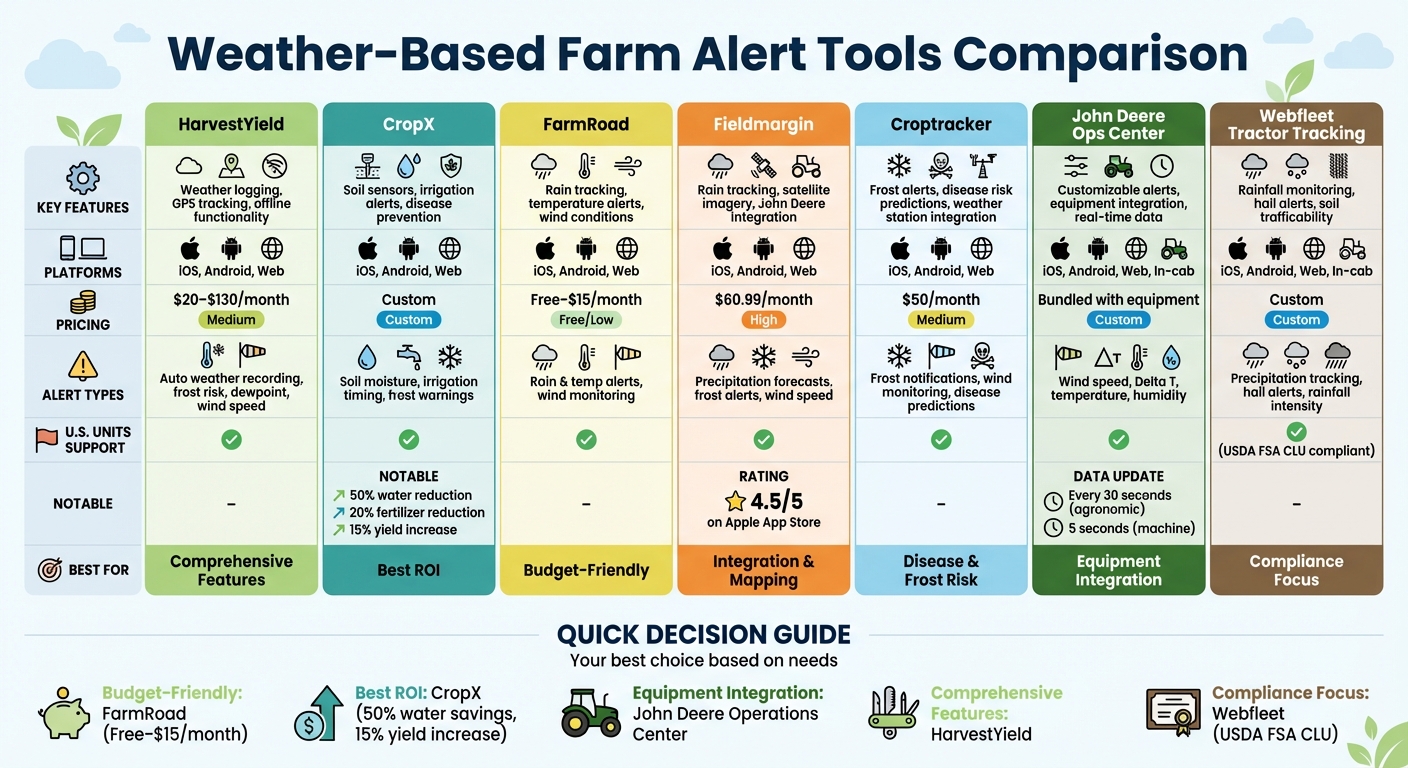
Weather-Based Farm Alert Tools Comparison: Features, Pricing, and Platforms
Farm Weather full introduction
Transform Your Agricultural Team
Streamline job management, field mapping, and machine tracking with HarvestYield. Simplify your operations and eliminate paper job sheets.
Continue1. HarvestYield
HarvestYield takes the hassle out of manual record-keeping by automatically logging weather conditions at the start and end of every job. This ensures farm managers and contractors have precise timestamps that reflect real field conditions - perfect for documenting critical activities like spraying, planting, or harvesting.
How It Works with Other Farm Tools
Even in remote areas with limited connectivity, HarvestYield records GPS paths and weather data offline, syncing everything to the cloud once a connection is available. This ensures your field data stays reliable no matter where you are. The weather data is automatically added to digital job sheets, simplifying EPA and FSA-compliant reporting. For payroll and invoicing, HarvestYield works seamlessly with QuickBooks and Gusto, turning field data into billable hours effortlessly. These features make it a go-to tool for US farms, integrating smoothly with other farm management systems.
Devices and Platforms Supported
HarvestYield supports iPhone and iPad (iOS 15.0 or later), Mac devices with an M1 chip or newer (macOS 12.0+), and Apple Vision (visionOS 1.0+). It also works on Android devices, giving teams the flexibility to use it across different platforms.
Features for US Farms
With GPS-verified acreage measurements, HarvestYield offers an accuracy range of ±0.5–2%, a big improvement over traditional methods that can vary by 5–15%. For smaller operations, a free tier is available, covering up to 50 active acres. Paid plans are priced by acreage rather than seats, starting at around $49 USD per month for up to 250 acres and $149 USD per month for up to 1,000.
2. CropX
CropX stands out as a powerful tool for modern farming, using real-time data to help farmers make smarter, faster decisions. By combining soil sensor readings with weather monitoring, it offers detailed insights into crop conditions. This allows farmers to address irrigation needs, potential disease risks, and nutrient levels before problems arise. With over 20,000 users across 70+ countries managing more than 100 crop types, CropX has become a trusted name in farm management.
Types of Weather Alerts Available
CropX keeps a close eye on evapotranspiration (ET) rates and weather patterns to send irrigation alerts before crops face water stress. For disease prevention, it evaluates environmental conditions to recommend the best timing for fungicide applications, reducing the risk of outbreaks. The platform also monitors leaching events and effluent applications, which is especially useful for US dairy and livestock farms that need to maintain compliance with environmental regulations. These alerts integrate smoothly with other farm management tools, offering a connected and efficient system.
How It Works with Other Farm Tools
The platform doesn’t operate in isolation - it pulls data from various sources like farm machinery, third-party weather stations, and rain gauges. Its collaboration with Reinke, a leading US irrigation equipment manufacturer, allows farmers to manage irrigation systems directly through the CropX interface. This setup combines real-time soil moisture data and weather insights, helping growers optimize water use and meet crop demands without over- or under-watering.
Features for US Farms
For farmers in the US, CropX delivers measurable improvements. Reports show water use dropping by as much as 50%, fertilizer and fungicide use decreasing by 20%, and yield gains climbing to 15% [13,14]. Its user-friendly dashboard can handle everything from a single field to thousands, making it ideal for large-scale row-crop operations. The sensors are designed for quick, five-minute installation and come with automatic calibration, catering to the hands-on approach many US farmers prefer. Additionally, the platform includes tools to track soil nitrogen levels and monitor effluent irrigation, helping farms stay aligned with regulatory standards [13,14].
3. FarmRoad
FarmRoad's weather alert features aren't extensively documented, leaving some questions unanswered. To get a better understanding, it's best to reach out directly to the provider. Ask about key aspects like real-time weather notifications, compatibility with your equipment, mobile apps for field teams, and how accurate the local data is. Requesting a live demo can also help you see how the alert system performs in action. This lack of detailed information highlights the importance of digging deeper when assessing weather alert tools for farms in the U.S.
4. Fieldmargin
Fieldmargin combines manual weather logging with satellite monitoring to create detailed historical weather records. It allows farm managers to track rainfall at specific field locations, offering a more precise way to manage weather-related data.
The platform's Field Health feature, available with the Pro plan (US $60.99/month), uses satellite imagery to assess crop conditions. It helps identify issues like drought, excessive moisture, and other weather-related stresses. This visual data works hand-in-hand with manual weather tracking, giving you a more comprehensive view of your fields' health.
How It Works with Other Farm Tools
Fieldmargin integrates seamlessly with John Deere equipment, displaying live machinery locations directly on your farm map. This ensures all team members have access to up-to-date information, improving coordination and decision-making. Additionally, field observations automatically sync to the cloud, so everyone stays informed in real time.
"Having a visual map of the farm that updates in real time has really helped streamline day-to-day decision-making and improve communication across the team." – User Review, Brow Farm
This integration enhances operational efficiency and supports better collaboration across platforms.
Devices and Platforms Supported
Fieldmargin works on a wide range of devices, including iPhones, iPads, iPod touch (iOS 16.0 or later), Android phones and tablets, Apple Vision (visionOS 1.0 or later), and web browsers on desktops and laptops. With over 100,000 downloads on Google Play and a 4.5/5 rating on the Apple App Store, the app is both popular and reliable. It also offers offline functionality, allowing users to record data without a cellular signal and automatically sync it when back online.
Next, learn about Croptracker, another tool designed to provide weather-based alerts.
5. Croptracker
Croptracker connects farm records with weather data through APIs from the National Weather Service, NOAA, and on-site stations like Davis Instruments, RainWise, and Hoskin Scientific. This integration provides hyper-local weather insights, forming the backbone of its alert system.
Types of Weather Alerts Available
Croptracker offers alerts for various weather-related risks, including frost and heat damage. It evaluates real-time wind speed and direction to ensure spray safety and warns when fields are under- or overwatered. For irrigation management, it tracks soil moisture and evapotranspiration rates. Additionally, it predicts biological risks such as disease outbreaks and insect growth stages, while issuing chemical safety alerts for re-entry and pre-harvest intervals based on your spray records. Beth Bishop, Coordinator at Michigan State University's Enviro-weather program, highlights:
"Minimizing weather risk requires knowledge. Growers need to know the current weather conditions and have an idea of what they will be in the near future".
How It Works with Other Farm Tools
Croptracker seamlessly integrates weather data with spray records, planting schedules, and harvest yields, helping farmers understand how weather impacts production. It calculates Growing Degree Days (GDD) using temperature sensors - for example, using a base of 50°F for corn or 42°F for peas - to offer more accurate harvest predictions. Weather data such as wind speed, wind direction, and temperature is automatically added to pesticide and fertilizer application records, simplifying compliance documentation.
Devices and Platforms Supported
Croptracker is a cloud-based platform accessible through web browsers and mobile apps for iOS and Android. It also features tools like Harvest Quality Vision and Crop Load Vision, which use your phone's camera to capture real-time field data. Supported weather stations range in cost from $400 to $3,000, with options like Davis Instruments ($400–$2,000) and RainWise ($1,500–$3,000).
6. John Deere Operations Center
The John Deere Operations Center is a cloud-based system designed to bring together machines, fields, and farm teams using real-time data. Thanks to JDLink connectivity, it streams agronomic data every 30 seconds and machine performance data every 5 seconds. This continuous data flow supports its precise weather alert system.
Types of Weather Alerts Available
The platform offers customizable weather alerts for factors like wind speed, wind direction, Delta T, temperature, and humidity. If conditions exceed set thresholds during sensitive tasks like spraying, the in-cab display will turn red to warn the operator. Additionally, farm managers can use the Field Flags feature to document and mark weather-related conditions, such as "wet spots", helping operators identify areas that may be unsafe or inaccessible.
How It Works with Other Farm Tools
The Operations Center leverages real-time data to seamlessly integrate weather insights with other farm management tools. Through its "Connections" tab, the platform links with non-John Deere equipment and third-party software, making it easier for agronomists and crop insurance providers to access critical data. The Work Planner feature allows users to create and wirelessly send prescriptions to in-cab displays, ensuring weather-sensitive tasks are performed under optimal conditions. The Team feature lets you share access with trusted advisors, enabling them to analyze moisture and yield data remotely and offer timely advice on weather-related challenges.
Devices and Platforms Supported
The Operations Center is accessible through web browsers, iOS and Android devices, and in-cab hardware such as the G5, G5Plus, Gen 4 4600 CommandCenter, and 4640 Universal Display. Data transfers can be done wirelessly via JDLink, through the MyTransfer app, or using USB flash drives. Both account access and mobile app downloads are free, and JDLink connectivity is provided at no additional cost.
Features for US Farms
For farms in the United States, the platform includes a dedicated FSA Crop Reporting tool and Diagnostic Trouble Codes, which help identify and address machine issues during critical weather periods (see our Quick Start Guide for more on managing farm data).
7. Webfleet Tractor Tracking
Webfleet Tractor Tracking connects tractors with weather stations, drones, and farm management systems, providing farm managers with immediate field weather data. This helps them make smarter decisions about how and when to deploy equipment.
Types of Weather Alerts Available
The platform offers precipitation and rainfall tracking without the need for physical rain gauges. It monitors rainfall volume and intensity in real time. Additionally, farm managers receive hail alerts via email whenever their farmland is affected, allowing them to act quickly to protect their crops. These alerts integrate seamlessly into overall farm management workflows.
How It Works with Other Farm Tools
By combining satellite imagery and meteorological data, the system optimizes logistics and equipment use. It also uses soil models paired with weather data to analyze soil trafficability, helping farm managers determine if fields are safe for heavy machinery. This prevents issues like soil compaction and equipment damage during wet conditions. These features make the system a reliable tool across various farm operations.
Devices and Platforms Supported
Webfleet is available through web browsers, in-cab systems, and mobile apps for both iOS and Android. This multi-platform accessibility ensures farm managers can stay updated on weather conditions whether they're in the office, out in the field, or on the road. The system also meets USDA FSA Common Land Unit (CLU) requirements for farms in the United States.
Feature Comparison
Here's a breakdown of key features for U.S. farm managers, focusing on alert types, platform availability, pricing in U.S. dollars, and compatibility with imperial measurement units commonly used in American agriculture.
| Tool | Alert Types | Platform Access | Pricing (USD) | U.S. Measurement Units |
|---|---|---|---|---|
| HarvestYield | Automatic weather recording at job start/finish; frost risk, dewpoint, and wind speed | iOS, Android, Web | Free up to 50 acres; Starter $49/month (250 acres); Pro $149/month (1,000 acres); 30-day free trial | Yes – supports both imperial (acres, miles) and metric |
| CropX | Soil moisture, irrigation timing, frost warnings | iOS, Android, Web | Custom pricing | Yes |
| FarmRoad | Rain tracking, temperature alerts, wind conditions | iOS, Android, Web | Free to $15/month | Yes |
| Fieldmargin | Precipitation forecasts, frost alerts, wind speed | iOS, Android, Web | $49/month per user | Yes |
| Croptracker | Weather station integration, frost notifications | iOS, Android, Web | $50/month base | Yes |
| John Deere Operations Center | Field-level forecasts, precipitation alerts | iOS, Android, Web | Bundled with equipment | Yes |
| Webfleet Tractor Tracking | Precipitation tracking, hail alerts, rainfall intensity | iOS, Android, Web, In-cab | Custom pricing | Yes – meets USDA FSA CLU requirements |
HarvestYield stands out for its straightforward pricing, dependable GPS tracking, and strong offline functionality. It automatically logs weather conditions at the start and end of tasks, helping farmers maintain compliance records and make better decisions for spraying and harvesting.
For farms operating across multiple locations, the ability to switch between imperial and metric units is crucial. HarvestYield caters to this need by aligning with standard U.S. farming practices. This comparison highlights how accurate weather alerts and versatile platforms can help farms streamline their operations and improve efficiency.
Conclusion
Weather alerts play a crucial role in guiding decisions for planting, spraying, harvesting, and ensuring crew safety. Real-time updates on frost risks, wind speeds, dewpoints, and severe weather events - like lightning and hail - help protect crops, prevent chemical drift, and safeguard workers. As Cordulus puts it:
"Gone are the days of worrying about unnoticed frost nights during early spring or the risk of drift and run-off while applying crop protection."
Each tool available brings something different to the table. From hyperlocal accuracy provided by connected weather stations to alerts tailored to 18 specific weather parameters, the choice ultimately depends on what your farm requires most. Whether it’s field-level precision, seamless integration with existing equipment, or clear pricing without hidden fees, selecting the right platform is all about meeting your unique operational needs.
When evaluating systems, consider how alerts are delivered - whether through mobile apps, SMS, or web platforms. Check for offline functionality and support for imperial units. Set thresholds for conditions like rain or wind to align with your farm’s schedule. Free trials (typically 14–30 days) can help you test the accuracy of hyperlocal data before making major decisions. For tasks like irrigation timing or applying nutrients, professional-grade weather monitoring is a better choice than relying on basic regional forecasts. This strategic approach ensures the system you select is both reliable and tailored to your needs.
The right weather alert system can save time, reduce risks, and improve efficiency. With the features outlined above, you can confidently choose a tool that supports your crops and fits seamlessly into your workflow.
FAQs
How can weather-based tools improve farm operations?
Weather-based tools serve as a real-time early-warning system, helping farm managers plan tasks around the best possible conditions. These tools send automatic alerts for critical weather events like frost, high winds, heavy rain, or extreme heat. This allows for precise timing of essential activities such as planting, spraying, irrigation, and harvesting - helping to reduce waste, protect crops, and lower the risks tied to unpredictable weather.
When paired with a farm-management platform like HarvestYield, these tools become even more effective. Weather data is seamlessly connected to job records, giving operators a clear view of whether conditions are suitable for specific tasks. This makes it easier to adjust schedules, coordinate labor, and avoid downtime. The result? Better use of equipment and resources, along with significant time and cost savings.
What should I look for in a weather alert tool for my farm?
When choosing a weather alert tool for your farm, prioritize precision and flexibility. Opt for tools that deliver detailed, field-specific forecasts covering temperature, rainfall, wind, and frost. These insights can guide critical decisions like planting, spraying, irrigation, and harvesting. Customizable alerts are a must - set specific thresholds for conditions like frost, strong winds, or heavy rain to ensure you're only notified when it matters to your operations.
Evaluate how seamlessly the tool fits into your farm management systems. A platform that syncs weather data with job logs, field maps, and equipment records can streamline your workflow and reduce errors. Make sure it provides real-time updates via push notifications, text messages, or email, and check if it functions offline for areas with poor cellular coverage. Lastly, assess the price in U.S. dollars and confirm that the provider offers dependable support and regular updates to keep your alerts relevant and effective throughout the season.
Do these weather-based farm alert tools offer free trials?
Currently, there's no mention of free trials being available for the weather-based farm alert tools highlighted in the article. However, HarvestYield, a job management platform tailored for agricultural teams, does offer a 30-day free trial. While it's not specifically a weather-alert tool, it does incorporate weather data integration to streamline and improve farm operations.