Blockchain Traceability: Impact on Farm-to-Market Connectivity
Blockchain traceability is transforming how agricultural products move from farms to markets. By creating a secure, tamper-proof digital record of every step in the supply chain, blockchain ensures transparency, reduces waste, and builds trust among buyers and sellers. Here's the key takeaway:
- Problem: Food spoilage, fraud, and supply chain inefficiencies cause billions in losses annually. In 2023, over 2,000 food recalls in the U.S. were linked to mislabeling or contamination.
- Solution: Blockchain records critical data - like origin, quality, and logistics - at every step, enabling real-time tracking and automating compliance with smart contracts.
- Impact: Studies show blockchain reduces food waste by 25%, improves traceability accuracy to 98%, and speeds up transaction validation by 35%.
Farmers and businesses using platforms like HarvestYield can improve operations by integrating IoT sensors and GPS field mapping tools to feed accurate data into blockchain systems. While challenges like cost and regulatory differences remain, blockchain is paving the way for more transparent and efficient agricultural supply chains.
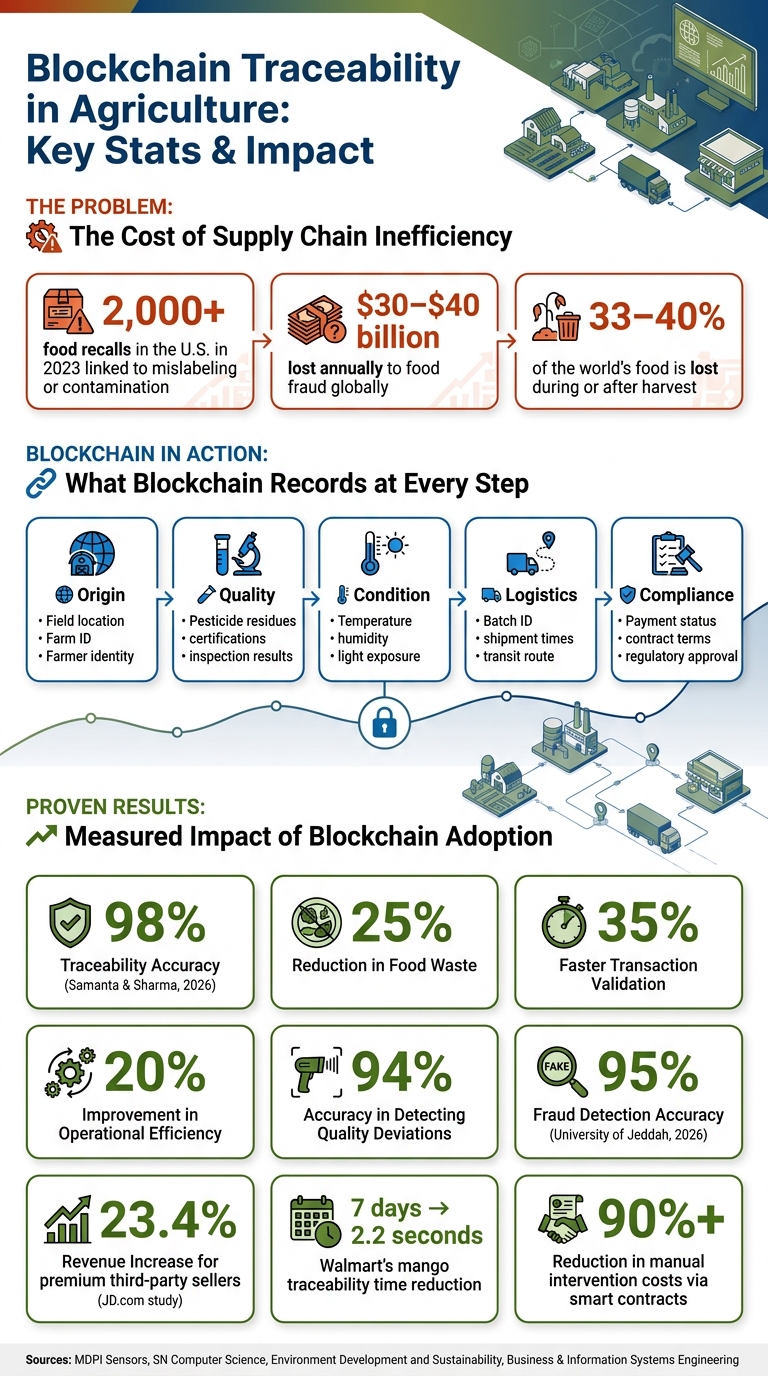
Blockchain Traceability in Agriculture: Key Stats & Impact
How Blockchain Works in Agricultural Supply Chains
What Data Gets Recorded on the Blockchain
Blockchain captures crucial data at every step of the supply chain. This data is grouped into several categories:
| Data Category | Specific Data Points | How It's Collected |
|---|---|---|
| Origin | Field location, Farm ID, Farmer identity | GPS, digital entry, photos |
| Quality | Pesticide residues, certifications, inspection results | Lab reports, AI-driven sensors |
| Condition | Temperature, humidity, light exposure | IoT sensors, edge devices |
| Logistics | Batch ID, shipment/delivery times, transit route | RFID, NFC, QR codes |
| Compliance | Payment status, contract terms, regulatory approval | Smart contracts |
Every piece of information is tied to a unique digital batch ID, allowing anyone - buyers, regulators, or retailers - to trace a product back to its source. To put it simply:
"Traceability relies on three fundamental elements: (i) product identity, (ii) event capture (what happens to it, where, and under which conditions), and (iii) information continuity." - MDPI Sensors
With this system, smart contracts ensure compliance and automatically initiate transactions based on the recorded data.
Smart Contracts: Automating Compliance and Payments
Once the data is recorded on the blockchain, smart contracts take over. These self-executing codes verify and enforce conditions automatically.
"Automation and enforcement of the millet supply chain standards, including quality inspections, delivery schedules, and payment releases, are achieved by integrating smart contracts with blockchain technology." - SN Computer Science
For instance, payments can be triggered as soon as GPS confirms a delivery, or shipments can be flagged if sensor data identifies a temperature issue. Studies show that automating processes with smart contracts can reduce manual intervention costs by over 90%. Furthermore, systems using this technology have achieved 94% accuracy in detecting quality deviations.
In a March 2026 study at the University of Jeddah, researchers led by Abdulrahman Alzahrani used a Hyperledger Fabric-based framework to process 190 food-related records at 180 transactions per second, achieving a fraud detection accuracy of 95% - all powered by smart contract verification.
This level of automation becomes even more effective when integrated with real-time data inputs from on-farm tools.
Connecting On-Farm Tools to Blockchain Systems
On-farm tools play a key role in feeding data directly into the blockchain. IoT sensors continuously monitor storage conditions like temperature and humidity. GPS-enabled machinery logs field activities and harvest locations. RFID and NFC tags track product movements at every handoff.
HarvestYield, for example, collects GPS-tagged job records, field measurements, and weather data to create structured, timestamped records for blockchain validation. This eliminates errors and gaps often caused by manual data entry, ensuring complete and accurate traceability.
A February 2026 study by Saikat Samanta and Vijay Shankar Sharma reported that combining blockchain with IoT sensors resulted in 98% traceability accuracy, a 35% faster transaction validation speed, a 25% drop in food waste, and a 20% improvement in operational efficiency across monitored supply chains. This on-farm data integration isn’t just helpful - it’s the backbone of the system, enabling the entire traceability network to function seamlessly.
Transform Your Agricultural Team
Streamline job management, field mapping, and machine tracking with HarvestYield. Simplify your operations and eliminate paper job sheets.
ContinueBenefits of Blockchain Traceability for Farms and Markets
Greater Transparency and Trust Across the Supply Chain
Blockchain introduces a tamper-proof, universally accessible record that tracks a product's journey from its origin to the market. This shifts trust from relying on reputation to relying on verified data. Every stakeholder in the supply chain gains access to the same accurate and immutable information, which eliminates isolated data silos and ensures consistency.
"Lack of transparency makes it difficult to achieve fair pricing and quality of products. The need for data-driven agriculture has resulted from regulating pressure, fraud, and food crisis." - MDPI Sustainability
Unlike traditional systems, blockchain incentivizes accurate reporting through automated rewards and penalties. This approach tracks agricultural teams and data quality at the source. The result? Greater trust among consumers and stakeholders, along with improved market appeal for farm products.
Better Market Access for Farmers
Blockchain transparency doesn’t just build trust - it opens doors. Farmers with verifiable records of their products' origins, quality, and handling can command higher prices and meet export standards more easily. This creates opportunities to tap into premium markets and expand their reach.
A real-world example comes from a study conducted by Jane Yi Jiang (Ohio State University) and Ken Moon (Cornell University). They analyzed JD.com's blockchain implementation in its seafood marketplace and found that independent third-party sellers of premium products experienced revenue increases of up to 23.4%. These gains were largely driven by informed shoppers who used blockchain data to confirm product quality.
"Blockchain tracing creates substantial value where consumer distrust is moderate, particularly for handling-sensitive and premium products sold by third-party sellers." - Jane Yi Jiang, Ohio State University
Additionally, blockchain streamlines compliance with regulations like the Food Safety Modernization Act (FSMA) in the U.S., which requires traceability standards. Digital records meet these requirements far more efficiently than traditional paper-based systems.
Faster Dispute Resolution and Reduced Fraud
Food fraud is a massive global issue, costing the industry an estimated $30 to $40 billion annually. On top of that, about 33–40% of the world's food is lost during or after harvest. Blockchain directly addresses these challenges.
Its tamper-resistant ledger allows disputes to be resolved quickly by providing instant access to verified records. For instance, Walmart's use of the IBM Food Trust blockchain platform reduced the time needed to trace mango origins from 7 days to just 2.2 seconds.
"Blockchain's inherent traits of transparency and immutability can enhance traceability, mitigate food fraud, and facilitate consumer trust, reshaping the information system's implementation in the FSC landscape." - Business & Information Systems Engineering
Some advanced blockchain systems even calculate a fraud risk score for each batch by identifying anomalies in the data. This proactive approach, combined with automated recall alerts triggered by smart contracts, shifts fraud detection from reactive to preventive. These improvements not only reduce fraud but also ensure smoother and more reliable market transactions.
What Farms Need to Implement Blockchain Traceability
Technical and Operational Requirements
To implement blockchain traceability, farms need to rely on a multi-layer framework that combines various technologies, as outlined in research:
| Layer | Purpose | Technologies |
|---|---|---|
| Identity | Product identification and verification | Barcodes, RFID, NFC, QR codes |
| Sensing | Capturing environmental conditions | IoT sensors, GPS, transport logs |
| Intelligence | Interpreting data and decision-making | AI, machine learning models |
| Integrity | Ensuring data security and reliability | Blockchain, cryptographic protocols |
| Interaction | Managing stakeholder access | Smart contracts, APIs, user interfaces |
For example, farms need reliable internet connectivity and IoT sensors to monitor real-time conditions. Tools like RFID tags or QR codes are essential for connecting physical products to their digital records. Additionally, clearly defined roles - such as overseeing access policies and conducting quality checks - ensure the system operates smoothly.
This structured framework paves the way for practical solutions like HarvestYield.
How HarvestYield Supports Blockchain Traceability
Platforms like HarvestYield are designed to address key challenges in data quality and integration, which are critical for blockchain systems to function effectively. Without accurate and complete data entering the blockchain, the entire system's reliability is compromised.
HarvestYield simplifies this process by automatically capturing detailed, GPS-tagged job records. These records include field locations, machine activities, and weather conditions, ensuring each task creates a precise digital footprint. Its field mapping and measurement tools assign unique digital identities to each parcel of land, aligning with the Identity layer of the framework.
"Integrating blockchain and Internet of Things technologies transforms agricultural supply chains by enhancing transparency, minimizing resource loss, and strengthening sustainability." - Environment, Development and Sustainability
The platform also supports the Interaction layer by using scheduling and client record tools to ensure that the right stakeholders can access relevant operational data when needed.
Barriers to Adoption and Scalability
Despite its potential, blockchain adoption in agriculture is uneven, especially among small and mid-sized farms. The upfront costs for hardware like RFID tags and IoT sensors, combined with the expense of cloud infrastructure, can be prohibitive. Additionally, integrating these technologies into a fragmented supply chain adds another layer of complexity.
Regulatory inconsistencies further complicate matters. Differing standards across states and export markets make it challenging to design a system that works universally. There's also a delicate balance between transparency and privacy: public blockchains may expose too much information, while private blockchains could limit the trust-building benefits of traceability. Cryptographic protocols can help by securing sensitive data while still enabling verified sharing among authorized parties.
For smaller farms, starting with strong on-farm data practices - such as maintaining accurate records, using GPS-verified field data, and consistently documenting tasks - can be a practical first step before integrating blockchain technology. Overcoming these hurdles is essential to fully realize blockchain's potential in agricultural supply chains.
Blockchain in Agriculture | The future of food supply chain
Conclusion: What Blockchain Means for the Future of Farm-to-Market Connectivity
Blockchain is reshaping agricultural supply chains, turning outdated, paper-based systems into transparent networks where every step can be verified. Studies show its impact is undeniable: blockchain frameworks have achieved 98% traceability accuracy, cut food waste by 25%, and boosted operational efficiency by 20%.
But blockchain's role isn't just about tracking - it’s about embedding accountability throughout the supply chain. As traceability evolves with technologies like IoT and AI working alongside blockchain, farms with solid data systems will be better prepared to join these advanced ecosystems. The key to this transformation lies in capturing accurate data right at the source - the farm.
"Blockchain technology promotes consumer empowerment by enabling direct product verification, improving purchasing decisions, and transforming the supply chain into a trust-based, participatory network." - Springer Nature
Platforms such as HarvestYield are already paving the way by automating the collection of GPS-tagged job records, field measurements, and weather data. This structured, timestamped information ensures traceability is reliable at every step. While the shift may take time, especially for smaller farms, those that embrace digital tools now are setting themselves up for the transparent, connected supply chains that consumers and markets will increasingly expect in the future.
FAQs
How is the accuracy of data on the blockchain verified?
Blockchain ensures data accuracy through a combination of advanced techniques:
- Cryptographic protocols: These secure the data by encrypting it, making unauthorized alterations nearly impossible.
- Distributed validation: Network nodes work together to verify transactions, ensuring transparency and reducing the risk of errors.
- Consensus mechanisms: Methods like proof of work confirm the validity of transactions, adding an extra layer of protection against tampering.
Together, these elements make blockchain data highly reliable and resistant to manipulation.
Do small farms need IoT sensors and constant internet to use blockchain traceability?
Small farms don’t have to rely on IoT sensors or continuous internet access to take advantage of blockchain traceability. While these technologies can boost real-time tracking and improve data precision, blockchain can still provide a way to build transparency and trust without needing constant data updates.
What should be stored on-chain vs. kept private for compliance and confidentiality?
In blockchain-based agricultural traceability, on-chain data refers to permanent records like origin information, harvest dates, quality inspections, and shipment milestones. These unchangeable entries promote transparency and build trust across the supply chain. At the same time, private data - such as farming methods, financial details, or proprietary information - should be kept off-chain or encrypted to maintain confidentiality. Striking the right balance between transparency and privacy is key to ensuring trust while safeguarding sensitive business details.