Best Practices for Client Agreement Management in Agriculture
Bad contract control can drain up to 9.2% of annual revenue. If I want fewer billing fights, fewer acreage disputes, and fewer mid-season delays, I need one clear process: write field-specific terms, control approvals and revisions, store the current signed file in one place by going paperless, and review it before the next season starts.
Here’s the short version:
- Define the job clearly: list fields, acres, service type, timing windows, and measurable work standards.
- Set money terms up front: use clear rates, due dates, deposits, late fees, and change-order rules.
- Plan for field delays: spell out weather pauses, crop-timing limits, access rules, and stop-work terms.
- Check risk items before signing: verify names, authority, insurance, liability language, and dispute steps.
- Use one approval path: draft, review, client edits, final approval, signature, and file storage.
- Track every revision: label files by version and date, and put amendments in writing.
- Keep records easy to find: use one naming format, short folder paths, status labels, and renewal reminders 60–90 days before expiration.
- Link contracts to field work: match agreement IDs with job sheets, field records, and invoices.
- Review each season: check expirations, unpaid balances, missed work, pricing drift, and insurance dates.
A few details matter more than most. Use exact planting or harvest windows, such as 04/10/2026–04/25/2026. If I allow extra work, I should require written approval by email or text before it starts. If field conditions stop work, the contract should say who decides and how fast notice must go out, like within 4 hours or with rescheduling within 48 hours.
The main point is simple: a farm agreement should match how work happens in the field, not how paperwork looks in an office. When the contract, job records, and billing records all use the same field IDs, dates, and service details, it gets much easier to prove what was promised, what was done, and what is owed.
Below, I break down the habits I’d use to keep agreements clear, current, and usable all season.
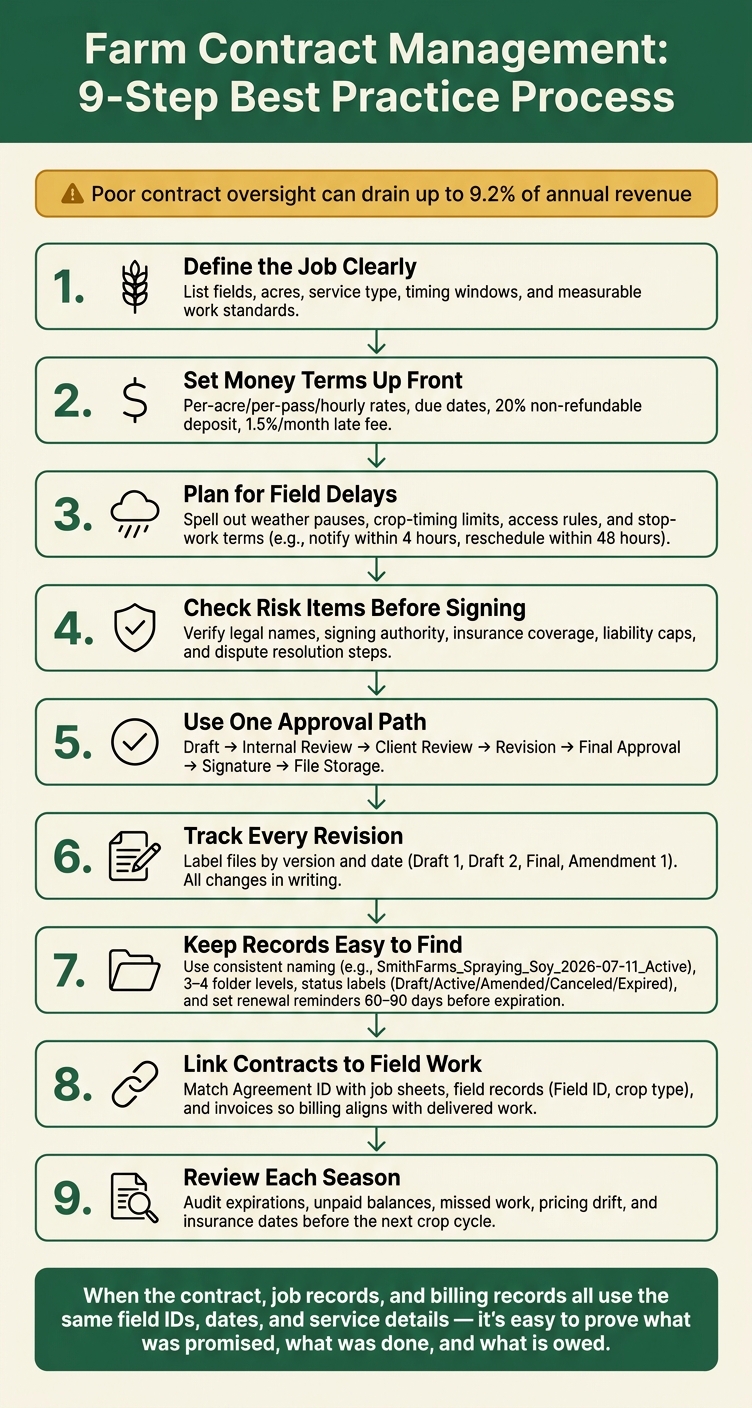
Farm Contract Management: 9-Step Process for Fewer Disputes & Lost Revenue
Key Points to Consider for Contract Farming Agreements | Rural Autumn Update
Explore our full library of agricultural training videos for more seasonal updates.
Transform Your Agricultural Team
Streamline job management, field mapping, and machine tracking with HarvestYield. Simplify your operations and eliminate paper job sheets.
ContinueBuild Agreements Around Real Agricultural Work
Vague contract language falls apart the minute field conditions shift. Start with the actual work, then build the agreement around that.
Define Scope, Deliverables, Timing, and Quality Standards
A contract needs to describe the job in plain, field-level terms: the exact operation, the result expected, and dates that match how farm work happens.
Start with the service itself. Skip broad wording like “harvesting services.” Instead, spell out combine harvest and grain hauling to the agreed destination, and name the fields and total acres involved. If the job includes more than one task, list each one on its own, such as planting, spraying, or harvesting.
Timing also needs to be tight. Use clear windows instead of open-ended wording. For example, a clause stating that planting must be completed between 04/10/2026 and 04/25/2026, subject to weather, gives both sides a clear target. For harvest, connect timing to things you can measure, like grain moisture, elevator delivery deadlines, or crop maturity stage. Acres should be measured using the same field records used for job tracking so invoicing lines up with the work actually done. For more on managing these records, see our Quick Start Guide.
Quality standards should be based on facts, not opinion. Acceptable harvest loss thresholds, planting depth ranges in inches, spray coverage rates, and application rates per label all work better than vague wording. Completion should be defined the same way: all contracted acres finished, grain delivered to the agreed destination, and moisture within the contracted range.
Set Pricing, Payment Terms, and Change Order Rules
Once the scope is clear, lock down billing and changes.
Pricing should match how the job is set up in the field:
- Use per-acre rates for uniform fields
- Use per-pass rates for jobs with high setup time
- Use hourly rates for small or irregular work
State what each rate includes and what counts as extra work. Payment terms need that same level of detail. Set invoice due dates, list accepted payment methods such as check, ACH, or card, and spell out deposit terms like a non-refundable 20% deposit at signing. Late fees should also be stated plainly, such as 1.5% per month on overdue balances.
Change orders need a process before the first machine rolls. The agreement should name who on the client side can approve extra work, require written approval by email or text before extra passes begin, and explain how that extra work will be billed. For fast-moving situations, like a sudden pest outbreak, verbal approval can be allowed as long as written confirmation follows on the next business day. That keeps decisions moving in the field without turning extra work into a paper trail mess.
Account for Weather, Crop Cycles, Field Access, and Termination
After pricing and payment, the contract should say when work can pause or stop.
Weather clauses should name the exact conditions that justify a delay instead of just saying “bad weather.” For example, spraying may stop when wind speeds exceed the application label limit or when temperatures drop below the labeled minimum °F threshold. Soil conditions matter too. Harvest or tillage may need to pause when fields are too wet to avoid compaction, with rescheduling agreed within 48 hours. The contractor should decide when fields are fit for work and notify the client within a set period, such as 4 hours, if conditions force a schedule change.
Crop timing also belongs on paper, not just in someone’s memory. Missing a planting window or leaving corn standing too long before harvest can hit yield hard. The agreement should refer to key growth-stage windows and set priority rules when several fields are competing for the same narrow timing slot. Field access terms should require the client to provide safe, lawful access, including gate codes, neighbor permissions for equipment crossings, and road compliance for wide loads. The contractor should also have the right to refuse work where safety or legal rules can’t be met.
Add clear notice rights tied to nonpayment, deposits, completed work, and final billing. Either party may also terminate with 30 days’ written notice before work starts.
Put Compliance, Risk, and Approvals Into a Simple Workflow
Once the contract terms are set, the next step is review, approval, and record control. After scope, pricing, and timing are locked in, run every agreement through the same review process. Keep it simple, repeatable, and documented.
Check Enforceability, Insurance, Liability, and Dispute Terms
Before any agreement goes out for signature, use a short internal checklist. Confirm the full legal names of both parties, including the business structure, such as LLC or sole proprietor. Verify that the person signing has authority to sign for the business. Then make sure the scope in the contract matches what the crew will do in the field.
Check these four items every time:
| Compliance Check | What to Confirm | Risk Mitigated |
|---|---|---|
| Insurance coverage | Proof of general liability, workers' compensation, commercial auto, or crop-related coverage when relevant | Uninsured loss claims |
| Indemnity language | Which party is responsible for damage to crops, equipment, fences, irrigation systems, or adjacent property | Costly liability disputes |
| Limitation of liability | A clear liability cap tied to the job value or contract amount | Disproportionate damage claims |
| Dispute resolution | A clear process such as direct discussion, mediation, or arbitration, plus governing law and deadlines | Drawn-out litigation |
These checks shape whether work can start, keep moving, or get resolved without a mess later. For agreements tied to federal crop insurance or USDA programs, flag arbitration deadlines inside the workflow. Arbitration is required before court review, and the deadline is often one year.
After those legal checks are done, move the agreement into a controlled approval path.
Create a Clear Draft-to-Sign Approval Process
Use one fixed flow: draft, internal review, client review, revision, final approval, signature, and storage. Assign one reviewer to pricing, one to field scope and timing, and one to final approval.
Send one draft to one client contact. If too many people edit the same agreement, things get messy fast. Conflicting comments slow everything down. Require all requested changes to come back in writing. Email works fine. Avoid phone-only changes.
That gives you a clean record of what was discussed and approved before work starts. If a scope issue pops up mid-season, you won't be left piecing the story together from memory.
Once the agreement is signed, version control helps keep it usable through the season.
Track Versions, Amendments, and Seasonal Updates
Label every file with a version and date: Draft 1, Draft 2, Final, Amendment 1. If something changes after signing, record it as a written amendment, not a text message or verbal side deal.
Each client's digital file should keep everything in one place:
- The signed agreement
- All amendments
- Proof of insurance
- Approval records
- Scope confirmations
- Key emails
That makes it easy to check what was approved and when, whether you're handling an internal review, an insurance claim, or an audit. Keep the file current so crews always work from the latest signed terms. HarvestYield can centralize client records, approvals, and job data in one place.
Organize Agreements So Teams Can Find the Right Record Fast
After approval and version control, the next move is simple: make the active agreement easy to find and use. Once agreements are signed, store them in a way that lets crews pull up the current record fast, even in the middle of planting or harvest.
Use Consistent Naming, Filing, and Renewal Tracking
Start with one naming format and use it across every agreement, every client, and every season. Something like SmithFarms_Spraying_Soy_2026-07-11_Active works well because it shows the client, service type, crop, date, and current status at a glance. Stick to hyphens or underscores only. Skip special characters that can mess with search or file sharing.
Folder structure matters too. Organize files by client, then season, then agreement type. For example: Contracts\SmithFarms\2026\Spraying. Try to keep folder depth to 3–4 levels. Go deeper than that, and finding the right file gets slower when someone needs an answer on the spot.
Each file also needs a clear status label:
- Draft
- Active
- Amended
- Canceled
- Expired
Set renewal reminders 60–90 days before expiration. That gives the team time to review pricing, confirm acreage, and get a new agreement signed before the next crop cycle starts.
Naming makes files easier to find. Linking those files to the rest of your records is what keeps billing and job tracking lined up.
Link Agreements to Job Sheets, Field Records, and Client Data
Link each agreement to its job sheets, field maps listed in the scope, the client record, and the invoices tied to finished services.
Use the same identifiers across all records: Client ID, Field ID or map reference, Service Type, Crop type, and Agreement Period. If a spraying contract covers Fields 12 and 14 in April–May 2026, those same field numbers, crops, and dates should show up on every related job sheet and invoice.
That kind of cross-reference does a lot of work behind the scenes. It shows what was promised, what was done, and whether the bill matches the field work. It also helps teams keep signed terms lined up with what happened during planting, spraying, and harvest.
Use Centralized Digital Records to Cut Paper Errors
Digital storage works best when naming, folders, and linked records all follow the same setup. Put agreements and related records into one digital system so teams aren't chasing paper files or working from old copies.
HarvestYield lets agricultural teams manage client records, schedule jobs, capture job details with GPS and weather data, and map and measure fields in one place. When an agreement is amended or a new season starts, the update is visible to the right team members, so crews work from the current terms.
Centralized records make retrieval faster, billing cleaner, and paper mistakes less likely.
| Record Type | Data to Centralize | Operational Benefit |
|---|---|---|
| Client agreements | Signed contract, amendments, status label, expiration date | Fast retrieval during audits, disputes, or renewals |
| Job sheets | Service date, field ID, crew, GPS location, weather conditions | Confirms delivered work against contract terms |
| Field records | Mapped boundaries, acreage, crop type, field ID | Prevents work on wrong fields; supports accurate billing |
| Invoices | Agreement ID, billed services, payment status | Links financial records directly to contract obligations |
Review Active Agreements and Improve the Process Each Season
If all your agreements sit in one place, you're in good shape. But storage alone doesn't solve much. Someone still has to review those agreements on a set schedule.
That seasonal review is what turns records into something useful. It helps you spot issues before they show up again next season: unfinished work, pricing drift, field access trouble, and insurance gaps.
Audit Expiration Dates, Pricing, and Unmet Obligations
Start each review with the items most likely to cause trouble. Pull every agreement that expires before the next season begins. Flag unfinished field work, confirm payment status, and make sure insurance certificates are still current. Then compare the original scope with what actually happened in the field - what was promised versus what was delivered.
Review these items each season:
| Audit Category | Key Items to Review | Why It Matters |
|---|---|---|
| Expiration & Renewal Dates | Contract end date, notice windows, auto-renew provisions | Avoid missed renewals or unwanted auto-extensions |
| Pricing & Payment Terms | Rates per acre, fuel surcharges, unpaid balances | Keep agreements profitable as input costs shift |
| Unmet Obligations | Missed field passes, incomplete spray logs, late payments | Catch compliance gaps before the next season starts |
| Insurance & Risk Clauses | Policy expiration dates, coverage limits, liability terms | Confirm ongoing protection against accidents and disputes |
| Performance & Renewal Fit | Dispute history, margin per contract, on-time completion | Decide whether to renew, reprice, or end the relationship |
Poor contract oversight can drain up to 9.2% of annual revenue through missed obligations and missed renewals. For a farm business managing several client agreements, that number can add up in a hurry.
Use what you find to decide whether the agreement should be renewed, repriced, or retired.
Update Templates and Internal Rules on a Set Schedule
A post-season review helps you catch problems while they're still easy to fix - pricing gaps, unclear scope language, and repeat access disputes. Then a pre-season refresh makes sure each active agreement, renewal, and insurance document is ready before field work starts.
Pay close attention to scope definitions, change order language, weather-delay terms, and payment timing. If crews kept losing time because they couldn't get field access, the template should spell out notice rules more clearly. If out-of-scope work kept happening without written approval, the template needs a tighter change order rule.
Use that same schedule to check approval authority, amendment labels, and escalation steps. Clear standards help teams avoid old forms and cut down on informal text-message approvals that never make it into the record.
Conclusion: The Habits That Keep Agreement Management Consistent
Keep terms tied to field work, keep approvals standardized, keep versions clean, keep records in one place, and keep reviews seasonal. None of these steps is hard by itself. The hard part is doing them every season, across every client.
When agreement management becomes part of the farm's normal operating rhythm - instead of something people scramble to fix after a problem - it saves time, reduces disputes, and gives managers a better view of what the business promised and what it delivered. If HarvestYield already stores jobs, fields, and client data, use those records to make the seasonal review faster and easier.
FAQs
What should I include in a farm service agreement?
Include the scope of work, pricing, payment terms, and what each party is expected to handle. Add contact details for both the provider and the client, plus the fields covered, GPS boundaries, acreage, access notes, and any known hazards.
It also helps to spell out the rate schedule, material use, and any price changes tied to rough field conditions. Add service history, equipment used, seasonal expectations, preferred ways to communicate, and the process for reporting issues or making service changes.
How do I handle weather delays in a contract?
Handle weather delays with clear, data-backed communication. With HarvestYield, you can log time-stamped, GPS-verified weather data during each job, including wind speed, temperature, and current conditions.
That gives you a dependable record showing why work was delayed or pushed back for safety and compliance.
If weather slows a job down, tell clients as soon as possible. At the same time, document field conditions and weather status. This keeps schedule changes professional, well supported, and easy to explain.
How often should I review client agreements?
Review client agreements during the year so they stay in line with how the business is running and what it needs to earn. A common rhythm is to check them in January, March, June, and September, then do a full year-end review in November.
It also helps to look at key numbers like revenue per client and cost per acre. That gives you a clear picture of which accounts are paying off and where margins may be getting squeezed, so you can renegotiate terms or adjust pricing when needed.