How Cross-Platform Data Sharing Improves Farm Operations
Cross-platform data sharing simplifies farm management by connecting different systems, tools, and equipment. It eliminates manual data entry, reduces errors, and improves efficiency across operations. Here's why it matters:
- Real-Time Updates: Machine locations refresh every 6 seconds, and coverage maps update every 30 seconds, ensuring precise coordination.
- Streamlined Communication: Managers can oversee multiple machines, reducing reliance on phone calls and paper records.
- Cost Savings: Accurate GPS mapping prevents overbuying of seeds, fertilizers, and pesticides by identifying acreage discrepancies (5–15% on average).
- Simplified Record Keeping: Automated syncing ensures consistent and error-free data, even in areas with poor connectivity.
- Better Resource Management: Features like Section Control optimize machine usage, cutting input costs and improving efficiency.
Platforms like HarvestYield enable these benefits by integrating data from various sources, syncing it to the cloud, and making it accessible across devices. With tools for real-time tracking, geo-notes, and maintenance logs, farms can reduce administrative tasks and focus on decision-making. Start by assessing your current tools, choosing a central hub, and training your team for smooth implementation.
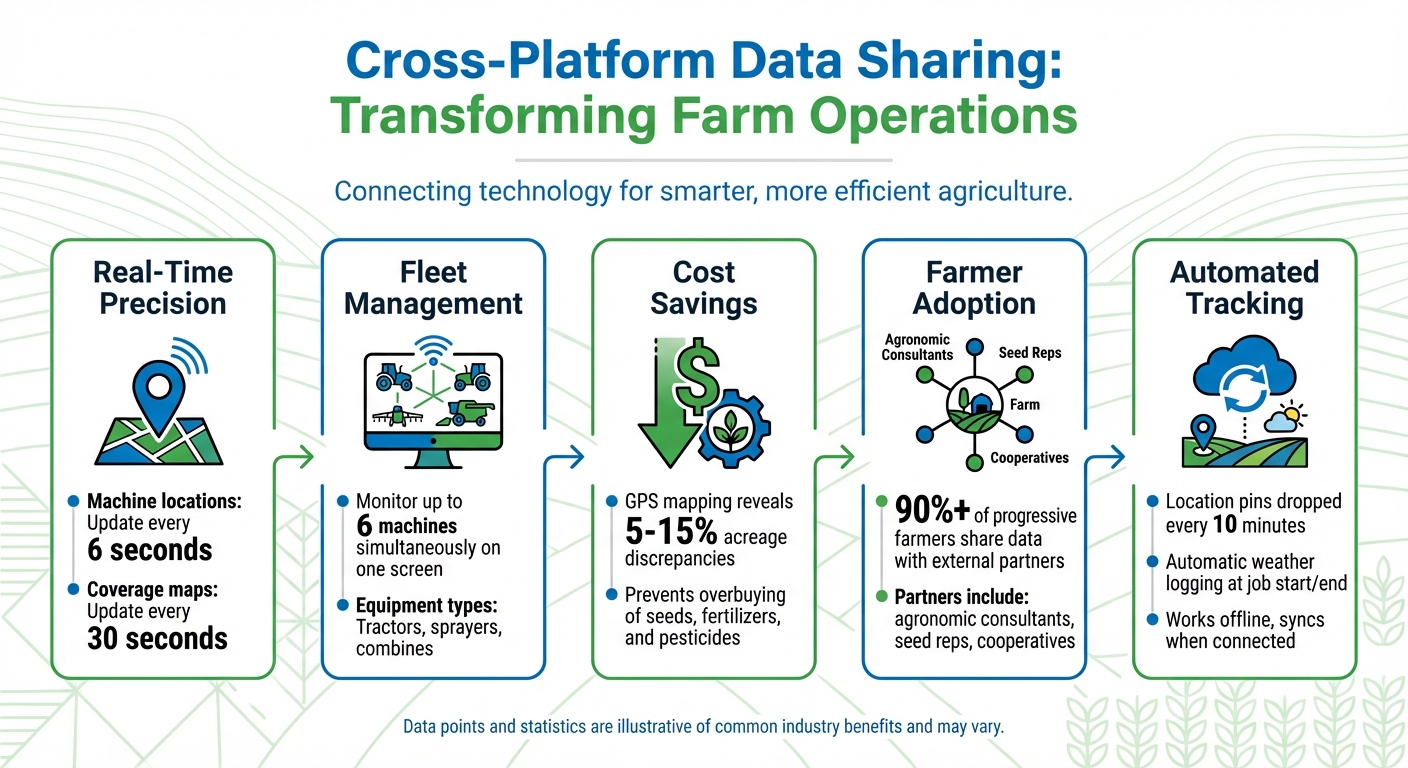
Key Benefits of Cross-Platform Data Sharing in Farm Operations
What Cross-Platform Data Sharing Means for Agriculture
Defining Cross-Platform Data Sharing
Cross-platform data sharing brings together different farm management systems, equipment, and mobile devices into one connected network. This setup allows critical information to move effortlessly between various systems, even if you're working with multiple equipment brands on the same farm.
With this system, real-time updates keep everything in sync. For instance, as-applied maps, guidance lines, and vehicle locations are shared between machines in the field. Coverage maps typically refresh every 30 seconds, while machine positions update every 6 seconds, ensuring precise coordination.
If you're a contractor or farm manager handling a mixed fleet, you can oversee up to six machines - whether they’re tractors, sprayers, or combines - on a single screen. Instead of relying on brand-specific telematics that limit compatibility, mobile devices enable equipment from different manufacturers to communicate through one unified platform.
This level of integration depends on specific technologies designed to make data sharing seamless.
Technical Features That Enable Data Integration
The technologies behind cross-platform data sharing are what make it practical and efficient for modern farming operations.
A key component is cloud-based synchronization, which ensures that data collected locally on mobile devices is automatically uploaded to a central system as soon as an internet connection is available. This feature is particularly useful in remote areas with unreliable cell service. Teams can keep working offline, and once they reconnect to 3G, 4G, or Wi-Fi, all their data syncs up.
APIs (Application Programming Interfaces) play a crucial role by linking different software systems. For example, farm management platforms can integrate with accounting tools like Xero, QuickBooks, and Sage, or connect to IoT devices such as weather stations from Davis, Sencrop, or METOS.
Finally, device compatibility ensures that these systems work seamlessly across smartphones, tablets, and desktop computers. This eliminates the need for costly, brand-specific hardware. Many farms have successfully shifted entire teams from paper-based methods to GPS-enabled mobile platforms, making field navigation and task management far more efficient.
Benefits of Cross-Platform Data Sharing for Farms
Better Team Coordination and Communication
Cross-platform data sharing takes teamwork to the next level by ensuring everyone operates with the same information. When farm teams use a unified data platform, managers can monitor up to six machines - like tractors, sprayers, or combines - on a single screen, keeping operations smooth and synchronized.
Remote access to data allows agronomists to quickly address any gaps or errors, boosting field productivity. But the benefits don’t stop with the immediate team. A 2017 survey revealed that over 90% of progressive soybean farmers were already sharing data with external partners such as agronomic consultants, seed reps, and cooperatives. With integrated platforms, you can securely share records directly with verified partners like packhouses, auditors, and government agencies, cutting down on paperwork. As vineyard manager Adam Foden explains:
"Cut-out the middleman on the paperwork and allow people who are better suited to be out in the field, get back to their work".
Simpler Record Keeping and More Accurate Data
Unified data management doesn’t just improve teamwork - it also makes record keeping more precise. Automated synchronization eliminates the need for manual data entry, reducing errors like misspelled names or duplicate records. Even in areas with poor cell service, mobile apps can store data offline and sync it once a connection is restored.
A centralized system ensures consistency across all devices, so everyone uses the same client names, field boundaries, products, and tank mixes. This avoids confusion caused by multiple versions of the same information. Additionally, sharing exact equipment measurements across your fleet ensures precision tools like Section Control work seamlessly, no matter which machine is in use.
Better Resource and Machine Management
Streamlined communication and accurate records set the stage for smarter resource management. Integrated systems automatically adjust Section Control settings across machines, helping to cut input costs.
For example, precise GPS mapping often reveals a 5–15% discrepancy in acreage. Using this data when buying seed, fertilizer, or pesticides can prevent overbuying and save money. Digital field boundaries and access points sent directly to contractors or employees save time by eliminating confusion - especially during high-pressure planting or harvest seasons.
Support operations also benefit. Grain cart operators can view live harvester positions on their screens, making offloading faster and more efficient. Hazards like damaged tile lines or rocks can be flagged digitally in the field and synced in near real time to all connected devices, reducing the risk of machinery damage across your fleet.
How to Implement Cross-Platform Data Sharing on Your Farm
Assess Your Farm's Data Sharing Requirements
Before diving into tools, figure out your main goal - whether it’s boosting profits, ensuring compliance, or improving coordination. This decision will guide everything else you do.
Start by listing all the digital tools you currently use - like mobile apps, in-cab displays, smartphones, or hardware. Then, identify everyone who needs access to your farm's data. This could include your internal team, such as operators and managers, as well as external partners like agronomists, seed representatives, landowners, or custom contractors.
Next, narrow down what specific data each person or group requires. For instance, agronomists might need details on soil moisture and spray records, while landowners may only need yield maps and field boundaries. Decide how this information will be shared - via USB drives, email, or automated cloud syncing. Lastly, clarify who owns and controls the data, especially when working with third-party providers. As John Fulton, a Professor and Extension Specialist at Ohio State University, points out:
"The key to making data valuable to a farm is storing it in a location where it can be used (i.e., 'actioned') to generate information".
These steps will help you lay the groundwork for a unified data-sharing system.
Set Up a Central Data Hub
Once you’ve defined your needs, choose a cloud-based platform to serve as your main data hub. Platforms like HarvestYield offer a secure space to manage, monitor, and analyze data from various sources - all without switching between multiple systems.
Start by setting up your farm’s structure within the platform. This means creating profiles, defining field boundaries, assigning team roles, and listing your equipment. Data can then be added in several ways: wireless transfers from machines, mobile apps for field updates, or manual USB uploads for older equipment. Many platforms also allow you to link external tools like weather stations or agronomic services through their integrations feature.
Keep your data organized and backed up securely. Establish a routine for digitizing any handwritten notes or manually collected records to ensure nothing gets overlooked. Once everything is set up, the next step is to focus on training your team to use these tools effectively.
Train Your Team on New Tools
Even the most advanced platform won’t help if your team doesn’t know how to use it. Training is key, and hands-on, visual demonstrations work best. Show operators how to handle specific tasks, like joining in-field work groups, logging job details with GPS, or navigating to fields using the app.
Roll out training in phases. Start with managers during the setup phase, spending about two weeks covering field mapping and standard operating procedures. After that, hold a focused one-hour session for operators, teaching them app basics and how to update job statuses. Follow this with a three-week trial period where the team uses the system during real tasks and provides feedback. Keep monitoring and tweaking the process as needed.
HarvestYield offers a free plan covering up to 50 active acres, which is ideal for testing and practice. Once your team is comfortable, you can upgrade to a paid plan such as Starter, which costs $49 per month, covers up to 250 active acres, and includes unlimited team members. With proper training, your team will ensure data is accurate and well-maintained on the central hub, improving efficiency across your farm.
Transform Your Agricultural Team
Streamline job management, field mapping, and machine tracking with HarvestYield. Simplify your operations and eliminate paper job sheets.
ContinueHow HarvestYield Enables Cross-Platform Data Sharing
HarvestYield Features for Data Integration
HarvestYield offers a powerful suite of tools designed to simplify field management and integrate data seamlessly.
Compatible with both iOS and Android devices, HarvestYield connects with a variety of machinery brands, making it easy to coordinate operations across different equipment. The platform automatically gathers essential work data: real-time coverage tracking maps the operator's path (displayed as a red line) while calculating the area covered and job duration. Additionally, it logs weather conditions at the start and end of a job and drops location pins every 10 minutes for precise tracking.
These features ensure precision in field operations. For example, geo-notes allow users to attach specific details - like wet spots, power lines, or gate codes - to exact map locations. These notes remain accessible to any operator working on that field in the future. The machinery log book is another standout feature, tracking fuel usage, repairs, and maintenance schedules. This data helps calculate the true operating costs of each machine. Additionally, all field data syncs to the HarvestYield cloud as soon as an internet connection is available, ensuring records stay accurate and up-to-date. These tools not only improve field transparency but also integrate seamlessly with other management systems.
The platform’s capabilities shine in real-world scenarios.
Practical Examples of HarvestYield in Action
In January 2020, PR, JM, and SC Houlston Contracting in North Yorkshire adopted HarvestYield to manage their busy silage season, which involved coordinating up to 12 self-employed workers. Steven Houlston used the app to replace traditional paper timesheets and guide seasonal staff using GPS. One particularly useful feature was the machinery log, which helped the team identify a diesel quality issue. Houlston shared:
"The app made it easy to see when the last filter change was. On one machine, a set of filters had only done 189 hours."
This level of detail would have been nearly impossible to achieve with paper records. The company also leveraged HarvestYield to track job-specific metrics, such as bale counts and wrap usage, enabling accurate billing and inventory management.
Optic Ag targets data gaps with connected farm operations platform
Conclusion
Sharing data across platforms can transform how farms operate by reducing paperwork, keeping teams aligned, and providing real-time insights from the field. When your equipment, mobile apps, and cloud systems work in sync, you can monitor operations as they happen, conserve resources with automated shut-offs, and speed up financial tasks like invoicing. These benefits are backed by data.
More than 90% of forward-thinking farmers collaborate with external partners by sharing data, showing how centralized information leads to better decision-making. As John Fulton, Professor and Extension Specialist at Ohio State University, puts it:
"The key to making data valuable to a farm is storing it in a location where it can be used (i.e., 'actioned') to generate information".
Starting with integrated data systems doesn’t require a big investment. Platforms like HarvestYield offer flexible plans that can grow with your needs. Even in areas with poor cell service, the system works offline and syncs automatically when connectivity returns, ensuring your data stays intact.
This move toward integrated systems isn’t just about adopting new technology - it’s about simplifying your workload and improving how decisions are made. Whether it’s managing multiple machines during harvest or keeping track of maintenance schedules, the right tools can make even the most complex operations easier. Take the first step by identifying your current data challenges and exploring solutions that bring your field operations together.
FAQs
How does sharing data across platforms help lower farm operation costs?
Cross-platform data sharing plays a key role in cutting farm costs by enabling smooth communication between equipment, teams, and systems. This allows for real-time updates on critical tasks like field mapping, input application, and equipment usage, helping to reduce waste and boost efficiency.
When farms avoid over-applying inputs, fine-tune machine performance, and improve team coordination, they can significantly lower expenses tied to labor, fuel, and general overhead. This connected approach doesn't just save money - it also drives better overall productivity across operations.
What technologies make it easier to share and integrate farm data?
Modern farms are taking full advantage of cutting-edge technologies that make data sharing and integration a breeze. IoT-enabled equipment and telematics systems are game-changers, allowing machinery like tractors and sprayers to send real-time data - such as GPS locations and operational stats - straight to the cloud. This constant flow of information helps farms avoid inefficiencies like overlapping or missing sections during fieldwork, ensuring every inch of the land is used effectively.
Another key innovation is the use of standardized APIs, which convert data from various devices into a single, compatible format for farm management software. On top of that, mobile apps like HarvestYield let farmers track job details, GPS routes, and equipment usage on the go. Once connected online, these apps sync effortlessly, eliminating the hassle of manual record-keeping. Together, these tools are transforming operations, helping farms across the U.S. make smarter decisions, stay organized, and leave behind outdated paper systems.
How can farms effectively start using cross-platform data sharing?
To make cross-platform data sharing work seamlessly, start by choosing a dependable farm management platform like HarvestYield that stores data securely in the cloud. Install the app on all devices used in the field so operators can record and sync details, even when offline. Set up key elements like fields, equipment, and client accounts to ensure all records stay consistent.
Activate automatic data syncing to make updates from the field - such as job timings, GPS coordinates, or acreage covered - immediately available to the entire team. Train your crew to log activities as they happen, and use the platform's dashboard to review shared data, track equipment, and organize operations. Shifting from paper records to a centralized digital system not only boosts efficiency but also cuts down on errors and strengthens team coordination.