Cross-Platform Messaging for Farm Teams: Benefits
If your farm team works across fields, trucks, and the office, one shared message stream can cut missed updates, lower delays, and track your agricultural team in one place.
From what I see in the research, the main upside is simple: people get the right update sooner, especially for weather alerts, task changes, machine moves, and shift handoffs. The strongest studies support faster action from mobile advice tools, while proof for internal crew chat systems is more limited. One review covered 49 studies, and one case example reported 30% less time on management tasks plus 25% lower costs after moving to integrated digital communication.
Here’s the short version:
- Best-supported gains: faster information flow, cleaner records, fewer missed handoffs
- Most useful farm cases: weather alerts, field-specific updates, machine coordination, scout notes
- What works best: messaging tied to job, field, map, and equipment data
- Big limit: internal farm-team messaging has less direct testing than farmer advisory messaging
- Main risk: broadband gaps; only about 55% of U.S. farms report broadband access
A basic text thread can help. But when messages connect to field maps, GPS pins, schedules, and machine info, your crew has more of what they need without extra calls or paper notes.
That’s the core takeaway from this article.
What the Research Shows About Productivity and Coordination
Evidence on Faster Task Execution and Fewer Coordination Delays
Research points in a pretty clear direction: digital communication tends to help work move sooner, especially when timing matters.
A systematic review of 49 ICT-based agricultural interventions, including SMS, voice calls, and mobile apps, found that digital channels often improve how fast information reaches people and help them act sooner on time-sensitive advice. In farming, that timing can make all the difference. Advice that shows up at the right moment is simply more likely to be used.
Randomized trials in South Asia back this up. In studies involving thousands of farmers, people who received agronomic advice through mobile phones, including SMS and interactive voice response, acted sooner on tasks like fertilizer application and irrigation scheduling than control groups that relied on standard extension methods. The main effect was simple: less time between advice and action.
That same pattern appears in team operations too. When field conditions shift, messaging helps crews reroute labor and equipment with less waiting around. If one block needs attention first or a machine has to be moved, people can adjust on the fly instead of losing time through slow handoffs.
Operational Gains vs. Directly Measured Farm Outcomes
It helps to separate operational gains from direct farm results.
For farm teams, the clearest measured gains are operational. Across systematic reviews, case studies, and industry reports, the same themes show up again and again: less paperwork, faster schedule changes, fewer in-person check-ins, and better visibility across crews. Those are day-to-day workflow gains. They don't automatically mean higher yield, but they do mean work gets coordinated with less friction.
One example comes from an FMIS guide. It cites an East African rice-and-beans trader that estimated a 30% reduction in time spent on management tasks and a 25% reduction in operational costs after adopting integrated digital communication. That's a strong example of coordination paying off in practical terms, though it's still not the same as proving a direct production gain.
Direct farm outcomes like yield or income are much harder to pin on messaging alone. The strongest evidence there comes from randomized trials focused on advisory messaging for individual farmers, not from controlled tests of one team communication setup versus another. Put differently, we have better proof that messaging can help a farmer act sooner than we do that a crew chat system by itself will lift output or profit.
There's another wrinkle here. Many reviews note that messaging tools are often bundled with other functions, such as decision support, data capture, and automation. So when a farm sees better results, it's not always possible to say how much came from messaging itself and how much came from the rest of the system.
The safest read is this: operational gains have better support than yield claims. For farm teams, the main upside is faster coordination, clearer visibility, and fewer missed handoffs.
Documented Benefits and Evidence Strength
| Benefit | Messaging/Tool Type | Source Type | Measured Outcome | Evidence Strength |
|---|---|---|---|---|
| Faster access to information | SMS, voice, mobile apps | Systematic review (49 studies) | Timely decisions, practice adoption | Strong |
| Faster task coordination | In-app messaging, mobile alerts | Case studies, industry reports | Fewer missed updates, faster reassignment | Moderate |
| Reduced paper records | Integrated FMIS messaging | Industry reports, case studies | Less manual transcription and more complete records | Moderate |
| Faster adoption of recommended practices | SMS, interactive voice response | Randomized trials | More timely input application and irrigation scheduling | Strong |
The strongest evidence comes from randomized trials, and those trials mostly focus on messaging that sends agronomic advice to individual farmers. Team-level coordination gains are supported too, but the backing comes more often from case studies, systematic reviews, and industry reports than from controlled experiments. That gap matters when you read claims about productivity gains from cross-platform messaging.
Transform Your Agricultural Team
Streamline job management, field mapping, and machine tracking with HarvestYield. Simplify your operations and eliminate paper job sheets.
ContinueSafety, Weather Alerts, and Multi-Location Farm Management
How Real-Time Alerts Help Crews React to Changing Field Conditions
Cross-platform messaging becomes most useful when field conditions shift without warning.
Weather can turn in a hurry. SMS alerts, email, and app-based warnings can reach crews fast. For U.S. farm teams dealing with tornado warnings, flash floods, or fire weather, that speed matters because crews may need to stop work, secure equipment, and get to shelter fast.
That same speed matters even more when an alert is tied to a specific field or a set threshold. Some tools refresh weather data every 15 minutes and can send text, email, or push alerts when conditions change on a specific plot. The payoff gets bigger when alerts are field-specific. Managers can pause spraying when wind gusts move past a safe limit or change work-rest schedules when temperatures climb above a set °F threshold.
Pest and disease alerts follow the same pattern. A Penn State project used field diagnosis to send SMS pest and disease alerts to 350,000 rural farmers. For scouting teams working across many sites, an alert tied to one field helps them decide where to go next without waiting for a manager to relay the message.
Why Structured Message Channels Matter for Operators, Scouts, and Managers
Not every update belongs in the same thread. On multi-location farms, role-based routing helps weather warnings, machine updates, and scout notes reach the crew or field that needs them.
That shows up in day-to-day work. Operators need machine reassignment updates. Scouts need field-specific pest or disease notes. Managers need a clear view across crews. When messages are routed by role or location, they’re less likely to disappear inside one busy group chat.
It also works well with machine tracking. GPS-based tools can show where equipment is, how it’s being used, and help with safer routing and supervision across multiple locations.
Role- and location-based routing also keeps urgent alerts from getting buried in general chat. Here’s the practical difference:
| Coordination Task | Unstructured Messaging | Role-Based Channels |
|---|---|---|
| Weather/safety alerts | Broad group message that can get buried | Sent to the affected crew or location |
| Machine coordination | Scattered calls and texts | Shared status tied to a machine or job |
| Scout field updates | Buried in general chat | Tagged to a specific field or block |
| Shift handoffs | Relies on memory or paper notes | Kept in the same communication flow |
For multi-location farms, that structure helps keep the right crew tied to the right alert. For help setting up your team, see our Quick Start Guide.
Why Messaging Works Better When It's Tied to Job and Field Data
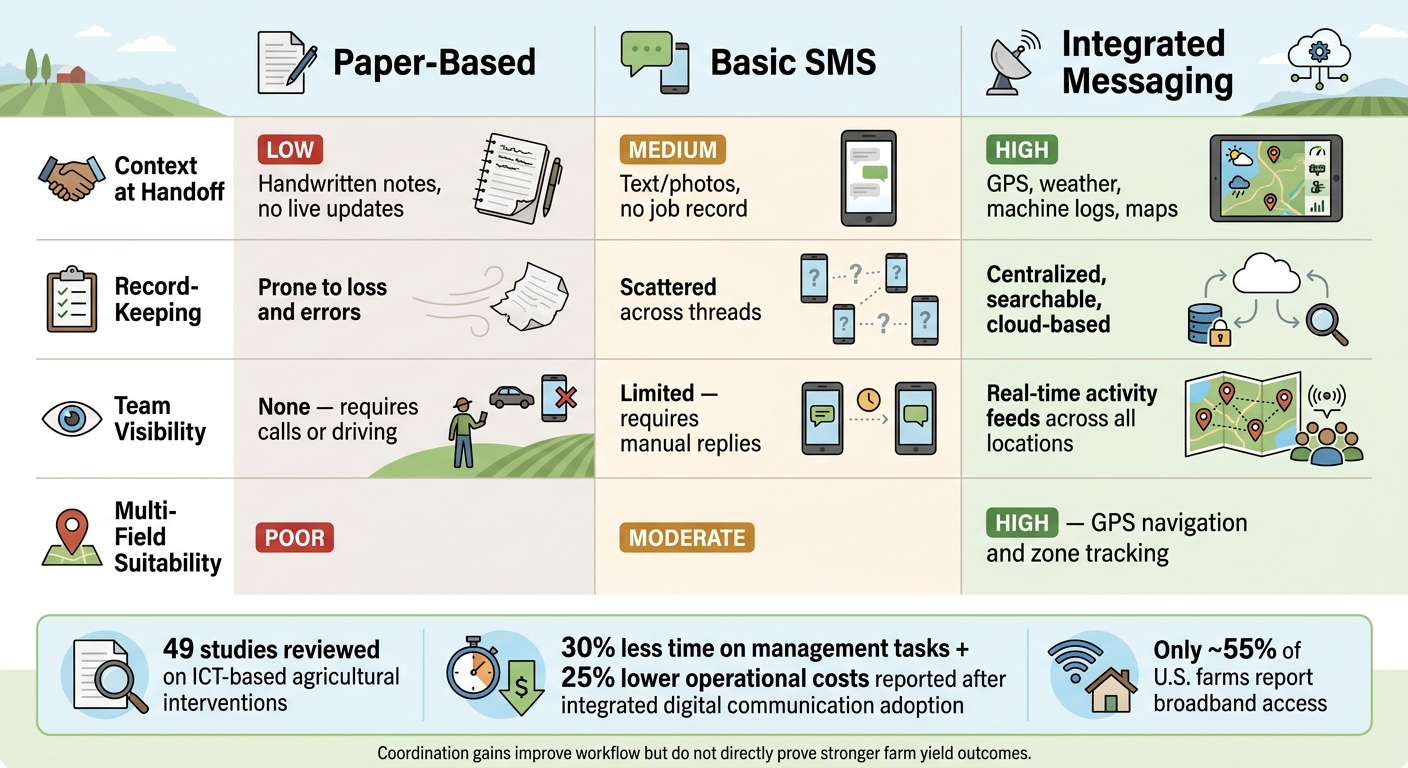
Paper vs. SMS vs. Integrated Messaging for Farm Teams
From Paper Job Sheets to Integrated Job Updates
Role-based channels solve who gets the message. Job-linked data solves what they need to do next.
A text can assign a task, but it often misses the details that make the task usable in the field. Where is the crew supposed to go? Which machine should they use? What changed, and why? Without that context, people end up making follow-up calls just to fill in the gaps.
When an update includes the field, GPS pin, acreage, assigned equipment, weather note, and start time, crews can move right away without hunting for more info.
That context matters even more when teams still depend on paper handoffs. Paper job sheets are slow to change, easy to lose, and tough to keep in sync across multiple crews. Digital job records give everyone one current version instead.
How HarvestYield Fits the Research on Integrated Farm Communication
HarvestYield fits this model by tying scheduling, GPS job tracking, weather data, field maps, client records, and machine costs into one iOS, Android, and web system. When a manager updates a job, the revised task stays tied to the same field record, so the crew sees the latest plan without digging through scattered message threads.
Paper-Based Coordination vs. SMS vs. Integrated Messaging: A Comparison
The table below shows how each setup performs across the coordination tasks that matter most for U.S. farm teams working across multiple fields.
| Paper-Based | Basic SMS | Integrated Messaging | |
|---|---|---|---|
| Context at Handoff | Low (handwritten notes, no live updates) | Medium (text/photos, no job record) | High (GPS, weather, machine logs, maps) |
| Record-Keeping | Prone to loss and errors | Scattered across threads | Centralized, searchable, cloud-based |
| Team Visibility | None (requires calls or driving) | Limited (requires manual replies) | Real-time activity feeds across all locations |
| Multi-Field Suitability | Poor | Moderate | High (GPS navigation and zone tracking) |
These gains improve coordination, but they do not prove stronger farm outcomes.
Limits of the Evidence and Key Takeaways for U.S. Farm Teams
What Current Studies Support with Confidence
These coordination gains are practical. But the research is much stronger for advisory messaging than for internal crew systems.
The best support comes from digital advisory and extension tools, not from studies on how farm crews coordinate with each other. A 49-study review found that SMS and other mobile channels improved adoption of recommended practices. That backs a simple point for U.S. farm managers: timely, role-specific digital messages help people stay aware and make better day-to-day calls.
Where More Farm-Team Research Is Still Needed
Here’s the main gap: most strong studies look at farmer-to-advisor messaging, not at how crews manage work among themselves. No randomized trials have tested whether integrated messaging improves machine use or labor efficiency. That’s a big distinction. It affects how much weight you should give claims about internal team messaging.
Rural connectivity makes things even less certain. About 55% of U.S. farms report having broadband access, and that varies a lot by state. If coverage is spotty, real-time messaging and cloud-based job updates may fail at the worst time. The USDA has noted that inconsistent broadband access limits farmers' ability to adopt and benefit from new digital tools.
So U.S. managers should view claims about faster response times or fewer mistakes as plausible, but not yet proven. The evidence supports the direction: better access to information can help teams coordinate. But the size of that effect will depend on farm size, crop mix, and management style.
Conclusion: The Most Practical Benefits of Cross-Platform Messaging
The clearest and easiest-to-defend gains are pretty direct: cross-platform messaging helps farm teams share updates faster, coordinate work across multiple locations, improve safety communications, and keep cleaner digital records. These gains are most dependable when messaging connects straight to scheduling and field data.
Even without many direct trials, a few use cases stand out. Start with weather alerts and job-critical updates. Those are the moments when faster communication is most likely to cut risk or wasted time. And if broadband is unreliable, build in backup steps, such as scheduled check-in times or SMS fallbacks, so the workflow doesn’t fall apart when the signal drops.
FAQs
How does cross-platform messaging help during weather delays?
Cross-platform messaging makes weather delays much easier to handle. Instead of calling each operator one by one, managers can send an instant update to the entire team at the same time. Workers see delay notices or schedule changes right on their devices, and those alerts stay there until each person acknowledges them.
That matters in the field. When the weather turns, minutes count.
Operators can also send photos of field conditions, such as standing water, so managers can judge the situation fast and decide whether work should pause or shift to another area. With HarvestYield, everyone stays in the loop, crews lose less time, and teams can avoid safety issues before they get worse.
What should a farm team do if broadband is unreliable?
Use mobile apps with offline functionality. Operators can check assignments, use GPS to get to fields, and log job progress on their devices even without an internet connection.
When service comes back, the app syncs saved data automatically. That helps teams stay coordinated and keeps records accurate, even in remote areas where calls or texts may not go through.
Why is messaging more useful when tied to field and job data?
Messaging works best when it’s tied to specific field and job data. That cuts out guesswork and clears up ambiguity.
When a message is linked to an actual task, operators and managers get the details they need right away: the exact location, equipment needs, and step-by-step instructions. That helps prevent simple but costly mistakes, like sending a crew to the wrong field or missing details that were only shared out loud.
In HarvestYield, communication stays connected to job records, photos, GPS directions, and status updates. So instead of chasing people down with extra calls or texts, teams can see what’s happening in context. It also creates a searchable record, which makes coordination smoother and gives managers a clear trail of who said what and when.