Fuel Monitoring vs. Manual Tracking: Key Differences
If I need the short answer, here it is: automated fuel monitoring gives me better accuracy, less office work, and faster problem checks, while manual tracking costs less to start but slips more often as the farm gets busier.
Diesel price swings can hit hard. In June 2022, U.S. diesel reached $5.718 per gallon, up 74% from the year before. So even small record errors can distort machine costs. And when fuel use can shift a tractor from $25 to $35 per hour to run, the way I track fuel matters.
If I compare the two methods, I’m looking at four main things:
- How data gets recorded: sensors and software vs. paper logs and spreadsheets
- How close the numbers are: automated systems often land around ±1% to 3%
- How much time it takes: manual fuel admin can take 2–5 hours per week, while automated setups may cut that to under 1–2 hours
- How easy it is to trace problems: automated systems can flag tank drops or odd fuel burn by machine, time, and place
Manual tracking can still work on a small farm with one owner and simple fueling. But once I add more machines, more operators, more tanks, or more reporting, the weak spots show up fast.
That’s the core difference: manual tracking is cheaper to start, but automated monitoring gives me tighter records and less cleanup later.
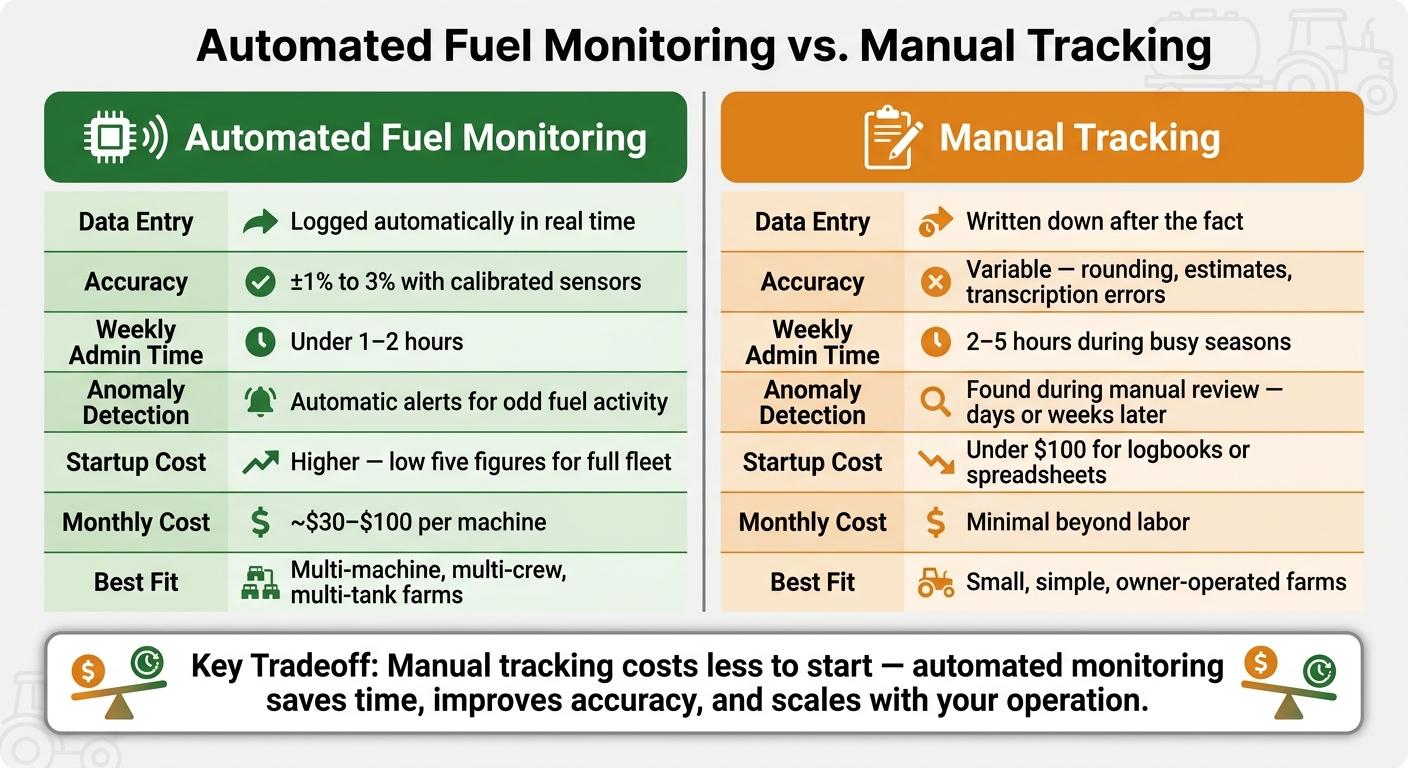
Automated Fuel Monitoring vs. Manual Tracking: Key Differences
How Fuel Monitoring System Works
Understanding how these systems function is the first step toward tracking fuel costs and machine hours to identify equipment inefficiencies.
Transform Your Agricultural Team
Streamline job management, field mapping, and machine tracking with HarvestYield. Simplify your operations and eliminate paper job sheets.
ContinueQuick Comparison
| Criteria | Automated Fuel Monitoring | Manual Tracking |
|---|---|---|
| Data entry | Logged automatically | Written down later |
| Accuracy | About ±1% to 3% | Varies by operator and record quality |
| Labor | Lower weekly admin time | More entry, review, and fixes |
| Problem checks | Alerts for odd fuel activity | Problems found later during review |
| Best fit | Farms with several machines, crews, or tanks | Small, simple farm setups |
| Startup cost | Higher | Low, often under $100 |
| Monthly cost | Often $30–$100 per machine | Usually little to none beyond labor |
If I want clean fuel costs by machine, field, or job, this comparison shows where each method holds up - and where it starts to break.
How Each Fuel Tracking Method Works
Each method records fuel use in a different way. The main split is simple: automated systems log data on their own, while manual methods rely on someone writing it down later.
Automated Fuel Monitoring Systems
Automated fuel monitoring records fuel data without asking the operator to enter it by hand. On farm equipment, this usually comes from fuel level sensors, flow meters, or CAN bus links to the machine's engine computer, often connected with GPS telematics for farm equipment.
As equipment runs or tanks get refilled, the system logs key details like the time, quantity, machine ID, and location. That information then shows up in a central dashboard by machine, tank, and location. In plain English, you get a fuel-use record tied to each piece of equipment instead of a pile of handwritten notes.
If something seems wrong, the system can flag it right away. For example, if a bulk tank drops overnight when no equipment was scheduled to run, managers get an automatic alert so they can check it fast. That’s a big reason automated tracking fits farms that need a live view of fuel use across several machines or crews.
Manual Fuel Tracking Methods
Manual tracking works in a much simpler way: someone records the fuel details after the fact. Operators write down gallons added, machine ID, hours or odometer, date, and sometimes the field or job name in a logbook, tally sheet, or spreadsheet.
This approach uses very little tech, which can make it easier to start with. But it also depends on people entering the same details the same way every time. That’s where things can go sideways. Common issues include missed entries, number swaps, hard-to-read handwriting, and different names for the same machine, especially when multiple operators share equipment or pull fuel from the same bulk tank.
Manual records can still help with machine cost tracking. But there’s a catch: the record is only as good as the person entering it.
| Feature | Automated Monitoring | Manual Tracking |
|---|---|---|
| Data capture | Real-time via sensors, CAN bus, and telematics | After the fact via logbooks, spreadsheets, and receipts |
| Relies on | Hardware and software | Consistent human input |
| Anomaly alerts | Yes - automatic notifications | No - issues found during manual review |
| Best for | Multi-machine, multi-crew operations | Small operations with simple fuel use |
Those workflow differences set up the accuracy and accountability gaps covered next.
Accuracy, Visibility, and Accountability: Key Differences
When fuel totals don’t line up, the tracking method matters. It shapes how fast you can find the issue, and sometimes whether you can find it at all.
Accuracy is what turns fuel data into a cost control tool instead of just paperwork. Automated systems rely on calibrated flow meters, sensor-based tank gauges, and telematics data from a machine’s ECU. In most cases, they deliver measurement accuracy of about ±1% to 3%. Manual tracking leaves room for mistakes at almost every step: reading the pump, rounding hour-meter values, jotting numbers down later, or typing them into a spreadsheet afterward. A few small misses each day may not look like much, but over a full season, they can add up to a big gap. And when fuel loss needs to be traced before the trail goes cold, speed makes all the difference.
Data Quality: Side-by-Side Comparison
| Dimension | Automated Monitoring | Manual Tracking |
|---|---|---|
| Measurement accuracy | About ±1% to 3% with calibrated sensors and meters | Variable; subject to rounding, estimates, and transcription errors |
| Error risk | Low - hardware or configuration issues are the main risk | High - multiple human touchpoints, especially under time pressure |
| Visibility and anomaly detection | Flags unusual drops or consumption spikes; records tied to machine, location, and time | Issues spotted during manual reconciliation - often days or weeks later |
| Audit trail | Timestamped refill records linked to machine and operator | Date and gallons from a receipt; precise timing and location often missing |
There’s also a useful benchmark here: an automated reporting system reached 98% accuracy in daily checks of tank inventory against dispenser activity, while needing much less manual intervention than manual methods.
Spotting Discrepancies and Fuel Loss
With automated monitoring, managers can trace a discrepancy by time, location, and machine. They can review fuel burn against engine-hour readings, check GPS traces to confirm where refueling took place, and compare that with operator schedules. That gives them enough context to move fast instead of guessing.
Manual investigation is much messier. Picture this: a 500-gallon bulk delivery looks 60 gallons short at month-end. Now someone has to pull delivery receipts, sort through handwritten operator logs, check any dipstick or sight gauge readings that were written down, and call operators to piece the story together from memory. By that point, days or weeks may have gone by, and the trail may be half gone.
Automated records leave a trail you can actually use. Manual logs often leave gaps.
HarvestYield keeps job records, GPS data, and machine costs on the same timeline for faster audits. The next question is whether that visibility is worth the added cost and setup.
Cost, Labor, and Day-to-Day Use on the Farm
Upfront Cost vs. Ongoing Labor Cost
The price gap between these two methods is real. But it looks different once you stop looking at startup cost alone.
Manual tracking is cheap to begin with. A paper logbook or basic spreadsheet often costs under $100 to set up. Automated monitoring is a bigger buy. Hardware for bulk tanks and a fleet of 5–10 machines, plus software subscriptions, can push the upfront spend into the low five figures, with software fees usually landing around $30–$100 per machine per month.
That said, the sticker price doesn't tell the whole story.
Labor adds up fast, especially during busy parts of the season. A mid-size row-crop farm can spend 2–5 office hours per week on manual fuel admin during planting and harvest. That includes entering logs, chasing down receipts, fixing mistakes, and building reports. If manager or office time runs $25–$40 per hour, those hours turn into a steady cost.
Automated systems cut much of that routine work. In many cases, fuel admin drops to under 1–2 hours per week. At that point, the job is mostly reviewing exceptions and exporting reports the system already put together. Over a full season, those labor savings can eat into a big chunk of the upfront price gap. You feel that most when the farm is moving at full speed.
Ease of Use, Setup, and Maintenance
Paper logs and spreadsheets are easier on day one. Most operators already know how to jot down gallons and machine hours. No setup. No install. No training curve worth talking about.
The trouble starts when the season gets hectic.
During planting and harvest, people are moving fast. Paperwork gets skipped, left in the cab, or filled out in a rush. That's where a simple system starts to crack.
Automated systems ask for more work up front. Sensors need to be installed. Telematics need to be connected. Calibration takes time, especially with older equipment or mixed fleets. Compatibility can also be a headache.
But once the setup is done and the system is dialed in, fuel tracking becomes much less hands-on. Data collection fades into the background, and office staff can work from dashboards that sort by machine, date, or field instead of digging through piles of handwritten notes.
Connecting Fuel Records to Machine Cost Tracking
Once you have fuel records, the next move is turning them into machine cost data.
With automated monitoring, fuel use is tied to machines and time periods by default. That makes it much easier to figure out fuel cost per hour or per acre. Say a sprayer burns 4 gallons per hour and diesel costs $4.00 per gallon. That's $16 per hour in fuel alone. Tie that to acres covered, and now you have a cost-per-acre figure you can actually use.
Manual systems can do the same math, but there's more drag in the process. Operators have to write down machine names and job IDs on every entry, and then someone has to stitch it all together later in a spreadsheet. It works, but it's slow, and gaps show up all the time.
HarvestYield puts fuel-related costs, GPS-recorded jobs, field records, and machine costs in one place. When fuel costs are tied to actual jobs instead of sitting off in a separate spreadsheet, it's easier to spot which work makes money and where rates may need to change. It also keeps job records cleaner, without relying on paper job sheets.
Which Method Fits Your Operation
Matching the Right Method to Your Farm Size and Setup
The better option comes down to how complex your farm is today and how much growth you expect next.
Here’s a quick way to match the method to your setup:
| Farm Situation | Better Fit | Why |
|---|---|---|
| Small owner-operated farm, simple reporting needs | Manual tracking | Simple setup, lower upfront cost, and the owner can usually record fueling consistently |
| Multiple operators sharing equipment or tanks | Automated monitoring | Manual logs become harder to keep accurate when several people are involved |
| Several storage points (main tank, mobile trailers, remote tanks) | Automated monitoring | Too many transfer points for manual records to stay accurate |
| Strong reporting needs (custom work, client billing, lender or insurance documentation) | Automated monitoring | Time-stamped, machine-level records make reporting and reconciliation easier |
| Small farm growing quickly, adding machines or staff | Automated monitoring | It is easier to build a scalable system early than to retrofit later |
This point matters most for farms that need job-level cost records, not just total gallons in a tank. If you do contract work, you need to tie fuel use back to specific jobs and fields. HarvestYield keeps job details, GPS data, and machine costs in one place. At that stage, the main tradeoff is simple: accuracy versus labor.
Key Takeaways
Automated monitoring is usually the better fit for farms with multiple machines, several operators, or more than one fuel storage point. Manual tracking can work on small, steady farms. But once the setup gets busier, manual records tend to slip.
Choose based on four things:
- machine count
- operator count
- tank count
- reporting needs
If two or more of those are leaning toward complexity, automated monitoring is the better long-term investment.
FAQs
When should I switch from manual fuel tracking to automated monitoring?
Switch when manual tracking stops giving you accurate equipment cost data, eats up too much admin time, or starts getting in the way of growth. Manual methods often lead to errors, missed expenses, and costly blind spots.
Automated monitoring gives you real-time fuel use, operating hours, and location data. That means you can spot waste and issues sooner, with far less manual entry.
How long does it take to set up an automated fuel monitoring system?
The available information does not include a set timeline for putting an automated fuel monitoring system in place.
That said, systems like HarvestYield are built to make day-to-day work easier. They automate machine cost tracking and cut down on manual data entry and paper records. Once the system is part of your workflow, it can support real-time tracking of fuel use and equipment costs.
Can automated fuel monitoring work with older farm equipment?
Yes. Automated fuel monitoring can work with older farm equipment.
Newer machines may come with built-in telematics. But older tractors, combines, and other equipment can still be tracked with aftermarket hour meters that record usage data.
You can also use HarvestYield to set up a profile for each machine and keep all the day-to-day records in one place. That includes:
- refueling
- repairs
- maintenance
From there, you can calculate fuel economy and operating costs per hour or per acre.