GPS vs. Wearable Sensors for Livestock Tracking
If you need to know where cattle are, start with GPS. If you need to know how cattle are doing, start with wearable sensors. That’s the short answer.
I’d sum it up like this:
- GPS collars fit large ranches, open pasture, geofencing, and grazing maps.
- Wearable sensors fit dairies, feedlots, breeding, health alerts, rumination, and estrus detection.
- GPS gives location data. Wearables give activity, behavior, and health signals.
- GPS hardware often runs about $80–$200 per head. Wearables often run about $15–$40 per head.
- Wearables can detect estrus at up to 92% accuracy and may flag illness 48–72 hours before visible signs.
- GPS battery life is often 1–3 years, while smart ear tags may last 5+ years.
If I were choosing, I’d match the tool to the main problem first. For a 1,000+ acre ranch, GPS usually makes more sense. For a dairy or feedlot, wearables usually make more sense. For mixed goals, a split setup often works well: GPS on 5%–10% of lead animals, with wearable tags on the rest.
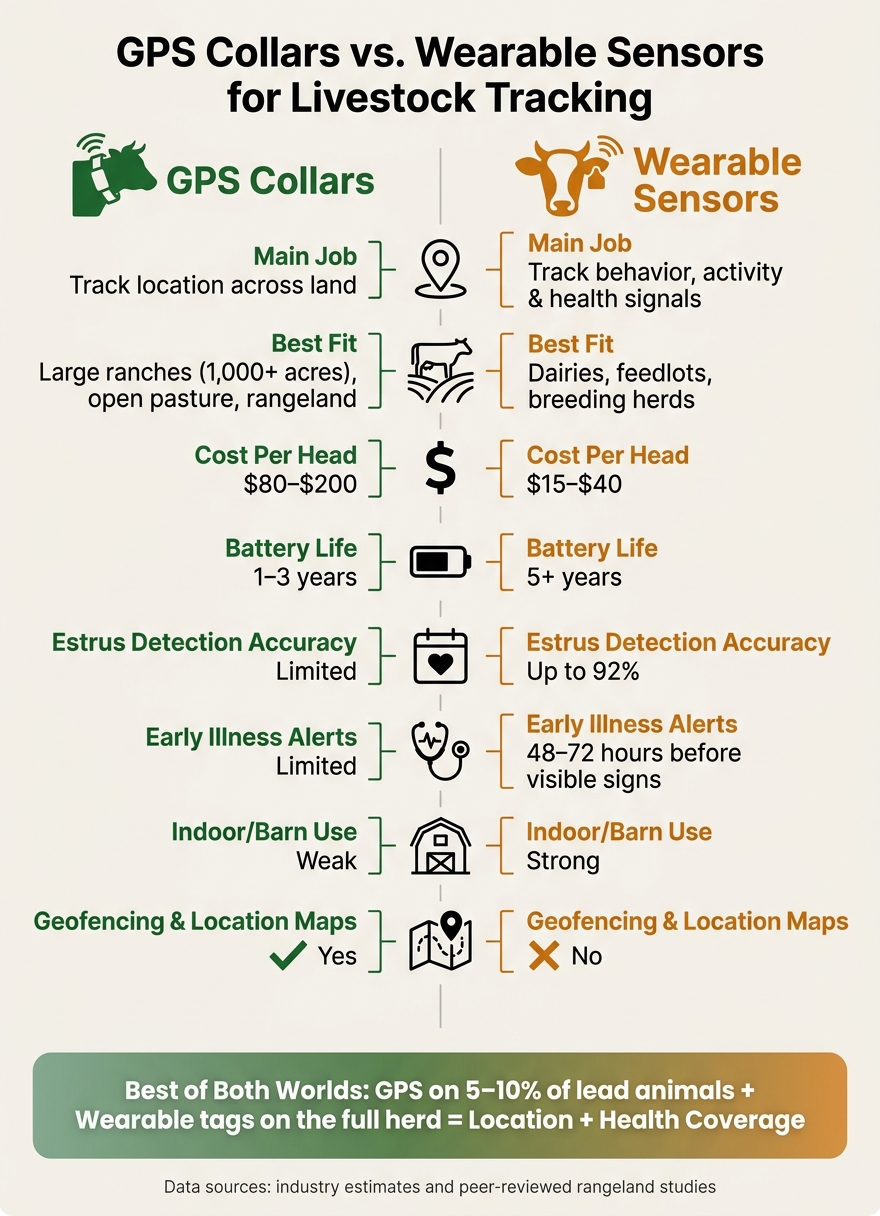
GPS Collars vs. Wearable Sensors for Livestock Tracking
CGREC John Nowatzki: GPS Collars and Smart Tags
Transform Your Agricultural Team
Streamline job management, field mapping, and machine tracking with HarvestYield. Simplify your operations and eliminate paper job sheets.
ContinueQuick Comparison
| Criteria | GPS Collars | Wearable Sensors |
|---|---|---|
| Main job | Track location | Track behavior and health signals |
| Best fit | Large pasture and rangeland | Dairy, feedlot, breeding groups |
| Shows location on a map | Yes | No |
| Geofence alerts | Yes | No |
| Grazing pattern history | Yes | Limited |
| Estrus detection | Limited | Up to 92% |
| Early illness alerts | Limited | Often 48–72 hours earlier |
| Indoor use | Weak | Strong |
| Battery life | 1–3 years | 5+ years |
| Cost per head | $80–$200 | $15–$40 |
Bottom line: I’d use GPS for movement across land, wearables for daily animal signals, and both together when herd location and herd health matter at the same time.
GPS Collars: Location, Movement, and Pasture Use
A GPS collar records an animal’s location on a set schedule, usually every 5 to 60 minutes, then sends that data through cellular, LoRaWAN, or satellite. On large North American ranches in remote country, direct-to-satellite is often the better fit because it doesn’t depend on on-farm towers or base stations. In plain terms, GPS shines when you need to know where cattle are and how they use pasture. It’s less useful for reading behavior or spotting health issues.
Where GPS Delivers the Most Value
GPS tends to pay off most on big-acre operations where checking every part of the ranch by sight just isn’t realistic each day. It can help you find animals that drift from the herd, see whether cattle are reaching far-off water points, and flag animals that may be straying or stolen.
Geofencing adds another layer. It can send boundary alerts, which cuts down on manual fence-riding. GPS records can also feed grazing heat maps, showing which paddocks get hit hard and which ones cattle barely use. That gives managers a clearer picture for pasture rotation and stocking decisions.
A 2023 Alberta rangeland study found that GPS collars helped spot an injured bull early and showed positive ROI on remote pastures more than about 31 miles from the home ranch.
For ranches that don’t need collars on every animal, a layered setup can work well. One common approach is to put GPS collars on a small share of the herd, often lead cows or high-value bulls, and use lower-cost sensors on the rest. In one estimate, that cut 5-year costs from about $300,000 to $30,000 for a 500-head operation.
Limits of GPS in Daily Use
That value starts to drop when the main question is not where the animal is, but how it’s moving.
The biggest trade-off is battery life. Updates every 5 minutes may last about 6 months, while hourly updates can stretch to 2 to 3 years, especially with solar help. Accuracy can also slip in heavy tree cover or rough, hilly ground. In those settings, performance may fall from about 2 to 5 meters to 10 to 15 meters. Barns, dense canopy, hills, and cold weather can weaken both signal and battery life too.
So GPS gives you position, not behavior. It tells you where an animal is, but not much about what it’s doing. That’s the gap wearable sensors are built to fill.
Wearable Sensors: Activity, Health, and Behavior Patterns
Where GPS tells you where an animal is, wearables tell you what’s going on with its body and daily activity. That difference matters a lot when the goal is early sickness detection, breeding alerts, or calving warnings. If the main question isn’t location but what the animal is signaling, wearables are often the better fit.
What Wearable Sensors Can Detect
Most wearable systems use accelerometers to track movement and behavior, including walking, standing, lying, eating, and rumination. Some systems also add temperature, sound, or rumen pH sensors. Where the sensor sits on the animal makes a big difference. Ear tags work well for rumination and temperature monitoring, leg-mounted sensors are better for lying-to-standing time and step counts, and rumen boluses give the most direct reading of core temperature and pH.
This is where wearables start to pay off. Automated activity monitoring reaches about 92% accuracy for estrus detection, compared with 50% to 60% for visual observation. Wearables can also spot Bovine Respiratory Disease early enough to cut treatment costs by 40% to 60%, mainly because first-line antibiotic use can be timed better. Calving alerts follow the same basic idea: the system looks for changes in standing-to-lying transitions and restlessness to flag that labor is getting close.
The catch is simple: these signals only help when the system can turn raw data into clear, usable alerts.
Limits of Wearables in Daily Use
The trade-offs are pretty clear. Wearables don’t give you dependable field location. They can show that an animal stopped moving, but not which part of a pasture it’s standing in. The data also needs software to make sense of it, because raw accelerometer output has to be processed and classified before anyone can act on it.
Results vary by setting, too. In research, statistical methods have shown about 64% overall behavior detection accuracy in extensive grazing systems, while accelerometer-based models have reached up to 96% in more controlled settings. In other words, the same sensor can perform very differently depending on the environment.
There’s also the data load. Wearables produce enough information that it often needs filtering or compression before transmission. That can put pressure on low-bandwidth networks like LoRaWAN when the network can’t keep up. On the upkeep side, smart ear tags have an annual loss rate of roughly 1% to 3%, and collars on growing animals may need periodic adjustment. At the same time, modern smart ear tags can run for 5+ years on a battery.
GPS vs. Wearable Sensors: Side-by-Side Comparison
The main difference is straightforward: GPS tracks location, while wearables track behavior. That one split shapes everything else, from cost and setup to the kind of data you get and how your team uses it day to day.
Movement Tracking vs. Behavior Tracking
GPS tells you where an animal is. Wearables tell you how that animal is doing.
In practice, that means wearable sensors can flag changes in activity and rumination compared with an animal’s normal pattern. GPS can’t do that, but it can show field position and movement across pastures. So the tradeoff is pretty clear: one system is built for location, the other is built for behavior. That shows up fast in connectivity needs, hardware costs, and daily workflow.
Farm Setup, Cost, and Data Workflow Differences
The better choice depends a lot on the operation. A ranch spread across open ground has different needs than a dairy or feedlot. Here’s how the two systems stack up.
| Consideration | GPS Collars | Wearable Sensors |
|---|---|---|
| Western rangeland fit | Strong fit | Limited unless paired with location tools |
| Rotational grazing fit | Strong for pasture use and fence-line movement | Useful for grazing behavior and health checks |
| Dairy fit | Useful when location tracking matters | Strong fit for estrus, rumination monitoring, and health alerts |
| Feedlot fit | Usually less useful in confined settings | Strong fit |
| Indoor barn fit | Limited | Strong fit |
| Per-head hardware cost | $80–$200 | $15–$40 |
| Battery life | 1–3 years | 5+ years |
| Connectivity | Cellular, satellite, or LoRaWAN | LoRaWAN, BLE, or proprietary RF |
| Staff workflow | Review maps, geofence alerts, and movement history | Review dashboards, behavior flags, and exception reports |
You can see the pattern. GPS collars make more sense when animals cover a lot of ground and location matters every day. Wearable sensors fit better when the job is spotting heat, watching rumination, or catching health issues early.
When a Combined System Makes Sense
Sometimes the best setup isn’t either-or.
A layered system can work well: health-monitoring ear tags across the full herd, with GPS collars on a small group of lead animals. That gives you both location and health signals without paying for full-herd GPS coverage.
Choosing the Right Setup and Connecting It to Farm Records
Best Choice by Operation Type
Pick the setup that fixes your biggest bottleneck first.
Large ranches (1,000+ acres) usually get the most from GPS collars. You don’t need to tag every animal to see how the herd moves. In many cases, putting GPS on 5%–10% of lead animals gives enough coverage without paying for a full-herd rollout.
Dairies and feedlots are often a better match for wearable sensors. These tags can spot illness 48–72 hours earlier and catch estrus that visual checks often miss, with hardware costs of $15–$40 per head. That’s a pretty direct trade: lower equipment cost, plus earlier signals that help crews step in sooner.
Breeding herds and pasture-based operations can do well with both. A layered setup lets you track health across the full herd while using GPS only on lead animals. That way, you’re not paying for location data on every head if you don’t need it.
The tech itself is only part of the job. If alerts don’t reach the people making daily calls, they won’t help much. After you pick a setup, connect alerts to pasture maps, job logs, and weather records so the crew can respond fast. HarvestYield can tie sensor alerts to job records, weather, and field maps in one workflow.
Conclusion: What Farm Managers Should Prioritize
GPS fixes location issues. Wearables fix health and behavior issues. Start with the tool that closes your biggest gap first.
FAQs
Do I need GPS on every animal?
It comes down to what you’re trying to manage.
If your goal is to monitor individual animal welfare - for example, to spot a sick or injured cow - then each animal needs its own tracking device.
But if you just need to follow the herd’s general location and movement patterns, tracking a few herd leaders may be enough.
Which system gives the best ROI for my operation?
It comes down to what your operation is trying to do.
If herd health and reproductive efficiency are the main targets, multi-sensor ear tags often give you better ROI. They track temperature, activity, and rumination 24/7, and they usually cost less than GPS units at $30 to $80 per tag.
GPS makes more sense for extensive grazing setups where location data is a must. But the price is higher - usually $80 to $300 per unit - and it doesn't include health monitoring. So if most of your returns come from health management, GPS usually delivers lower ROI.
Can GPS and wearable sensors work together?
Yes. GPS and wearable sensors are often used together in one system to give farm teams a clearer picture of both livestock location and health.
GPS shows where animals move and how they graze. Wearable sensors track things like steps, resting time, rumination, and surface temperature. Put those data points together, and you get a much better read on what’s happening in the field.
That combined view can improve analysis and help teams monitor both location and physical well-being in real time.