How Virtual Fencing Works for Livestock Management
Virtual fencing lets me move livestock with a map instead of interior wire. Animals wear GPS collars, learn a warning tone, and turn back before crossing a digital line. In many cases, that means minutes to shift a paddock, not hours spent moving fence.
Here’s the short version:
- It does not replace perimeter fence. It replaces many interior fence lines.
- It uses GPS collars and software. I draw boundaries in an app, then send them to the herd.
- Animals get a tone first, then a mild pulse if they keep moving past the boundary.
- Training matters. Many cattle learn the tone fast; one study found 50% responded to the audio cue alone after about six interactions.
- Containment can be high. One strip-grazing trial reported 99% containment.
- There are limits. GPS drift, weak signal, battery work, and collar fit all affect results.
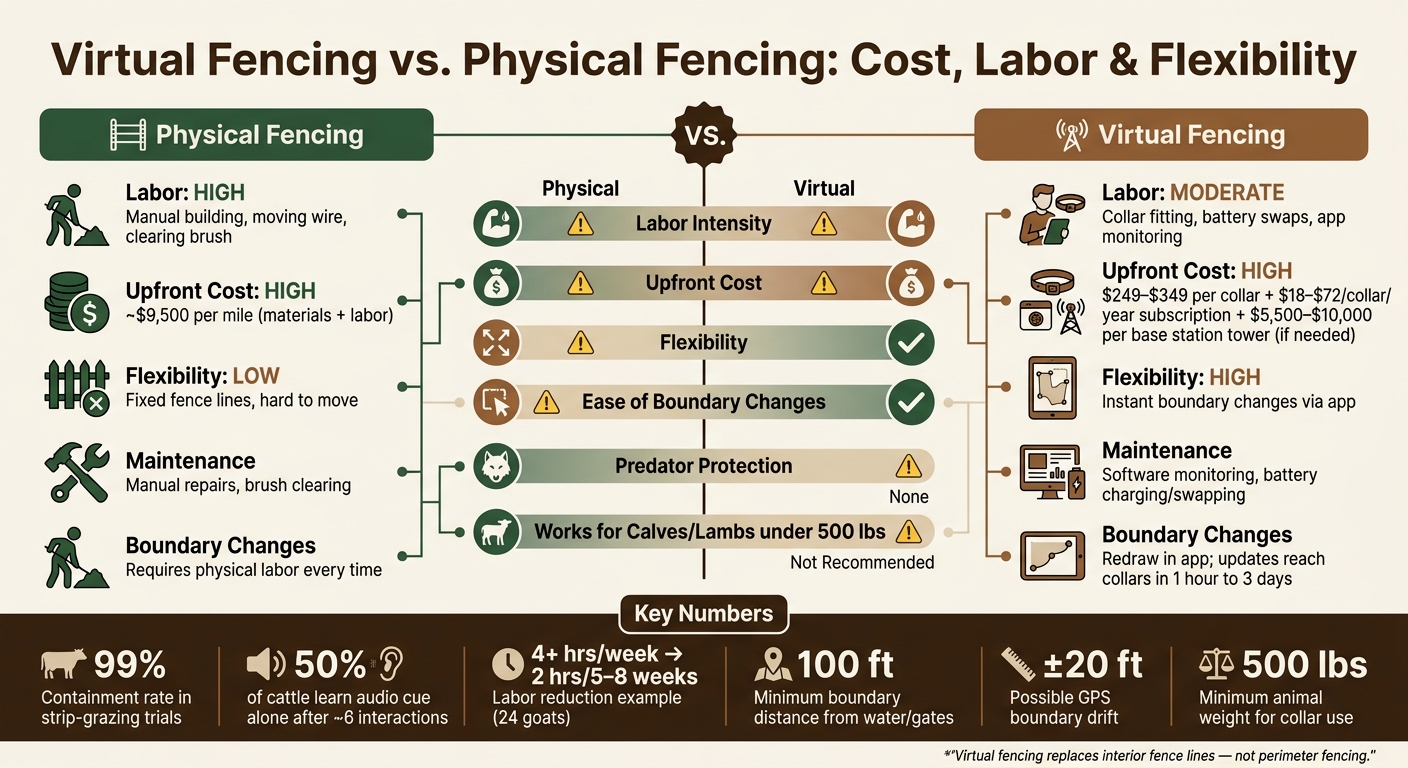
- Cost is a big factor. Collars run about $249 to $349 per head, plus $18 to $72 per collar per year in subscription fees. Some systems also need towers that cost $5,500 to $10,000.
- Best use cases: rotational grazing, cover crop strip-grazing, and keeping livestock out of streams, wetlands, and seeded areas.
If I had to sum it up in one line: virtual fencing trades fence-building work for collar work, app checks, and herd training.
A few numbers stand out:
- Physical wire fencing can cost about $9,500 per mile with labor
- Boundary updates may take 1 hour to 3 days to reach all collars
- Collars are often not used for calves or lambs under 500 pounds
- Boundary lines should stay at least 100 feet from water, gates, and other must-reach spots
This article explains the system in plain English: what the collars do, how animals learn it, what it costs, where it fits, and where it can fall short.
The Core Technology Behind Virtual Fencing
GPS Collars, Sensors, and Animal Cues
Each collar combines a GPS unit, a processor, a speaker, and neck contact points that deliver cues when an animal reaches the mapped edge. When the animal enters the buffer zone near a boundary, the speaker plays a high-pitched tone. If the animal keeps moving forward, the collar delivers a brief, low-level pulse.
Many collars also include an accelerometer that tracks movement patterns and can flag unusual activity. Some models use breakaway features to cut snag risk in brush or wire.
Connectivity, Mapping, and Control Software
Collars send location data and receive boundary updates through three common connection types:
- Cellular service
- LoRaWAN base stations
- Satellite links
Managers draw grazing and exclusion zones on a map, then send updates from a web app or phone. How fast those updates go through depends on signal quality.
The hardware you choose shapes two big things in the field: how long the system can run and how well it works in remote pasture.
Battery Life, Durability, and Field Conditions
Battery life ranges from a few months to a year, depending on use and power source. That choice affects how often someone needs to swap or charge batteries. Solar-integrated collars can cut down on manual battery changes, but cold weather and heavy cloud cover can reduce solar charging efficiency.
GPS accuracy matters too. In pasture, location error can shift the effective boundary. That is why virtual boundaries should not be placed within 100 feet of a water tank, gate, or other needed infrastructure. If they are too close, animals may get unintended cues or lose access to places they need to reach.
Field conditions can also change how the collar sits and performs. In rough brush or on bulls, recheck collar fit on a regular basis.
With the hardware set up, the next step is mapping paddocks, fitting collars, and training animals to respond.
How it works - Virtual Fencing for Beef Powered by Satellite | Halter
How Virtual Fencing Works Step by Step
Once the collars and software are set up, the day-to-day process is pretty simple: map, train, then monitor.
Map Grazing Areas and Set Boundaries
Open the software on your phone, tablet, or computer, then pull up a satellite or topographic map of your pasture. Most platforms let you build three kinds of zones:
- Inclusion zones to keep cattle inside a grazing area
- Exclusion zones to keep them out of riparian areas, wetlands, or newly seeded ground
- Movement fences that shift a boundary in one direction over time so cattle move onto fresh grass
Start with water when you plan boundaries. On large rangelands, moving cattle from one water source to another can help increase stock density and focus grazing on the areas you want used first.
Fit Collars and Train Animals
Put collars on in a squeeze chute with two people, one on each side, so the job stays safe and accurate. The collar should sit snugly, but it shouldn't be tight. If it can slip over both ears, it's too loose. With growing yearlings, check the fit again every 6 to 8 weeks during the season as they put on weight.
Training usually goes best in a small area with a physical fence. Place the virtual boundary right on top of the physical fence at first, so the fence backs up the audio cue. After cattle start responding to the tone by itself, move the virtual boundary about 33 to 66 feet inside the fence. That lets you test whether they're following the cue without the physical barrier doing the work.
Research shows that 50% of cattle learn to avoid the boundary based on the audio cue alone after an average of six interactions, and naive heifers usually comply within 3 to 7 days. A simple way to track progress is to watch pulse frequency in the software. Fewer pulses usually mean the herd is learning.
Move Herds, Check Alerts, and Keep Records
After training, most daily management happens in the app. You can redraw paddock boundaries from a distance to move cattle to fresh grass without driving out to the field. The movement fence tool also helps with assisted moves toward corrals or new pastures. One thing to watch: updates aren't always instant. Based on connectivity, boundary changes may take anywhere from one hour to three days to reach all collars.
Check the app often for boundary alerts and low-battery notices. Heat maps show where cattle spend the most time, which can help you spot overgrazing pressure or underused water sources before they turn into bigger issues. It also helps to line up collar swaps or battery changes with scheduled jobs like pregnancy checks, which cuts down on extra handling.
Keep records on grazing pressure, battery changes, and boundary alerts. Over time, those records can show whether the system is improving grazing control and saving labor.
Transform Your Agricultural Team
Streamline job management, field mapping, and machine tracking with HarvestYield. Simplify your operations and eliminate paper job sheets.
ContinueWhere Virtual Fencing Helps Most and What It Costs
Virtual Fencing vs. Physical Fencing: Cost, Labor & Flexibility Compared
Rotational Grazing, Exclusion Zones, and Targeted Use
Virtual fencing fits best where boundaries need to move fast. That includes rotational grazing, strip-grazing annual forages, and exclusion zones. In University of Nebraska-Lincoln trials, containment reached 99% in one strip-grazing trial.
Exclusion zones are another strong fit. Researchers at the University of Arizona's Santa Rita Experimental Range used virtual fencing in 2023 and 2024 to keep cattle out of a sensitive riparian area while pushing grazing toward less-used parts of the pasture. That kind of control matters on rough or brushy rangeland, where putting in permanent wire can be a headache and hard to pencil out. Traditional wire fencing can cost around $9,500 per mile once labor is included.
Labor Savings, Equipment Costs, and Ongoing Work
This is where the tradeoff gets clear: virtual fencing doesn't erase labor. It changes where the work goes. Instead of hauling wire and setting posts, the job shifts to collar fitting, battery swaps, and app checks.
One example makes that pretty concrete. Managing 24 goats with virtual fencing collars cut fencing labor from 4+ hours per week to about 2 hours every 5 to 8 weeks for battery swaps and collar adjustments.
The upfront price can still sting. Collar prices range from about $249 to $349 per head, depending on the system. Annual subscription fees run about $18 to $72 per collar, and base station systems can add $5,500 to $10,000 per tower.
| Factor | Physical (Interior) Fencing | Virtual Fencing |
|---|---|---|
| Labor | High (building, moving wire) | Moderate (collar fitting, battery swaps) |
| Upfront Cost | High (materials and labor per mile) | High (collars and base stations) |
| Flexibility | Low (fixed lines) | High (instant boundary changes via app) |
| Maintenance | Manual repairs, clearing brush | Software monitoring, battery charging |
Using Grazing Data for Better Planning
The GPS side of virtual fencing does more than help you find animals. It can also help with day-to-day grazing decisions. Heat maps can show which paddocks are getting hit hardest and which water sources pull the most cattle. GPS records can also flag animals that are moving less.
Before making the call, it helps to look at animal welfare, collar fit, and herd behavior alongside the cost and labor picture.
Animal Welfare, Fit for Your Operation, and Final Takeaways
Animal Welfare and U.S. Management Factors
Once the system is up and running, animal welfare and herd fit are what make or break it over time.
Animals should be trained in a small fenced area for 1 to 2 weeks so they learn the tone before the correction cue. If training gets rushed, stress goes up and containment tends to get weaker.
Collar fit also needs regular checks through the grazing season. As animals gain or lose body condition, the fit can change, and that affects neck contact. Collars are not recommended for calves or lambs under 500 pounds. Most systems also stop cues after repeated nonresponse to help limit stress.
If you're grazing on state or federal grazing lands, check with the land management agency before you deploy a system. Virtual fencing rules can change from one jurisdiction to another.
When Virtual Fencing Makes Sense
The next step is simple: look at your herd, your land, and your signal coverage, then compare them against the system's limits.
| Factor | Good Fit | Poor Fit |
|---|---|---|
| Herd Type | Adult cattle, goats, sheep | Calves or lambs under 500 pounds |
| Terrain | Flat to moderately rolling | Steep or heavily wooded terrain unless the system uses satellite |
| Connectivity | Reliable cellular (3G/4G/LTE), LoRaWAN, or satellite coverage | Areas with no reliable signal |
| Grazing Goal | Intensive rotation, exclusion zones, riparian protection | Continuous grazing in already fenced pastures |
| Labor Profile | Comfortable monitoring apps and swapping batteries | No capacity for digital monitoring or routine collar checks |
| Predator Pressure | Low to moderate | High, since virtual fencing provides no protection against predators |
There are a couple of limits you can't ignore. GPS boundaries can drift by up to 20 feet, so don't place lines too close to crops or neighbor property. And physical perimeter fencing still matters.
Conclusion: Key Points to Remember
Virtual fencing works through GPS collars, digital boundary software, and trained animal behavior - not physical barriers.
It's a strong fit for rotational grazing, exclusion zones, and places where running wire is impractical or too expensive. But there’s a tradeoff: you need steady monitoring, routine collar upkeep, and reliable connectivity. In plain English, virtual fencing works best when the herd can be trained, the land has signal coverage, and someone is ready to keep an eye on the system on a regular basis.
FAQs
How accurate is virtual fencing?
Virtual fencing works well in practice. Once livestock are trained, containment rates usually fall between 80% and 99%. GPS tracking also tends to be fairly close, with animal location accuracy of about 10 to 35 feet.
That said, results can shift depending on the ground, plant cover, and how each animal behaves. Even so, most livestock learn the system fast enough that they respond to audio cues alone more than 90% of the time.
How long does it take cattle to learn it?
Training cattle to respond to virtual fencing usually takes 4 days to 1 week. The exact timing depends on the animal and how often it runs into the virtual boundary.
Over that training period, cattle learn to connect the audio cue with the electrical pulse. After a bit of repetition, many start reacting to the sound alone, which is the whole point of the system.
In most cases, a herd is treated as trained once it stays inside the set area for 4 consecutive days.
What happens if a collar loses signal?
If a virtual fencing collar loses signal, it doesn’t stop working for the livestock. The collar keeps the most recent boundary data stored on the device, continues tracking the animal by GPS, and still delivers cues when needed.
What changes is the connection side of things. During the outage, the collar can’t send live tracking data or receive new boundary updates. Once it reconnects, it automatically syncs any pending data and downloads the latest updates.