How IoT Tracks Crop Growth in Real Time
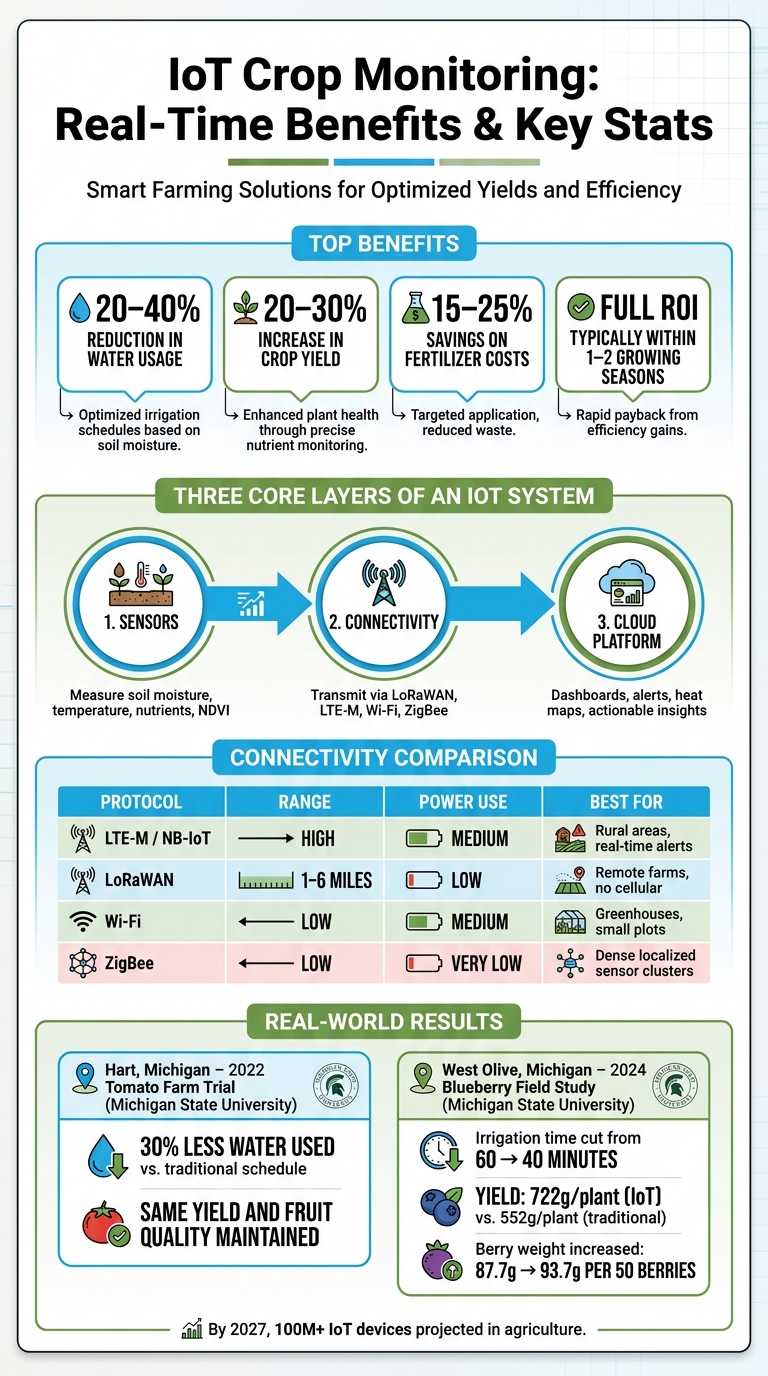
IoT is changing farming by providing real-time data to monitor crops and make precise decisions. Farmers use sensors, communication networks, and cloud platforms to track soil moisture, temperature, nutrients, and more. This helps reduce water waste by up to 30%, cut fertilizer costs by 15–25%, and boost yields by 20–30%.
Key points:
- Sensors measure soil, air, and plant health.
- Wireless networks like LoRaWAN and LTE-M transmit data.
- Cloud platforms turn data into actionable insights.
- Alerts help address issues like water stress or pests early.
IoT Crop Monitoring: Key Benefits, Components & ROI Stats
Agricultural IoT: Smart Farming & Precision Agriculture with Sensors and Automated Irrigation
Transform Your Agricultural Team
Streamline job management, field mapping, and machine tracking with HarvestYield. Simplify your operations and eliminate paper job sheets.
ContinueKey Components of an IoT Crop Monitoring System
An IoT crop monitoring system operates through three interconnected layers: sensors that gather data, a network that transmits it, and a cloud platform that transforms it into real-time insights. Together, these elements help farmers make better decisions.
Sensors and Field Devices
At the heart of any IoT system are sensors. Choosing the right sensors depends on your crops and the challenges you face.
Soil moisture sensors are a common starting point. Volumetric sensors measure how much water the soil holds, while tension-based sensors (tensiometers) assess how hard roots must work to draw water. These sensors are versatile across different soil types, from clay to sandy loam, and typically cost between $50 and $300.
Temperature and humidity sensors track air and soil conditions, helping farmers time planting, manage frost risks, and control greenhouse environments. Meanwhile, nutrient sensors, such as electrical conductivity (EC) sensors, monitor fertilizer effectiveness and warn of salinity issues. These can range in price from $500 to $2,000.
For a broader perspective, NDVI (Normalized Difference Vegetation Index) imaging sensors are used to evaluate plant health, stress, and biomass. These sensors are often mounted on drones or fixed stations. Agricultural drones equipped with NDVI sensors can cost anywhere from $1,000 to over $25,000, depending on their features.
Installing sensors at various depths - 6", 12", and 24" - can improve irrigation and root zone monitoring, offering a better understanding of underground conditions.
"The Hawk delivers data that is accurate, ensuring that irrigation management is both effective and efficient." - Andy Nadler, Founder and Consulting Agricultural Meteorologist, Peak HydroMet
Once sensor data is collected, the next challenge is transmitting it efficiently and securely.
Connectivity and Data Transmission
Data collected in the field needs to make its way to analysis centers. The right connectivity option depends on factors like farm size, location, and how quickly you need updates. Here’s a breakdown of some common protocols:
| Protocol | Range | Power Use | Best Use Case |
|---|---|---|---|
| LTE-M / NB-IoT | High | Medium | Rural areas with mobile signal; real-time alerts |
| LoRaWAN | ~1–6 miles | Low | Remote farms without cellular coverage |
| Wi-Fi | Low | Medium | Greenhouses or small plots near buildings |
| ZigBee | Low | Very Low | Dense, localized sensor clusters with a central hub |
For medium to large farms in the U.S., a hybrid setup often works best. LoRaWAN can handle data transmission from fields to a gateway, while cellular networks send the data from the gateway to the cloud.
Field devices must be durable, meeting an IP65 weatherproof rating and functioning in temperatures between –4°F and 140°F. On large properties with weak signal coverage, mesh networking allows devices to relay data through one another until it reaches the gateway.
Cloud Platforms and Data Analysis
Once transmitted, data is processed on cloud platforms, turning raw numbers into actionable insights. These platforms transform readings into dashboards, heat maps, alerts, and reports, making it easier for farmers to act quickly and effectively.
One standout feature is automated threshold alerts. For example, if soil moisture drops below a certain level, the system can send a notification or text message before crops show visible signs of stress.
In a 2022 trial at a tomato farm in Hart, Michigan, Michigan State University's Irrigation Lab used the LOCOMOS IoT system to automate irrigation based on real-time soil moisture data. This led to a 30% reduction in water usage without compromising yield or fruit quality.
"An IoT soil monitoring system... replaces guesswork with data." - Agrinovo
Cloud platforms can also integrate IoT data directly into farm operations. For instance, HarvestYield (harvestyield.com) links field data to job records, logging where and when inputs were applied, along with GPS coordinates and weather conditions. This seamless integration eliminates data silos and provides a complete, traceable record of every decision made on the farm.
How to Set Up IoT for Crop Growth Tracking
Planning Where to Place Sensors
Before investing in any sensors, take the time to map your fields into zones. These zones should reflect variations in soil type, elevation, and crop behavior. Once mapped, aim to place 2–3 sensor stations in areas that best represent the diversity of your field.
The depth at which you install sensors is just as important as their location. For example, placing sensors at 6 inches helps you monitor irrigation timing, while sensors at 12 inches ensure water is reaching the roots. Deeper placements, like 24 inches, can help detect over-irrigation. For orchards or vineyards, where root systems go deeper, installing sensors at 36–48 inches can provide additional insights. If your soil has been recently tilled, wait 2–3 weeks before installing sensors to allow the soil to settle for more accurate readings.
| Farm Type | Sensor Stations | Typical Setup |
|---|---|---|
| Uniform row crops | 1 per 2–5 acres | Moisture + temperature at 2 depths |
| Variable soil types | 1 per 1–2 acres | Moisture + EC + temperature at 2–3 depths |
| Orchards/vineyards | 1 per 1–3 acres | Tensiometers at 3 depths + temperature |
| Greenhouses | 1 per zone | Moisture + EC + pH + temperature |
| High-value specialty | 1 per 0.5–1 acre | Full sensor suite at multiple depths |
Once you've planned sensor placement, you're ready to move on to installation and connecting the devices.
Installing and Connecting Devices
With your sensor placement strategy in hand, the next step is installation. Start by mounting your IoT controller on a sturdy post, ideally 3–5 feet above ground. This height protects it from farm equipment while ensuring a clear transmission signal. To power the system, position solar panels facing south at a 30–45° angle to maximize energy collection throughout the year. Keep all devices away from irrigation spray to prevent water damage to connectors.
Connect sensors to your field controller using standard communication protocols like SDI-12 or RS-485 Modbus. Then, set up a gateway to send your data to the cloud. Depending on your farm's connectivity, you can use cellular options like LTE-M or opt for LoRaWAN if cellular coverage is limited. LoRaWAN gateways are especially useful for large farms, as they maintain a stable connection across a 300–500-foot radius, even in areas with dense crop canopies. Once everything is set up, register each device on your cloud dashboard. This allows for remote configuration, firmware updates, and real-time monitoring.
Organizing Data and Farm Operations
After your devices are up and running, the next step is to integrate the data into your daily operations. The key is to turn raw sensor data into actionable insights by following a cycle: observe, diagnose, decide, and act.
Set up alerts via SMS or email for critical thresholds, like when soil moisture drops below 20%. This way, your team can respond quickly without needing to constantly monitor the dashboard. Encourage team members to log events - such as irrigation adjustments or equipment repairs - directly into the platform. These notes add context to your data, turning numbers into a usable operational record.
For a more streamlined approach, consider integrating IoT data with a job management platform like HarvestYield (https://harvestyield.com). Linking real-time sensor data to tasks, GPS locations, and weather conditions creates a clear picture of both field conditions and the actions taken. This is especially helpful for audits, end-of-season analysis, or scaling operations across multiple fields. By connecting data to decisions, you ensure every action is traceable and informed.
Using Real-Time Data to Manage Crops
When your IoT system funnels real-time data into your platform, it turns raw sensor readings into practical insights you can act on right away.
Improving Irrigation and Fertilization
One of the biggest advantages of IoT monitoring is how it transforms water and nutrient management. Traditional irrigation schedules often miss the mark, overwatering some areas while leaving others too dry. Sensor data eliminates the guesswork by providing real-time, zone-specific information.
For example, you can automate irrigation based on soil moisture levels - trigger watering when moisture drops below 15% VWC and pause when rainfall hits your set threshold. Use 6-inch sensors to determine when to irrigate and 12-inch sensors to ensure water is reaching the root zone. If 24-inch sensor readings remain high, it’s a red flag for over-irrigation and wasted resources.
Similarly, EC sensors allow you to monitor soil fertility in real time. A rising EC indicates recent fertilizer application, while a decline shows plant uptake or leaching. Aim for an EC range of 0.8 to 2.0 dS/m for optimal fertility; levels above 4.0 dS/m require immediate adjustments. Farms using IoT-driven fertilization have reported 15% to 25% savings on fertilizer costs, and precision irrigation can reduce water use by 20% to 40% in the first season.
Take the 2022 growing season in Hart, Michigan, as an example. An IoT-enabled irrigation system on a tomato field used 30% less water compared to the farmer’s traditional schedule, all while maintaining the same yield and fruit quality.
This level of precision not only optimizes water and nutrient use but also lays the groundwork for proactive disease management and streamlined operations.
Monitoring for Pests and Disease
IoT sensors aren’t just for irrigation - they also act as an early warning system for pest and disease risks. Humidity levels and leaf wetness duration are key factors in fungal outbreaks like powdery mildew and white mold. When these conditions persist, the likelihood of an outbreak grows, often before any visible symptoms emerge.
Set alerts to notify your team via SMS or push notifications whenever prolonged high humidity or extended leaf wetness signals a potential disease threat. This gives you a chance to act quickly - whether that means adjusting irrigation patterns or applying a targeted fungicide - before the issue spreads.
"These sensors go beyond the visible symptoms that point to issues. They look deeper, down to the molecular level, to identify the root causes of problems early." - Liang Dong, Professor, Iowa State University
For soil-borne pathogens like Phytophthora, multi-depth soil sensors are particularly effective. Saturated soil at the 6-inch depth often signals the waterlogged conditions these pathogens thrive in. Catching this early allows you to tweak drainage or reduce irrigation before root damage occurs.
Linking IoT Data to Job Records
Once you’ve optimized inputs and set up early alerts, the next step is connecting this data to your field operations.
By linking sensor alerts to specific actions, you create a seamless workflow. For instance, every moisture-triggered irrigation or disease response can be tied directly to field records.
This is where tools like HarvestYield come in. By combining sensor data with GPS, timestamps, and weather information, you build a detailed history of every decision made in the field. This record becomes invaluable for reviewing performance at the end of the season, preparing for audits, or planning inputs for the next year. Plus, HarvestYield’s machine cost tracking lets you link interventions to equipment and labor expenses, giving you a clearer picture of where your budget is going.
The result? A continuous improvement loop. IoT data drives actions, actions are recorded, and those records refine your decisions for the next season, making your farm more efficient year after year.
Maintaining and Scaling Your IoT System
Seasonal Maintenance Checklist
Keeping your IoT system in top shape is crucial to avoid data gaps during key growth stages. Seasonal recalibration is a must. For example, as soil properties shift between wet and dry periods, sensors calibrated in spring may start giving inaccurate readings by midsummer. To stay ahead, recalibrate soil moisture probes at the start of every season to ensure reliable data.
Plan quarterly physical inspections to check for weather damage, pest interference, or accidental machinery impacts on sensors and solar panels. At the same time, monitor battery voltage through your cloud dashboard to identify power issues before they lead to downtime. Use remote firmware updates to fix bugs and add improvements without needing to visit the field. It’s also helpful to maintain a log for each sensor, noting details like its type, installation depth, calibration date, and service history. This makes troubleshooting and onboarding smoother throughout the season.
A well-maintained IoT system ensures accurate and timely insights, which are essential for smart farming. You can see these tools in action to understand how they streamline data management.
Expanding IoT Coverage Across the Farm
Once your system is running smoothly, you can plan for gradual expansion to maintain consistent data quality across your farm. A smart way to begin is by installing two or three sensor stations in key zones - one in an area with uniform soil and another in a spot with variable soil texture or elevation. Use the data from these zones to guide further expansion.
When scaling up, opt for modular hardware that supports multiple sensor protocols, such as SDI-12, RS-485, or analog. This flexibility allows you to integrate different sensor types, like those for electrical conductivity (EC), temperature, and leaf wetness, without overhauling your existing setup. For remote fields with poor cellular reception, consider a hybrid connectivity solution that combines LTE-M/NB-IoT with LoRaWAN to ensure reliable data transmission. Sensor density will vary depending on your farm type, so refer to placement guidelines from the setup section to determine the best configuration.
Measuring ROI and System Performance
Once your system is scaled, it’s important to evaluate its performance and return on investment (ROI). ROI isn’t just about yield increases - it’s also about preventing losses. For instance, a frost alert at 3 AM that activates a fan or heater could save an entire crop cycle, making it more valuable than all other sensors combined. Beyond risk reduction, track water and fertilizer savings as key performance indicators.
A great example comes from a 2024 Michigan State University study. Using the LOCOMOS IoT system in a blueberry field in West Olive, Michigan, growers reduced irrigation time from 60 to 40 minutes by relying on real-time sensor data. This resulted in a yield of 722 g (approximately 1.59 lb) per plant, compared to 552 g (about 1.22 lb) in a traditionally managed plot. The IoT-managed plot also saw an increase in berry weight, with 50-berry weights rising from 87.7 g (roughly 3.09 oz) to 93.7 g (around 3.30 oz). Most precision agriculture systems achieve full ROI within one to two growing seasons.
"ROI often comes from avoided losses rather than increased inputs, making smart farming technology a defensive and offensive investment." - WiccaGrow
From a technical perspective, aim for sensor accuracy within ±0.02 cm³/cm³ (Mean Bias Error) and a Root Mean Square Error (RMSE) below 0.035 cm³/cm³ to ensure your data is reliable for decision-making. At the end of each season, review metrics like water usage, input costs, and labor hours to identify successes and areas for further investment.
Conclusion
IoT crop monitoring has moved far beyond being a niche technology. By 2024, over 75 million IoT devices were in use in agriculture, and projections suggest this number will surpass 100 million by 2027. For serious growers, real-time tracking has become a standard practice.
The benefits of adopting IoT in farming are hard to ignore: 20–40% water savings, 20–30% yield improvements, and 15–25% reductions in fertilizer costs. As WiccaGrow aptly stated:
"Real-time farm monitoring is no longer about watching fields from afar. In 2026, it is about understanding crops continuously, responding precisely, and farming with precision and reliability."
However, data alone isn’t enough - it needs to drive action. By integrating sensor data with platforms like HarvestYield, farmers can turn insights into results. For example, when IoT sensors detect a drop in soil moisture or identify pest risks, HarvestYield enables farm managers to schedule tasks, log field activities with GPS and weather data, and maintain a detailed, paperless record of every action. This seamless connection between sensor alerts and documented interventions ensures every step is traceable and effective.
Starting small is key. Deploy a few sensors, calibrate them regularly, and integrate the data with your task management tools. The technology works, the savings are measurable, and the tools to make it all happen are readily available.
FAQs
How many sensors do I need to start?
Starting small is a smart approach. Many farms kick things off with just a few soil moisture sensors and one gateway, thanks to the modular nature of modern IoT systems. Soil moisture monitoring tends to deliver the best bang for your buck, while temperature sensors are great for keeping tabs on germination or root activity. As you gather more data and identify specific needs, you can gradually add sensors like pH or conductivity to fine-tune your field management strategies.
What connectivity works if I don’t have reliable cell service?
If cellular service isn't dependable, LoRaWAN offers an excellent alternative. This low-power, long-range technology can reach up to five miles in rural areas. By installing a private LoRaWAN gateway, you can collect sensor data from your fields and transmit it to the internet via Wi-Fi or Ethernet. This setup enables real-time monitoring, even in areas with little to no mobile signal.
How do I turn sensor data into day-to-day actions in HarvestYield?
HarvestYield’s tools make it easy to turn sensor data into practical actions. By linking your IoT sensors, you can track real-time conditions, set alerts for specific thresholds (like moisture levels or nutrient content), and analyze trends over time. If a threshold is crossed, you'll get notifications to help you plan tasks such as irrigation or fertilization. This approach simplifies your workflow, removes uncertainty, and combines job details with weather and GPS data effortlessly.