How LoRaWAN Improves Energy Use in Livestock Tracking
LoRaWAN is a low-power, long-range wireless technology that makes livestock tracking more energy-efficient and cost-effective. Here's why it stands out:
- Low Energy Use: LoRaWAN uses just 20 mJ to send a 10-byte data packet, compared to 90 mJ for alternatives like NB-IoT or Sigfox. This efficiency extends battery life significantly - up to 10 years with a standard 1,900 mAh battery.
- Extended Range: Capable of transmitting data up to 9 miles (15 km), LoRaWAN is ideal for remote, large-scale ranches without reliable cellular coverage.
- Cost Savings: Operating on unlicensed frequency bands, it eliminates subscription fees tied to cellular networks.
- Battery Optimization: Features like deep-sleep modes, low-power accelerometers, and selective GPS activation further reduce power consumption.
To maximize performance, focus on proper tracker placement, adjust data collection frequency, and integrate multiple sensors like accelerometers and temperature monitors. Smart network design, such as strategic gateway placement, ensures optimal coverage with minimal infrastructure.
LoRaWAN's energy efficiency not only lowers operational costs but also simplifies livestock management, making it a practical choice for modern ranching.
Webinar: Implementing a GPS cattle tracking solution with LoRaWAN - The Things Industries/Moovement
Transform Your Agricultural Team
Streamline job management, field mapping, and machine tracking with HarvestYield. Simplify your operations and eliminate paper job sheets.
ContinueHow LoRaWAN Reduces Energy Consumption
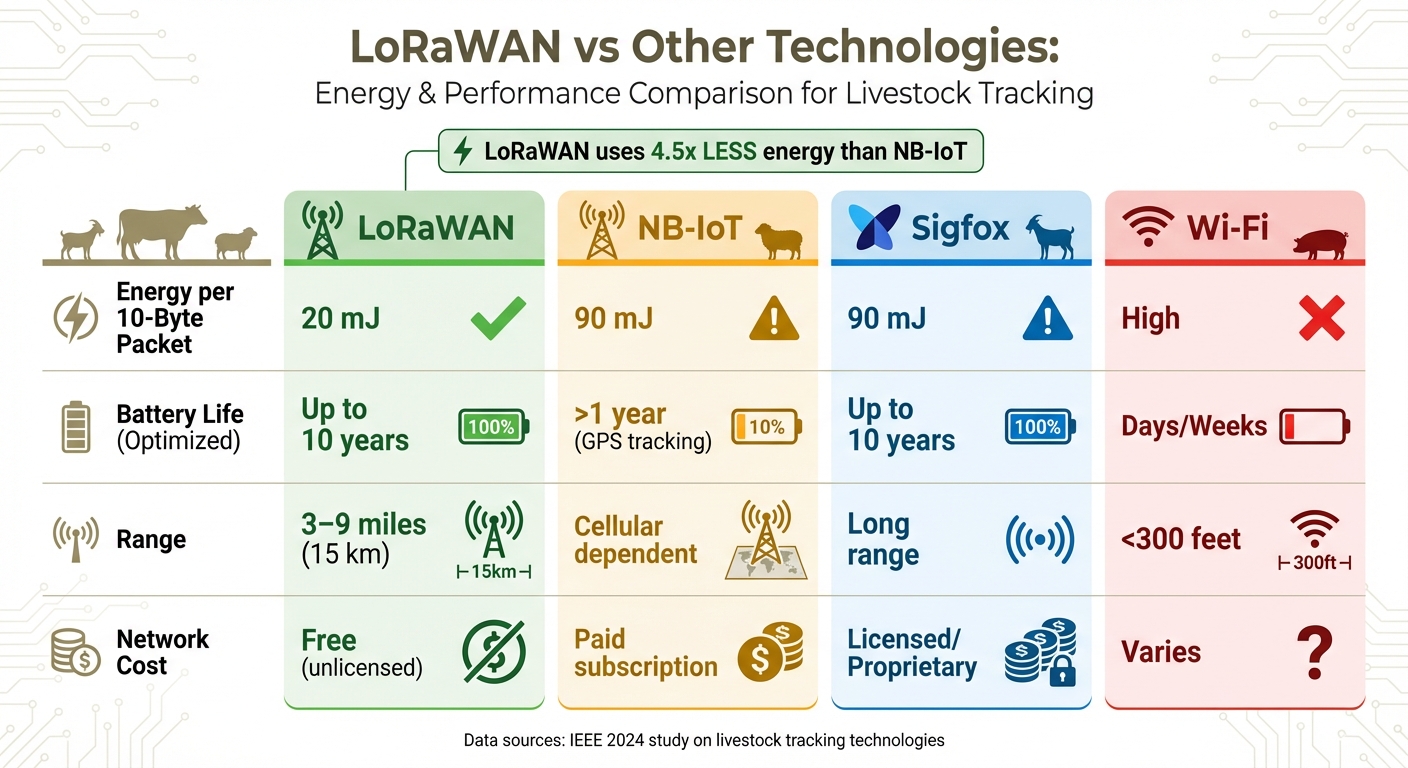
LoRaWAN vs Other Technologies for Livestock Tracking: Energy Efficiency Comparison
Cutting energy use in livestock tracking doesn’t just lower costs - it also boosts reliability. LoRaWAN achieves this through a combination of low-power modulation and long-range transmission. Its design allows devices to send data across distances of up to about 9 miles (15 km) while consuming very little power. Unlike cellular systems, which need constant network connections and paid subscriptions for licensed frequencies, LoRaWAN operates on free frequency bands. This reduces both energy demands and recurring expenses.
LoRaWAN devices stay in deep-sleep mode most of the time, waking only briefly to send small packets of data. For instance, transmitting a 31-byte packet at spreading factor 8 takes just 170 milliseconds of airtime, keeping battery usage to a minimum. This efficiency is largely thanks to LoRaWAN's specialized modulation.
Low-Power Modulation and Long-Range Transmission
LoRaWAN’s modulation is tailored for long-range communication with minimal energy use. While Wi-Fi struggles to maintain a connection beyond around 300 feet, LoRaWAN can reach up to 9 miles (15 km) from a single gateway. This makes it perfect for tracking livestock across wide-open spaces where cellular coverage is often unreliable.
Unlike cellular systems, which require higher transmission power in areas with weak signals, LoRaWAN depends on nearby gateways. Devices transmit data to local hubs instead of distant cell towers, conserving energy.
Some devices, like the MOKO SMART LW001-BG Pro released in July 2024, take energy efficiency even further. This tracker combines GPS, Bluetooth, and Wi-Fi positioning with a 12,000 mAh battery designed to last up to 10 years. It activates the GPS module only when necessary, using lower-power Bluetooth and Wi-Fi for positioning when possible. Additionally, some trackers use low-power accelerometers, consuming just 36 µA, to detect motion before turning on the GPS module. This ensures only essential data is sent, saving even more power.
Battery Longevity and Device Lifespan
LoRaWAN’s efficient data transmission translates directly into extended battery life, which is crucial for remote ranch operations. For example, an IEEE study from 2024 revealed that a LoRaWAN-based estrus detection collar could run for 10 years on a single 1,900 mAh LiSOCl₂ battery. In contrast, an NB-IoT low-power GPS tracker using the same battery lasted just over a year.
Even with frequent monitoring, LoRaWAN trackers remain energy-efficient. A cattle tracker with a 5.2 Ah battery can function for 4 months under intensive use. Adding a small solar panel (about 1.1 in² or 7.36 cm²) extends this by 40%, while larger panels (around 3.2 in² or 20.46 cm²) can potentially make the device self-sustaining.
This extended battery life reduces the need for frequent replacements, saving on labor and operational costs. For more on optimizing your setup, see our Quick Start Guide. For farm managers overseeing large herds, fewer battery replacements mean lower expenses and less wear and tear on devices. This also helps maintain waterproofing and durability, which are critical for devices exposed to the elements.
| Technology | Energy per 10-Byte Packet | Battery Life (Optimized) | Range | Network Cost |
|---|---|---|---|---|
| LoRaWAN | 20 mJ | Up to 10 years | 3–9 miles (15 km) | Free (unlicensed) |
| NB-IoT | 90 mJ | >1 year (GPS tracking) | Cellular dependent | Paid subscription |
| Sigfox | 90 mJ | Up to 10 years | Long range | Licensed/Proprietary |
| Wi-Fi | High | Days/Weeks | <300 feet | Varies |
Tips for Optimizing LoRaWAN Device Performance
To get the most out of LoRaWAN trackers, focus on three key areas: placement, data collection frequency, and sensor integration. Even small tweaks can dramatically extend battery life - sometimes from months to years.
Let’s start with the basics: proper placement.
Tracker Placement on Livestock
For monitoring cattle, collar-mounted trackers are the go-to option. These should be attached to the upper neck using adjustable nylon belts, ensuring a clear view of the sky. Why? Because an unobstructed sky view is critical for accurate GPS readings. On the other hand, placing trackers in indoor or heavily obstructed areas can lead to measurement errors or GPS drift.
Collars also offer the added benefit of accommodating larger batteries. For instance, a tracker equipped with a 12,000 mAh battery can last up to 10 years, depending on its configuration. This makes collar-mounted trackers both practical and long-lasting.
Balancing Monitoring Frequency and Battery Life
When it comes to LoRaWAN trackers, GPS acquisition is the biggest battery drainer. To strike the right balance, adjust the data collection frequency based on your needs. For routine herd management, hourly GPS updates are usually sufficient and help extend battery life. However, in situations requiring real-time monitoring - such as detecting illness or injury - shorter intervals, like 15 minutes, may be necessary. These shorter intervals can reveal patterns of immobility or other indicators of poor welfare.
"The process of GPS acquisition demands significant power, leading to a dilemma between prioritizing high-frequency, short-duration experiments, or low-frequency data collection for longer-duration studies." - Shelemia Nyamuryekung'e et al.
Next, let’s look at how sensor strategies can further optimize performance.
Using Sensor Fusion to Reduce Power Demand
A smart way to conserve power is by combining GPS with low-power accelerometer data. Here’s how it works: the accelerometer monitors motion at frequent intervals - say, every minute - and only activates the GPS when significant movement is detected. This approach cuts down on unnecessary GPS usage during periods of inactivity, saving battery life and reducing false alerts caused by GPS noise.
"The fusion of GPS and accelerometer data better detected animal welfare implications related to immobility in grazing cattle." - Shelemia Nyamuryekung'e et al.
Some advanced trackers take this a step further by integrating Bluetooth and Wi-Fi positioning. For example, Bluetooth can confirm proximity to key locations like water troughs or feeding stations, eliminating the need to engage the GPS module unless absolutely necessary.
Designing Energy-Efficient LoRaWAN Networks
Creating an energy-efficient LoRaWAN network for livestock tracking involves smart gateway placement and a network design tailored to your operation's specific needs. The goal? Use fewer devices, reduce power consumption, and eliminate ongoing subscription fees.
Since LoRaWAN operates on unlicensed frequency bands, this approach builds on its inherently low-power design, as previously discussed.
Gateway Placement for Maximum Coverage
One LoRaWAN gateway can cover an impressive range of 5 to 15 kilometers. To maximize coverage, position gateways at elevated locations to ensure a clear line of sight. Ideal spots include 10- to 15-meter poles, feed mill towers, or any other high vantage points. If your livestock grazes in remote or shifting areas, consider mounting gateways on mobile platforms like farm vehicles or even drones to dynamically extend the network's reach.
Before finalizing placement, conduct a site survey to map signal strength. Tools like Radio Mobile can help pinpoint the best locations based on the terrain. This ensures you only deploy the infrastructure you truly need.
Beyond where you place your gateways, designing the network to match the size of your operation is key to achieving maximum efficiency.
Network Design for Different Ranch Sizes
While efficient hardware is important, the network layout must also align with the size and terrain of your ranch. For smaller operations, a single, centrally located gateway may suffice. Larger ranches, however, will need multiple gateways arranged to create overlapping coverage zones, ensuring there are no gaps.
LoRaWAN's chirp-spread spectrum technology is particularly suited for rugged pastures and wooded areas, as it can penetrate foliage and handle challenging terrain. For larger setups, a hybrid strategy can bring added efficiency: equip select animals with GPS-enabled trackers and use lower-cost Bluetooth tags for the rest. The GPS trackers can pinpoint the location of nearby Bluetooth-tagged animals, cutting down on both hardware expenses and energy usage.
Keep in mind the duty cycle limits, which are typically 1%. A single LoRaWAN channel can handle around 720 messages per hour - enough to support hundreds of sensors sending updates every 15 minutes. This ensures your network runs smoothly without overwhelming the gateways.
Combining Sensors for Efficient Monitoring
Using a consolidated sensor design can cut down on unnecessary radio transmissions, which are a major cause of battery drain. The strategy? Operate low-power sensors continuously and save GPS for occasional use. Take triaxial accelerometers, for instance - they consume far less energy than GPS modules while providing consistent motion data. By combining these sensors, you can track animal behavior effectively without draining the battery too quickly.
Energy-Efficient Animal Welfare Monitoring
Motion sensors offer a way to monitor animal welfare without the high energy demands of constant GPS use. For example, if accelerometers detect no movement, the system can flag potential immobility - a critical health indicator - without needing to activate GPS.
Between October and December 2020, researchers at New Mexico State University's Clayton Livestock Research Center tested Abeeway Industrial Trackers on grazing cattle. Under the guidance of Shelemia Nyamuryekung'e and Santiago Utsumi, they set accelerometers to record every minute while GPS readings were taken every 15 minutes. They developed the "CorrectedDist_Act" algorithm, which combined motion and GPS data to eliminate false movement signals caused by GPS drift. This approach allowed them to accurately detect immobility while achieving a projected 5-month battery life on a 14 Ah battery.
"The fusion of GPS and accelerometer data better detected animal welfare implications related to immobility in grazing cattle." - Shelemia Nyamuryekung'e, Division of Food Production and Society, NIBIO
Temperature sensors add another layer, helping to identify heat stress and environmental challenges through a single, energy-efficient LoRaWAN uplink. This highlights how combining sensors can improve overall system efficiency.
Reducing Redundancy with Multi-Sensor Systems
Integrating multiple sensors into a single device eliminates the need for separate systems, each with its own battery and transmission schedule. For example, a 240-gram tracker that combines GPS, accelerometer, and temperature sensors replaces multiple devices, simplifying the setup and reducing power consumption.
This method strikes a balance between data collection frequency and battery life. A LoRaWAN tracker collecting GPS data hourly (24 positions per day) can last about 20 months. However, increasing GPS readings to every 15 minutes while pairing it with 1-minute motion tracking reduces battery life to approximately 5 months. Since motion sensors provide continuous monitoring, GPS can be used less frequently without losing critical insights into animal welfare.
| Algorithm Type | Data Sources Used | Primary Benefit |
|---|---|---|
| RawDist | Raw GPS only | Simple but prone to errors from GPS drift |
| CorrectedDist | Filtered GPS (z-score) | Removes extreme outliers but may still misinterpret stationary objects as moving |
| CorrectedDist_Act | GPS + Accelerometer | Most precise; excludes GPS noise when no motion is detected |
Source:
Efficient data management is key for long-term livestock tracking with minimal maintenance. Instead of juggling multiple data streams, all sensor inputs can be routed through a single LoRaWAN gateway to platforms like ThingSpeak or Abeeway Device Manager for real-time visualization. By combining sensor functions into one device, LoRaWAN trackers deliver precise monitoring while keeping energy use low.
Conclusion
The advantages of LoRaWAN for livestock tracking, as detailed throughout this guide, highlight its practicality and efficiency for modern farming. Its ability to send a 10-byte payload using just 20 mJ of energy - requiring 4.5 times less power than comparable technologies - means sensors can function for years instead of months. This dramatically lowers energy usage, making long-term tracking both feasible and cost-effective.
Additionally, LoRaWAN's use of unlicensed frequency bands eliminates the recurring costs associated with licensed cellular networks. With a single gateway covering a range of roughly 3 to 9 miles, large-scale ranching operations can expand monitoring without needing extensive infrastructure investments. By carefully planning gateway placement and incorporating multiple sensors, farmers can further conserve power while ensuring comprehensive monitoring of livestock health and behavior. These combined benefits create a strong case for adopting LoRaWAN in large-scale applications.
To maximize these efficiencies, farm managers should focus on selecting LoRaWAN devices that align with their specific needs. Optimizing monitoring frequency, strategically placing gateways, and integrating multiple sensors are key strategies for reducing labor and operational costs. These methods not only decrease maintenance requirements but also ensure a steady flow of reliable data over time.
For even greater efficiency, integrating LoRaWAN systems with management platforms like HarvestYield can streamline operations. Platforms like this allow agricultural teams to merge tracking data with other critical farm management tasks, such as job scheduling and field activity recording, while incorporating GPS and weather data. This integration supports systems that reduce energy use and administrative effort, contributing to more efficient and sustainable farming practices.
FAQs
How many gateways do I need for my ranch?
The number of gateways you'll need largely depends on the size of your ranch, the layout of the terrain, and how much coverage you’re aiming for. In open areas, a single gateway can often cover several square miles. That said, if your ranch is larger or has challenging terrain, you might need more gateways to maintain consistent and reliable coverage throughout.
What GPS update rate provides the best balance of battery life and accuracy?
An adjustable GPS update rate that changes depending on movement and activity strikes the right balance between battery life and accuracy. This method saves energy while still ensuring reliable location tracking.
How do accelerometers reduce GPS battery drain?
Accelerometers play a key role in conserving GPS battery life by detecting motion. They ensure the GPS activates only during periods of significant activity. By keeping the GPS inactive when there's no meaningful movement, these sensors help optimize power usage in tracking systems.