Real-Time Herd Monitoring Tools: Pros and Cons
Real-time herd monitoring tools are transforming livestock management by providing immediate insights into animal health, behavior, and location. These tools use advanced technologies like IoT sensors, GPS, AI, and analytics platforms to help farmers address issues before they escalate. Here's a quick breakdown of the four main types covered:
- Wearable Sensors: Track individual health metrics (e.g., rumination, temperature) with up to 94% accuracy. Ideal for early illness detection but require regular maintenance and connectivity.
- GPS & Virtual Fencing: Monitor grazing patterns and create virtual boundaries. Useful for large pastures but comes with setup costs and limited precision.
- In-Barn Vision Systems: Use cameras and sensors to monitor group behavior and barn conditions. Non-contact but limited to indoor spaces.
- Integrated Analytics Platforms: Combine data from multiple sources for a complete herd view. Highly accurate but rely on tagging all animals and robust infrastructure.
Quick Comparison
| Tool | Strengths | Limitations | Best Fit |
|---|---|---|---|
| Wearable Sensors | Tracks health metrics, early issue alerts | Battery upkeep, potential discomfort | Dairy herds, health monitoring |
| GPS & Virtual Fencing | Spatial tracking, flexible boundaries | Costly, less accurate in hilly areas | Large-scale outdoor operations |
| In-Barn Vision | Monitors group behavior, non-contact | Indoor-only, lighting-sensitive | Indoor livestock housing |
| Integrated Platforms | Combines data for full insights | High setup cost, tagging required | Mixed-use, large-scale operations |
Each tool serves different needs, so selecting the right one depends on your operation's size, layout, and goals. The right system can improve efficiency, reduce losses, and support better animal welfare.
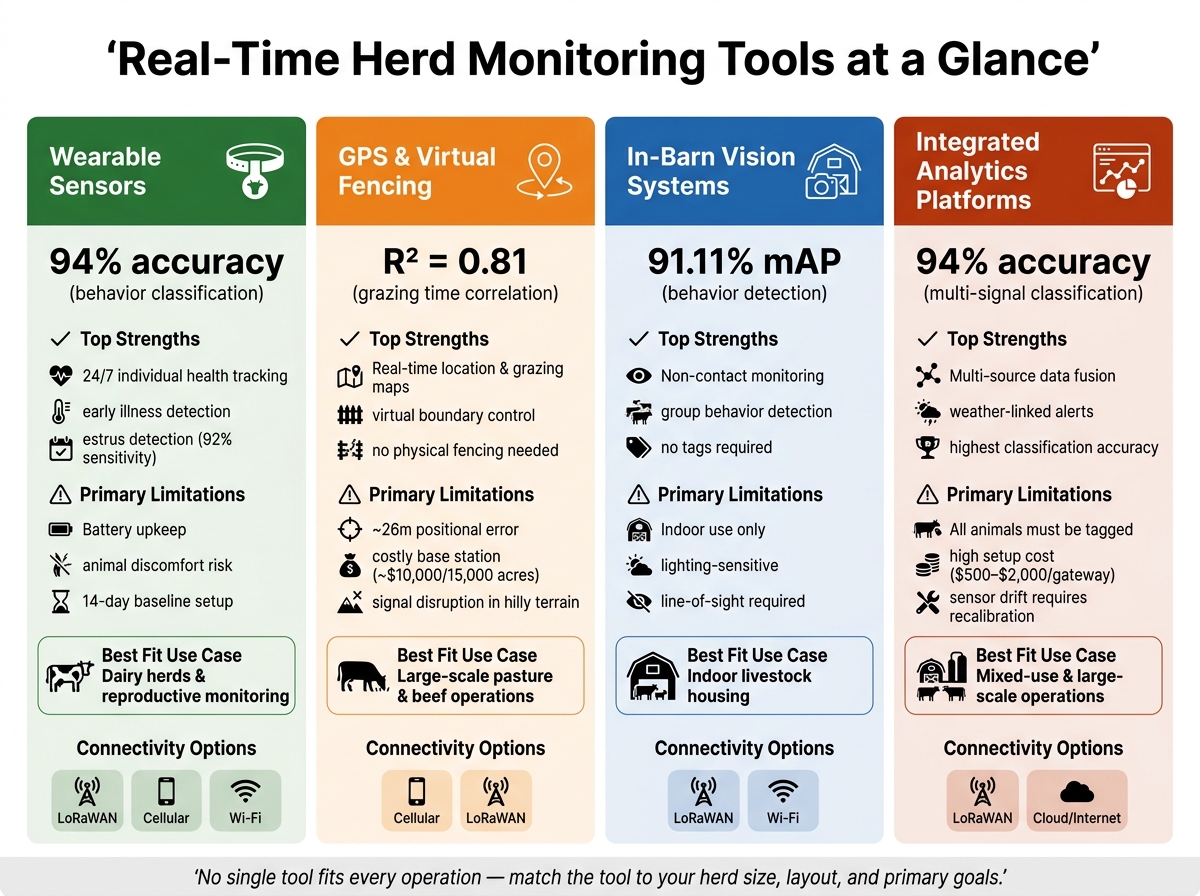
Real-Time Herd Monitoring Tools: Side-by-Side Comparison
Hands-Free Herd Management? Meet 701X’s Autonomous Ranch Tech
Transform Your Agricultural Team
Streamline job management, field mapping, and machine tracking with HarvestYield. Simplify your operations and eliminate paper job sheets.
Continue1. Wearable Activity and Health Sensors
Wearable sensors like collars, ear tags, and rumen boluses have become go-to tools in Precision Livestock Farming. They gather data on crucial metrics like rumination time, step counts, lying and standing durations, internal body temperature, and rumen pH. What's impressive is their ability to detect problems before symptoms are obvious. For instance, a drop in rumination time can signal post-calving diseases early, while shifts in standing behavior might point to heat stress or lameness.
These devices don’t just track activity - they also monitor environmental conditions, such as temperature, humidity, and light intensity, to understand how these factors influence the herd. With the help of AI, raw accelerometer data can be interpreted into behavioral patterns like rumination, feeding, and walking, achieving accuracy rates of up to 94%. Similarly, estrus detection models analyzing 72-hour activity patterns have shown 92% sensitivity and 95% specificity.
To function effectively, these systems need about 14 days to collect data and establish a baseline for each animal. This individual baseline approach minimizes false alarms caused by variations in factors like age, breed, or lactation stage.
"Behavioral patterns are key indicators of an animal's physiological state, with changes providing early signals of compromised well-being." - Scientific Reports
In addition to behavioral insights, reliable connectivity plays a critical role in real-time data collection. Systems rely on gateways, wireless networks, and cloud storage. The choice of connectivity depends largely on the operation's layout and needs:
| Feature | LoRaWAN | Cellular | Wi‑Fi |
|---|---|---|---|
| Range | Up to 6.2 miles (10 km, line‑of‑sight) | Carrier dependent | 165–330 feet |
| Battery Life | 5+ years | 3–12 months | Days to weeks |
| Data Cost | $0 (private network) | $2–$10/device/month | Broadband cost |
| Best Use | Remote, large‑area pastures | Urban/semi‑urban farms | Indoor barns or dense pens |
(Source:)
For ranches in remote locations with limited cellular coverage, private LoRaWAN gateways - priced between $500 and $2,000 - are often the most practical choice. In terms of longevity, neck tags can last 8–10 years, while ear-mounted tags typically last around 7 years. However, GPS-enabled devices tend to drain their batteries faster, and regular checks of collar fit are essential to avoid discomfort or inaccurate data.
2. GPS-Based Tracking and Virtual Fencing
GPS tracking takes livestock monitoring to the next level by providing precise location and movement data. Using GPS-enabled collars equipped with inertial sensors, ranchers can track real-time activities like grazing, ruminating, and lying down. These insights give a continuous view of herd behavior. For example, research has shown a strong correlation (R² = 0.81) between sensor-recorded activity and actual grazing time. This kind of data can help ranchers spot early signs of health issues, such as lameness or heat stress, long before visible symptoms appear. When combined with other sensor data, GPS tracking enables faster responses to behavioral changes.
Virtual fencing builds on GPS technology by adding a layer of behavioral control. Using a smartphone app, ranchers can redefine paddock boundaries in seconds, eliminating the need for traditional fencing materials like posts and wires. Systems like Nofence, eShepherd (Gallagher), and Vence (Merck) use a two-step process: animals first hear an audio alert when approaching a boundary, followed by a mild electrical pulse (around 3,000 volts) if they cross it. Most cattle adapt to this system within 3 to 10 days. Once trained, the need for electrical stimuli drops by up to 80% as animals respond to the audio cue alone.
"Predictability and controllability are critical for animal welfare, as they enable animals to avoid the electrical pulse by responding to the benign audio cue alone." - Ishaya Usman Gadzama, University of Queensland
Virtual fencing is particularly useful for creating exclusion zones, which can protect sensitive areas like riparian zones from erosion and water contamination. It also works well in places where physical fencing is impractical. Some systems even incorporate remote sensing tools, like NDVI, to assess forage quality and create heat maps of grazing pressure. This allows ranchers to rotate pastures more effectively and at the right time.
However, setting up virtual fencing requires some planning. These systems rely on cellular networks or LoRaWAN, but signals can be disrupted by hilly terrain or dense forests. A base station, which costs around $10,000, typically covers 15,000 acres. Non-solar collars need battery replacements every 5–8 weeks. Solar-powered collars cost between $199 and $345, while subscription-based options like Vence and Halter offer leasing models at about $50 per year or $6 per collar per month.
Despite its benefits, virtual fencing has limitations. It’s a behavioral tool, not a physical barrier. Occasionally, animals - especially if spooked - may breach the boundary despite the deterrent. For this reason, experts recommend keeping traditional perimeter fences for legal containment and predator protection, using virtual fencing mainly for interior paddock divisions. Additionally, 5% to 10% of animals may not adapt to the system and might need alternative management. By combining virtual fencing with traditional methods, ranchers can achieve more reliable herd control.
3. In-Barn Vision and Environmental Sensor Systems
In-barn systems offer a way to monitor both environmental conditions and animal behavior without any direct contact. These setups combine overhead cameras with IoT sensor networks to provide continuous updates on what’s happening inside livestock housing.
The vision component uses cameras mounted about 8 feet high, paired with advanced deep learning models like YOLOv8 and YOLOv9. These models can detect behaviors such as standing, lying, grazing, and estrus. Meanwhile, IoT sensor nodes measure critical environmental factors, including temperature, humidity, ammonia (NH3), carbon dioxide (CO2), hydrogen sulfide (H2S), methane (CH4), and particulate matter (PM2.5). Together, these tools paint a detailed picture of both animal behavior and environmental conditions. For instance, in 2025, researchers implemented this system on a Nestlé dairy farm with over 300 cows. The setup achieved a 91.11% mean Average Precision (mAP) in identifying detailed behaviors under varying conditions. It’s worth noting that air quality thresholds for dairy cows and pigs are breached when NH3 exceeds 10 ppm, CO2 surpasses 3,000 ppm, or H2S goes beyond 0.5 ppm. Combining these data streams allows for deeper insights into animal welfare and comfort.
This dual approach captures details that wearables might miss. For example, cattle and pigs adjust their lying posture based on temperature - lying on their sides (lateral) in hot conditions to release heat, and on their chests (sternal) in colder temperatures to retain warmth. A vision system tracking these posture changes offers a non-invasive way to assess thermal comfort. When paired with sensor data showing spikes in NH3 or CO2, the insights become even more meaningful. Research from Gyeongsang National University demonstrated that as greenhouse gas levels increased inside barns, pigs reduced their walking and standing time, opting for lateral-lying positions more often. This behavior was detected with a 98.67% mAP using YOLOv4. However, to make the most of these advantages, the system’s infrastructure needs to be robust and finely tuned.
"Vision-based technologies have the advantages of being non-contact and therefore non-stressful, with low cost and high yield potential." - MDPI Animals
To ensure these systems work effectively, specific design considerations are crucial. Vision systems require consistent lighting, clean lenses, and well-planned camera placements to prevent animals from obstructing each other. Environmental sensors, particularly those measuring NH3 and H2S, need recalibration every six months to maintain accuracy. For connectivity, private LoRaWAN networks are a practical solution. A single gateway can cover up to 10 kilometers and perform well even in barns with metal siding. All equipment must meet an IP67 durability standard to withstand barn conditions. Low-cost IoT multi-parameter devices have proven to deliver accuracy within 2.7% and precision within 3.3% during controlled tests in livestock housing, making them a cost-effective option for such applications.
4. Integrated Real-Time Analytics Platforms
Integrated analytics platforms take data from various sources - like wearables, environmental monitors, and parlor equipment - and combine it into a single, detailed management system. This creates a complete profile for each animal, offering insights into their behavior and health. For example, raw data from accelerometers is processed using machine learning to classify behaviors such as rumination, feeding, walking, resting, and social interaction with an impressive 94% accuracy in under 30 seconds. This level of integration allows for early intervention by building on the insights provided by individual sensors.
One of the standout features of these platforms is their ability to detect health issues early. Instead of waiting for visible symptoms, the system analyzes multiple signals at once. For instance, a combination of a temperature spike, reduced rumination, and signs of social withdrawal can trigger a health alert before any clinical signs are noticeable. Platforms like Feedlot IQ take this a step further by incorporating weather forecasts into their analysis. This helps farmers plan critical tasks - like feeding transitions or processing - around extreme weather, reducing stress on the herd. A Feedlot IQ user shared:
"The ability to track my activities and see what needs to be done - and when - will really help me manage my yard."
This integration not only improves detection accuracy but also supports timely adjustments, making herd management more efficient.
To ensure accuracy, these platforms establish a baseline period for each animal. During this time, the system learns what is normal for the individual rather than relying on herd averages. AfiFarm, used at Bawhill Farm in the UK, takes this even further by combining data from activity monitors, rumination trackers, milk meters, and parlor automation to analyze group-level trends, such as heat stress. Steve Cope from Bawhill Farm commented:
"AfiFarm is giving us the data that we need to make effective business management decisions and also helping us maintain the excellent."
On the technical side, these platforms often require a private LoRaWAN network, which is ideal for remote or large-scale operations due to its range of up to 6 miles (10 km) and long battery life of over five years. Alternatively, cloud-based systems rely on reliable internet connections. The costs for infrastructure are in line with previous sensor systems, with gateway units priced between $500 and $2,000, and cellular sensors requiring monthly data fees. However, every animal must be tagged for behavioral analytics; untagged animals are limited to basic health and production tracking. Another challenge is sensor drift, especially with gas sensors, which need regular recalibration to maintain accuracy.
Pros and Cons of Each Tool
Each tool has its strengths and challenges. The table below provides a quick comparison, followed by detailed insights into their advantages and limitations.
| Tool | Monitored Behaviors | Detected Environmental Factors | Detection Strengths | Primary Limitations |
|---|---|---|---|---|
| Wearable Sensors (IMU/Biologgers) | Rumination, grazing, resting, stress response, metabolic rate | Thermal stress (WBGT), housing density, heat index | 24/7 individual physiological precision; early illness detection | Battery management; vulnerable to environmental wear; potential animal discomfort |
| GPS & Virtual Fencing | Grazing distribution, travel distance, habitat selection | Forage availability, water/shade access, topography | Superior for large-scale outdoor spatial monitoring | Position accuracy of roughly 26 m; high infrastructure cost |
| In-Barn Vision & Environmental Sensors | Posture (lying/standing), social interactions, feeding time | Barn temperature, humidity, ventilation, social density | Non-invasive; no tags required; detects group-level stress | Limited to line-of-sight; sensitive to lighting and crowding; indoor use only |
| Integrated AI Platforms | Fused activity, temperature, location, rumination | Holistic health risk, feed efficiency, weather-linked stress | Highest classification accuracy (94%); multi-signal early alerts | Setup costs ($500–$2,000 per gateway); all animals must be tagged for full behavioral analytics |
This breakdown highlights how these tools aid in identifying behavioral shifts triggered by environmental factors, supporting proactive herd management.
Wearable sensors are ideal for tracking individual animals with precision. For example, a 1°C increase in Wet-Bulb Globe Temperature (WBGT) is associated with a 1.05–2.44% drop in Heart Rate Variability, which these sensors can detect before physical symptoms appear. However, device placement and weight are crucial - sensors should weigh less than 3–5% of the animal's body weight to avoid discomfort, and improper placement can lead to inaccurate ambient temperature readings.
GPS and virtual fencing shine in large-scale, outdoor monitoring, offering insights into grazing patterns and resource use. However, their positional accuracy is limited, with an error margin of about 26 meters, which can be a drawback for more precise needs.
In-barn vision and environmental sensors are excellent for monitoring group dynamics and subtle behavioral changes indoors. With the YOLOv8-L model achieving a mean average precision of 91.11% for behaviors like standing, lying, and estrus detection, these systems deliver reliable results. However, they are restricted to indoor use and can struggle with poor lighting or crowded conditions.
Integrated platforms combine multiple data streams for a comprehensive view of herd health and behavior. For instance, at Couco Creek Dairy in California, the GENEX HerdMonitor Cloud system led to a 10–15% improvement in heat detection and pregnancy rates in 2026. However, the system's full potential relies on consistent tagging of all animals, as untagged ones only receive basic tracking.
"The GENEX HerdMonitor™ cow monitoring system takes the guesswork out of those trips to the barn and allows us the opportunity to focus on animals that need our attention, saving not only time but money." - Jen McCormick, McCormick Family Dairy
Conclusion
After examining the comparative analysis, it’s evident that no single monitoring tool is perfect for every operation. Each tool brings its own strengths and weaknesses, making it essential to choose based on your specific needs. For dairy producers prioritizing reproductive efficiency, wearable sensors and integrated platforms stand out, boosting heat detection accuracy to an impressive 90–95%, compared to the 50–60% achieved through visual observation alone. On the other hand, GPS tracking is a game-changer for pasture-based beef operations, providing spatial insights that barn-mounted cameras simply can’t offer.
The key is to focus on tools that address your operation’s primary challenges. What works for a 500-cow dairy may not suit a sprawling ranch. As Peter Wang of Herdwize aptly notes:
"A dairy herd monitoring system should complement your existing herd management software, not replace it."
This synergy between monitoring tools and herd management practices is crucial for maximizing productivity while ensuring animal welfare.
Connectivity is another critical factor. For operations in rural areas with unreliable cellular service, a private LoRaWAN network is a strong option. These networks can support over 1,000 devices per gateway and maintain connectivity across distances up to 6.2 miles. Meanwhile, for indoor barn environments, WiFi-connected vision systems may suffice.
To make the most of your investment, consider these practical steps: request a customized ROI report tailored to your herd size and operational costs - vendors like GENEX offer these - and run a 90-day pilot program on a high-risk subset of your herd before committing to a full rollout. Additionally, confirm data ownership upfront. Ensure that your monitoring data remains yours, with full export rights and secure encryption. Lastly, evaluate the total cost of ownership over a 3–5 year period, accounting for subscription fees, tag replacements, battery upkeep, and gateway expenses.
FAQs
Which herd monitoring tool fits my operation best?
To find the right tool for your operation, think about your specific environment and management requirements. If you're working with large or remote grazing areas, satellite-based systems or LoRaWAN technology can offer dependable, long-distance monitoring. On the other hand, indoor or intensive dairy systems might benefit more from integrated health and fertility trackers or AI-driven solutions that don't rely on wearables.
Consider your primary needs - whether it's location tracking, monitoring health, or managing reproduction. Look for tools equipped with GPS, accelerometers, or environmental sensors to align with your goals.
What connectivity do I need for real-time monitoring?
To keep an eye on things in real time, you'll need a dependable method to send data from your sensors to your phone or dashboard. Here are a few options:
- Cellular (4G/LTE): Perfect for receiving remote alerts, no matter where you are.
- LoRaWAN: Ideal for setups that need long-range communication with minimal power usage.
- Bluetooth: Best suited for smaller, localized systems.
If you're working in areas with weak or no connectivity, offline-first tools are a great solution. They can store data while you're on the job and automatically sync everything once you're back online.
How do I calculate ROI before buying a system?
To figure out the return on investment (ROI) for a monitoring system, start by dividing the expected net income by the total cost of the system. Begin by identifying all direct costs - this includes things like hardware, installation, and labor. Then, compare these expenses to the potential benefits the system might bring. For example, you might see gains through improved conception rates or savings from reduced labor hours.
When estimating these benefits, it's important to stay realistic. A good rule of thumb is to plan for about 50–60% of the marketed benefits, rather than assuming you'll achieve the maximum possible outcomes. Also, consider external factors like commodity prices, the size of your operation (e.g., acreage), and how long the system is expected to last. These details will help you calculate the minimum return needed to make the investment worthwhile.