Top Features of Farm Scheduling Tools
Farm management is becoming increasingly complex, with challenges like rising labor costs (40–60% of operating expenses) and unpredictable weather. Over 65% of medium-to-large U.S. farms now use scheduling tools to simplify operations, reduce waste, and improve productivity. These tools save time, cut costs, and help farmers shift from reactive problem-solving to efficient planning.
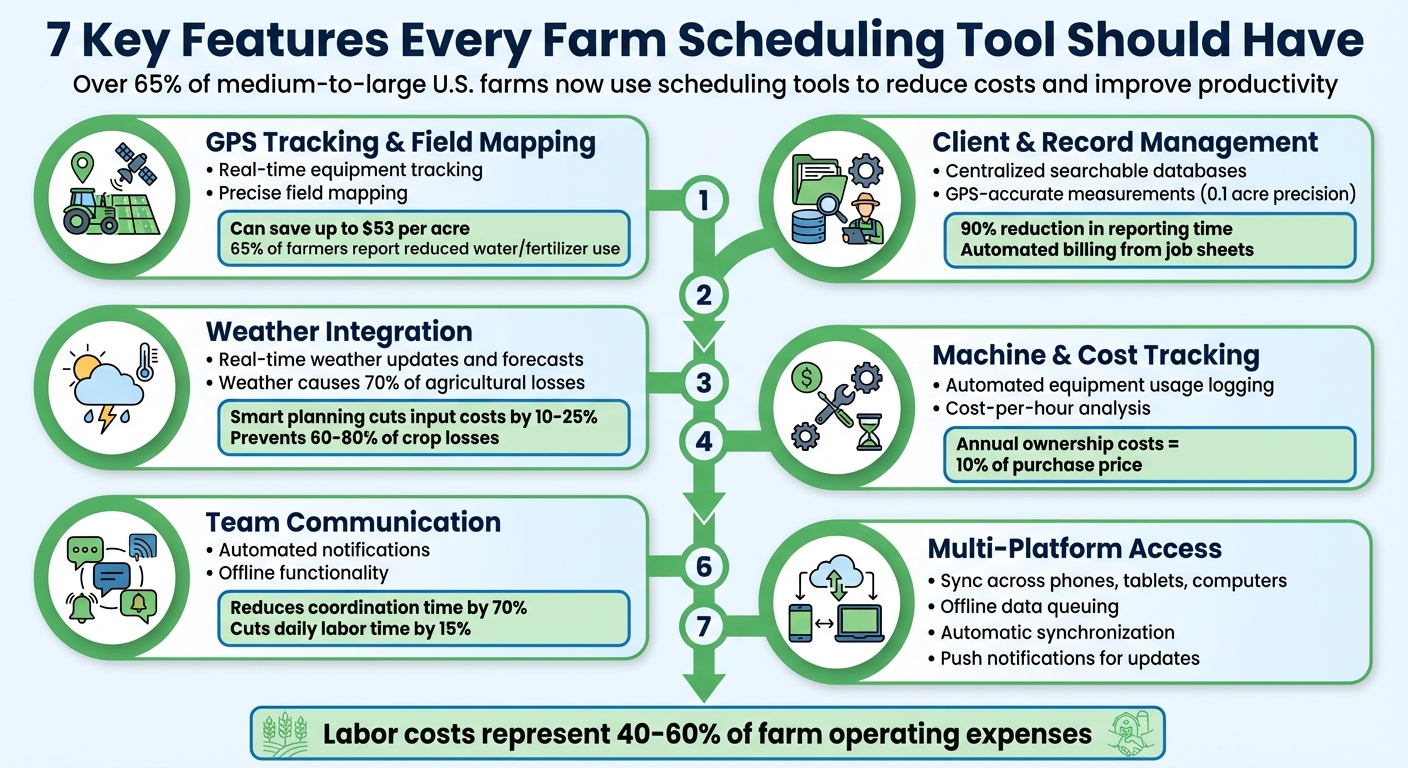
Here are the 7 key features every farm scheduling tool should have:
- GPS Tracking & Field Mapping: Real-time equipment tracking, precise field mapping, and obstacle marking improve efficiency and safety.
- Weather Integration: Real-time weather updates and forecasts help avoid losses and optimize irrigation, planting, and spraying schedules.
- Team Communication: Automated notifications and offline functionality keep teams aligned, even in remote areas.
- Customizable Scheduling: Tailored schedules for specific fields and tasks ensure flexibility and better resource allocation.
- Client & Record Management: Centralized, searchable databases simplify billing, compliance, and client communication.
- Machine & Cost Tracking: Automated tracking of equipment usage, fuel, and maintenance helps control costs and plan replacements.
- Multi-Platform Access: Sync data across devices for seamless updates, even in areas with poor connectivity.
These features replace outdated methods like paper job sheets and manual coordination, offering farms a more efficient way to manage operations. By identifying your farm's specific needs - whether it's reducing downtime, improving communication, or optimizing costs - you can choose the right tool to streamline your workflow.
7 Essential Features of Farm Scheduling Tools
Farm smarter, not harder: Simplifying farm management with data
Transform Your Agricultural Team
Streamline job management, field mapping, and machine tracking with HarvestYield. Simplify your operations and eliminate paper job sheets.
ContinueWhy Farm Scheduling Tools Matter
The difference between traditional farm management and modern scheduling tools lies in control. Modern tools allow you to anticipate and address issues before they escalate, unlike the constant firefighting that comes with manual coordination. Without these tools, you're stuck reacting - rushing to fix broken equipment, reassigning crews during unexpected rain, or driving out to fields to check if tasks are done. With the right digital tools, you move from reacting to proactively managing every aspect of your operations.
This proactive approach is already reshaping farming. Real-time monitoring offers live updates from the field, letting you make immediate adjustments to keep things running smoothly, even when equipment breaks down or weather conditions shift. Instead of discovering problems hours later, you can redirect crews, reallocate machinery, and avoid costly delays. These real-time insights enable smarter, faster decision-making.
Data-driven decision-making is another game-changer. By tracking detailed records - like equipment usage, task durations, and weather conditions - you can uncover trends that directly impact costs. For instance, you'll identify fields that consistently take longer to manage, machines that consume too much fuel, or crew assignments that could be more efficient. This kind of data helps you fine-tune operations and improve profitability.
Better team coordination is another key benefit. When everyone has access to the same information, your crew knows exactly where to go, what tools to bring, and what conditions to prepare for. Managers can monitor progress remotely, cutting down on miscommunication and wasted time while making the best use of labor and equipment.
The features that enable all this - GPS tracking, weather integration, communication tools, and cost monitoring - aren't just extras. They're essential components of efficient, modern farming. Below, we'll break down how each feature contributes to smoother, more productive operations.
1. GPS Tracking and Field Mapping
GPS tracking has completely transformed how fields are monitored by providing precise, real-time job coordinates. Instead of relying on guesswork or unnecessary trips, it reveals exactly where equipment is working, which fields have been completed, and how much progress has been made. This level of accuracy not only eliminates uncertainty but also boosts accountability across operations. When paired with field mapping, GPS tracking ensures a new level of operational precision.
Field mapping takes the guesswork out of measuring boundaries by replacing manual tools with digital accuracy. These maps record field dimensions, making it easier to calculate acreage, plan resources like seeds and fertilizer, and identify specific areas needing attention. Impressively, over 65% of farmers using precision mapping have reported noticeable reductions in water and fertilizer use, which translates directly into lower input costs. Tools like HarvestYield integrate these mapping capabilities to provide real-time insights, streamlining field operations.
Safety also gets a boost. With GPS, you can mark obstacles - like power lines, ditches, or trees - with pinpoint accuracy, helping to protect both operators and equipment. This is especially useful for training new team members or when using autopilot systems that depend on precise hazard mapping.
"By using GPS on the tractors, the entire process from leveling the field to planting the seed to irrigating the crop has been much more efficient than in the past." – John Boelts, Vice President, Yuma County Farm Bureau
Another standout feature of GPS is its reliability in low-visibility conditions, such as during rain, fog, dust storms, or at night. This allows for extended working hours, even in poor weather. Combined with automatic steering, GPS tracking can save up to $53 per acre. This blend of efficiency and cost savings makes GPS tracking a cornerstone of modern farm management, enabling farmers to plan proactively and maximize productivity.
2. Weather Data Integration
Adding weather data to farming tools takes decision-making to the next level. Weather impacts nearly every farming choice and accounts for over 70% of agricultural losses. By integrating real-time conditions and extended forecasts directly into scheduling tools, farmers no longer need to juggle multiple weather apps or sources. This streamlines planning, allowing adjustments to planting schedules, pesticide applications, or harvest timing before unfavorable conditions set in. The result? Fewer costly mistakes.
Smart weather planning can also cut input costs by 10–25% through more efficient use of resources like fertilizer and irrigation. For instance, if there’s a 40% or higher chance of rain in the next 24–48 hours, scheduling tools can skip irrigation, saving water and preventing nutrient runoff. Similarly, pesticide applications can be timed to avoid windy conditions (over 15 mph), reducing chemical waste and drift.
Advanced tools go beyond simple forecasts. They track variables like Growing Degree Days (GDD), Delta T, and high humidity (above 80%) to fine-tune decisions. These insights can predict crop maturity within 3–5 days, helping farmers plan harvests more accurately. Platforms like HarvestYield, which also helps farmers find agricultural contractors, even log weather data for every task, building a historical record that sharpens future planning.
"Smart farmers know that weather data isn't just about checking tomorrow's forecast - it's about making strategic decisions that can boost yields and protect profits." – FarmstandApp
Farmers using these tools have reported up to 20% higher yields, while predictive planning can prevent 60–80% of crop losses by issuing early warnings for frost, hail, or storms. Modern scheduling software also simplifies task management - entire teams can adjust schedules with just a few clicks, avoiding the hassle of manual coordination. This mix of precision and flexibility makes weather integration a game-changer for farm operations.
3. Team Communication and Collaboration Tools
Managing a farm team spread across multiple fields used to involve endless phone calls and paper trails. But digital communication tools have changed the game, making team coordination smoother and more efficient. With automated notifications and real-time updates, everyone stays on the same page. For example, when a manager assigns a task or adds a team member to a project, the system instantly sends out push notifications or emails. No more waiting around for a call to figure out what needs to be done - this streamlined approach saves time and eliminates confusion.
The results speak for themselves. Jack R., a farm owner, reported cutting daily labor time by 15% after adopting these tools. Automated messaging alone slashed coordination time by as much as 70%.
Smart notification systems take things a step further. Managers can set up priority-based alerts to focus on what matters most. For instance, if a tractor’s status changes to "Repair Needed", the system can notify the mechanic directly instead of alerting the entire team. This targeted method ensures urgent issues are addressed quickly, potentially reducing machinery downtime by up to 30%.
Even in remote areas with poor cell coverage, these tools remain effective. Platforms with offline synchronization queue messages and updates, syncing them automatically when connectivity is restored. Workers can log tasks, capture photos of crop issues, or report equipment problems regardless of signal strength. Tools like HarvestYield even record GPS locations and timestamps for every task, as part of going paperless on your farm.
Managers no longer need to drive between sites for updates. Instead, they can monitor real-time activity feeds from a central dashboard, tracking job progress as it happens. Workers receive digital work orders complete with GPS coordinates and turn-by-turn navigation to field gates, eliminating the guesswork of vague directions or paper maps. Features like photo verification also allow managers to require visual proof before marking tasks as complete, creating a reliable record for future use.
4. Customizable Job Scheduling
Farm operations are as diverse as the crops they grow and the regions they serve. Customizable scheduling tools transform farm management from reactive problem-solving to proactive planning. These tools adjust to the unique demands of each farm, avoiding rigid, one-size-fits-all templates.
A standout feature of advanced platforms is field-specific management. Instead of treating the entire farm as a single unit, these tools view each field as its own project. They track labor hours, inputs like seeds and fertilizer, and expenses tailored to each crop's needs. For instance, managing a 40-acre cornfield is vastly different from handling a 15-acre vegetable plot. When unexpected weather delays planting, the software automatically reschedules related tasks - such as cultivation, fertilization, and harvesting - without requiring manual updates.
"The Tasks [feature] is just excellent. You know this is what you have to do, that's how much time you're going to spend, who does what, and you just follow it from there." – Jacques Van Wyk from Orion's View Farm.
Recurring seasonal tasks also benefit from customizable templates. These templates can include priorities, equipment requirements, and labor estimates, saving time and effort across multiple seasons. For time-sensitive tasks like spraying before rainfall, templates ensure critical jobs are prioritized automatically. Platforms like HarvestYield go a step further, allowing managers to create job templates that factor in equipment availability, labor resources, GPS coordinates, and real-time weather updates.
These dynamic templates integrate smoothly with other scheduling features, cutting management time by up to 35%. They streamline machine coordination, precisely track labor, and enable bulk adjustments to schedules. By 2025, it's estimated that over 60% of large farms will adopt agriculture scheduling software to handle their daily operations.
5. Client and Record Management
Managing multiple client accounts in agriculture can get complicated fast. Each client comes with their own set of service histories, field details, and billing needs. Centralized record management simplifies this chaos, turning messy paper trails into organized, searchable digital databases.
These digital systems capture everything automatically - precise GPS measurements (down to 0.1 acre), timestamped job data, and even weather conditions. So, when a client asks about a past fertilizer application or billing details, managers can quickly pull up the full service history, no digging through filing cabinets required. This shift is a game-changer. For example, farms that switched from paper notebooks to digital in-field recording saw a 90% drop in reporting time for spray record compliance.
Billing also becomes much smoother. Traditional methods - like estimating acreage and manually calculating costs - often lead to disputes. But GPS-based systems eliminate the guesswork. Platforms like HarvestYield let contractors create invoices directly from job sheets, combining accurate field measurements with actual hours worked and materials used.
Here’s a quick look at how centralized digital records stack up against old-school methods:
| Operation | Traditional Methods | Centralized Digital Records |
|---|---|---|
| Field Measurement | Manual surveys; estimated acreage | GPS-based mapping; accurate to 0.1 acre |
| Job Records | Paper logs; manual entries | Automated logging with GPS paths & timestamps |
| Client Inquiries | Slow file searches; phone tag | Instant access to real-time data and history |
| Billing | Estimated acreage; disputes | Verified GPS data for precise invoicing |
This streamlined data doesn’t just help with billing - it also boosts scheduling and decision-making efficiency.
To make the most of these systems, maintaining clean and accurate client databases is key. Standardizing naming conventions across your team (e.g., using consistent field and client names) prevents data silos and confusion. It’s also critical to log data in real time while in the field. Waiting until the end of the day often leads to forgotten details, which can compromise accuracy.
6. Machine and Cost Tracking
Farm equipment is one of the largest financial commitments in agriculture, and keeping tabs on its usage is key to managing costs effectively. Modern systems now take over the tedious task of manual tracking by automatically recording engine hours, fuel usage, and maintenance schedules.
The real value comes from cost-per-hour analysis. By combining data on depreciation, fuel, and repairs, farmers can pinpoint the exact cost of running equipment per hour. This allows them to identify when a machine becomes too expensive to maintain and whether replacing it might save money in the long run. For instance, annual ownership costs for tractors typically equal about 10% of their purchase price. Repair costs can climb significantly over time - rising from around 14% of the machine’s list price at 600 hours to nearly 45% by 1,400 hours.
Digital tracking tools also reveal hidden costs that paper records often miss. For example, transport time between fields, idle hours, and non-productive "deadhead" driving can add up quickly. GPS-enabled systems can distinguish between active fieldwork and travel time, helping managers allocate these costs to specific jobs or clients. Even small details, like lubrication expenses - often about 15% of total fuel costs - can be tracked and managed more effectively with automated systems.
Maintenance scheduling becomes much more efficient with digital tools. These systems can store service records, photos, and maintenance histories in one place. Automated reminders ensure timely servicing, which helps avoid costly breakdowns and downtime.
Plug-and-play tracking devices simplify the process further by automatically logging every movement and engine hour. This approach not only saves time but also ensures greater accuracy compared to manual entries.
When machine data integrates with overall budgeting, the financial picture becomes clearer. Platforms like HarvestYield can link machine hours to specific tasks, making it easier to forecast expenses over the next decade or more. This insight helps managers plan capital investments and make informed decisions about repairs, replacements, and overall efficiency. By knowing exactly how equipment expenses break down, farmers can maximize their operational effectiveness.
7. Multi-Platform Access and Data Sync
Expanding on the benefits of real-time updates and team collaboration, multi-platform access ensures farm operations continue seamlessly, no matter where the work happens. Whether you're in the cab of a tractor, out in the field, or back at home, cross-platform compatibility keeps everyone connected. By syncing scheduling information across phones, tablets, and computers, it ensures all team members stay aligned, no matter the device they use. This smooth integration works hand-in-hand with the real-time updates and offline functionality discussed earlier.
One of the biggest challenges in agriculture is dealing with areas that lack reliable cellular coverage. Offline functionality solves this by queuing data in low-signal zones and automatically uploading it once connectivity is restored. As Planfix explains:
"The worker logs the data, and the app syncs it automatically once they drive back into range or return to the farm office Wi‑Fi".
This feature ensures no data is lost, even when workers spend hours in remote locations.
Automatic synchronization eliminates the need for paper job sheets by instantly transmitting data from the field to a centralized system. For example, schedule changes made by a farm manager on a computer are immediately visible on workers' mobile devices. This real-time visibility prevents confusion caused by outdated schedules or missed updates.
Push notifications further enhance coordination by alerting team members to schedule changes, urgent tasks, or weather updates as they happen. With offline capabilities ensuring uninterrupted data flow in remote areas, tools like HarvestYield provide multi-platform support across iOS, Android, and the web. This allows agricultural teams to access job sheets, field maps, and client records from any device, keeping operations efficient and eliminating the reliance on paper trails.
How to Choose the Right Farm Scheduling Tool
Choosing the best scheduling tool for your farm starts with identifying the specific challenges you face. Are you trying to cut down on fuel waste, resolve billing issues, or improve labor efficiency? Pinpointing these priorities helps you focus on tools that address your needs without paying for features you won’t use.
The type of farm you run plays a big role in your decision. For instance, livestock operations should look for systems with breeding and grazing management features. Row-crop farms, on the other hand, will benefit from tools tailored to field management. If you manage a mix of crops and livestock, you’ll want a platform that can handle both without forcing you to use separate systems.
Team size is another factor to consider. Larger farms often need tools with hierarchical communication features to avoid bottlenecks, while smaller teams benefit from simple, streamlined interfaces. According to a McKinsey survey from 2022, over 65% of medium-to-large U.S. farms and nearly 40% of small farms already use farm management software. For larger teams, features that create clear communication structures can make a big difference.
Don’t just look at the sticker price - evaluate the total cost of ownership. Subscription models can save small-to-medium operations 51–55% over five years, but watch out for hidden fees for extra seats, animal counts, or customer support. Transparent pricing models, like HarvestYield’s per-acre tiers - $49/month for up to 250 active acres, with no per-seat fees - make it easier to budget as your farm grows.
Finally, test the software to ensure it integrates smoothly with your existing systems. Many platforms offer 14- to 30-day free trials, which give you a chance to see if the interface works well for your team and if it connects seamlessly with payroll systems like QuickBooks, ADP, or Gusto. For example, HarvestYield provides a comprehensive job management platform with GPS tracking, weather data, field mapping, client management, and machine cost tracking. Available across iOS, Android, and web platforms, it eliminates the need for paper job sheets while keeping your operation efficient.
Conclusion
Farm scheduling tools have become a game-changer for modern agriculture. The seven features we’ve highlighted - GPS tracking, weather integration, team communication, customizable scheduling, client management, cost tracking, and multi-platform access - are designed to replace outdated paper systems and scattered communication. When combined in a single platform, these tools can make farm operations far more efficient than traditional methods.
The numbers speak for themselves. Over 65% of medium and large farms are already using farm management software. This shift isn’t just about keeping up with technology - it’s a necessity in a competitive industry where labor costs account for 40–60% of operating expenses and where timing is critical for success. By 2025, projections show that more than 60% of large farms will rely on scheduling tools to manage their daily operations.
Every farm has its own unique set of challenges, so choosing the right tool depends on your specific needs. A 500-acre row-crop farm might focus on different features than a diversified vegetable farm or an agricultural contracting business. The key is to identify where inefficiencies are costing you time or money. Are your workers losing hours waiting for instructions? Is equipment failing at the worst possible times? Are billing disputes cutting into your profits? The right scheduling platform can directly address these issues, helping you regain control and visibility over your operations.
While technology can’t replace the instincts and expertise that come with years of farming, it can give you the freedom to focus on what truly matters. Instead of being bogged down by paperwork and logistics, you can dedicate your time to improving crop quality, strengthening customer relationships, and making strategic decisions. Jacques Van Wyk from Orion’s View Farm captures this perfectly:
"The Tasks [feature] is just excellent. You know this is what you have to do, that's how much time you're going to spend, who does what, and you just follow it from there".
To see these benefits for yourself, take advantage of free trials (typically 14–30 days) to find a platform that fits your workflow. Look for tools that function offline for areas with unreliable connectivity, integrate seamlessly with payroll systems, and scale as your farm grows. HarvestYield is one such solution, offering GPS tracking, weather integration, field mapping, client management, and machine cost tracking across iOS, Android, and web platforms. It simplifies operations, eliminates paperwork, and keeps your team aligned - no matter where the day takes you.
FAQs
How do farm scheduling tools help improve farm operations and decision-making?
Farm scheduling tools bring a new level of efficiency to agricultural operations by combining real-time data with automation. These tools help streamline tasks and make decision-making more effective. For example, features like GPS tracking and weather data integration allow farmers to plan field activities with precision. This reduces overlaps, saves time, and helps cut down on resource waste. Plus, they make it easier to adjust schedules quickly when unexpected challenges, like sudden weather changes or equipment breakdowns, arise - keeping operations on track.
Another big advantage is how these tools improve team communication. They provide clear visibility into ongoing tasks and progress, which helps managers keep track of equipment and staff, even across large areas. This makes it easier to reroute resources or address problems as they come up. The added transparency ensures everyone stays aligned with the farm’s goals, reduces downtime, and increases productivity. By embracing these technologies, farms can work smarter, not harder, and achieve better results with less hassle.
How does using weather data in farm management help save costs?
Integrating weather data into farm management can significantly cut costs by fine-tuning essential activities like irrigation, fertilization, and pest control. With accurate weather forecasts, farmers can schedule these tasks more effectively, reducing waste and trimming input costs by an estimated 10–25%.
On top of that, weather data enables farmers to prepare for adverse conditions, such as storms or frost, helping to prevent crop damage and safeguard profits. This approach not only boosts efficiency but also supports smarter, more informed decisions for running a farm.
Why is GPS tracking important for modern farming?
GPS tracking has become a game-changer in modern farming, helping farmers work smarter and manage resources more effectively. By guiding machinery like tractors and harvesters with pinpoint accuracy, it minimizes overlap during planting, fertilizing, and harvesting. This means fewer wasted seeds and fertilizers, lower input costs, and better use of resources.
It doesn’t stop there. GPS tracking also enables farmers to monitor equipment in real time, improving coordination among teams and cutting down on downtime. Plus, it helps create precise field maps, which are essential for record-keeping, billing, and making informed decisions. With GPS technology in the mix, farms can run more efficiently and boost profitability.