Weather Data vs. Traditional Scheduling Methods
Farmers are moving away from fixed schedules and embracing real-time weather data to boost efficiency and reduce losses. Here's why:
- Weather unpredictability has made historical planting calendars less reliable, with extreme conditions increasing by 66%.
- Weather-responsive scheduling uses hyper-local data from IoT sensors, satellites, and AI to adjust farm operations in real time.
- Farmers using these systems report up to 20% higher yields, 10–25% lower input costs, and prevent 60–80% of crop losses.
- Traditional methods, based on fixed routines and regional forecasts, are less precise, with only 62% accuracy compared to 87% from AI-driven systems.
Quick Comparison
| Metric | Fixed Schedules | Weather-Driven Systems |
|---|---|---|
| Weather Accuracy | 62% | 87% |
| Yield Impact | Baseline | Up to 20% higher |
| Input Cost Savings | Baseline | 10–25% reduction |
| Downtime Reduction | Reactive; high delays | 47% less downtime |
Switching to real-time weather tools requires investment but pays off quickly by improving decision-making, conserving resources, and reducing risks.
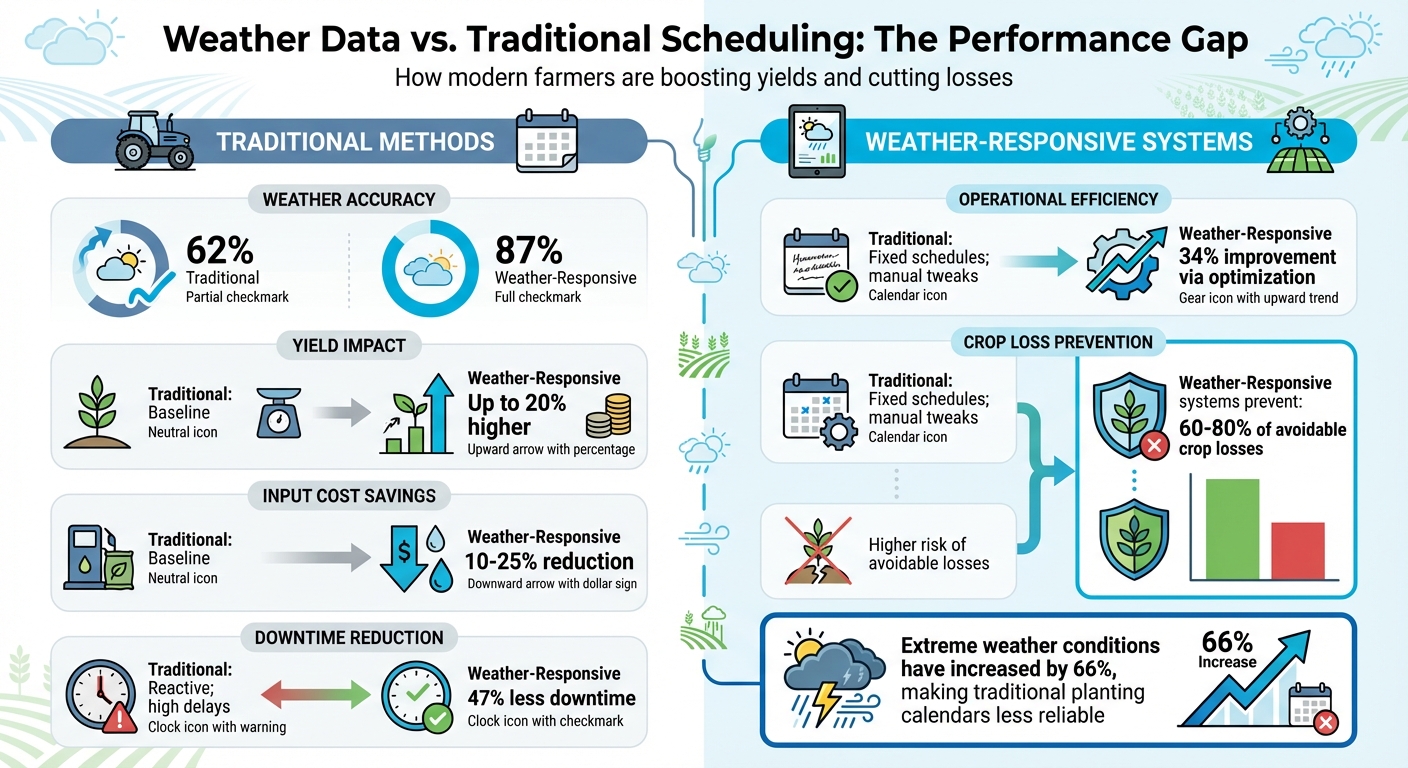
Weather-Responsive vs Traditional Farm Scheduling: Performance Comparison
Weather-Responsive Scheduling: Features, Benefits, and Challenges
Key Features of Weather-Responsive Scheduling
Weather-responsive scheduling systems bring a level of precision that goes beyond traditional weather forecasts. Instead of relying on broad regional data, these tools use GPS coordinates to focus on field-level conditions, monitoring factors like soil moisture, wind speeds, and evapotranspiration rates specific to your farm. On-farm sensors and IoT devices continuously stream real-time data to cloud-based dashboards, providing a detailed and up-to-the-minute view of your fields.
Predictive analytics play a major role, using Growing Degree Days (GDD) to forecast important milestones like crop maturity and pest activity. This shifts your decision-making from reactive to proactive. Additionally, automated alerts notify you of extreme weather events - frost, hail, or intense heat - giving you the chance to act before damage occurs.
These advanced features enable more precise and timely agricultural planning. You can see these tools in action to understand how they integrate with daily operations.
Benefits of Weather-Integrated Scheduling
Integrating weather data into your scheduling process can significantly improve efficiency and reduce losses. AI-driven systems have been shown to cut weather-related downtime by 47% and increase overall operational efficiency by 34%. This improvement directly impacts your bottom line, as better timing for irrigation and fertilizer applications can lower input costs by 10% to 25%.
Another major advantage is proactive risk management. Early warning systems can prevent 60% to 80% of avoidable crop losses by alerting you to threats well before they cause damage. These systems also use hyper-local data to establish thresholds tailored to your specific conditions - for example, setting a planting threshold based on a local nighttime low of 50°F rather than relying on generalized calendar dates.
While the benefits are clear, adopting this technology does come with its own set of challenges.
Challenges and Considerations
Weather-responsive scheduling requires reliable internet access and properly maintained equipment. Basic on-farm weather stations cost between $150 and $600, while commercial forecasting services range from $200 to $800 annually. For smaller farms, these costs might feel steep, but the potential for yield increases of up to 20% and reduced input costs often offsets the investment within a single season.
Setting up and maintaining these systems is another critical factor. Sensors need to be placed in open areas, away from obstructions like buildings or trees, to ensure accurate readings. While these systems provide detailed insights, there is a learning curve. Understanding metrics like evapotranspiration rates and GDD is essential to fully utilize the tools. That said, once the setup is complete, the automated features significantly reduce the workload compared to traditional, manual planning methods.
Transform Your Agricultural Team
Streamline job management, field mapping, and machine tracking with HarvestYield. Simplify your operations and eliminate paper job sheets.
ContinueTraditional Scheduling Methods: Features, Strengths, and Limitations
Core Features of Traditional Scheduling
Traditional scheduling relies on manual coordination through calendars, paper job sheets, and spreadsheets, often supported by phone calls to communicate tasks. Schedules are typically based on intuition, historical patterns, and generalized regional weather forecasts, rather than precise, field-specific data. These plans are often set weeks in advance, reflecting the experience and judgment of farm managers.
This system requires a significant time investment - around 7–12 hours each week - to handle tasks like checking weather forecasts, sharing verbal field descriptions, and jotting down notes to track progress. Weather updates are gathered manually, and they usually cover broad areas, such as entire counties, rather than the specific conditions of individual fields. While straightforward, this approach comes with both benefits and challenges.
Strengths of Traditional Scheduling
One of the main advantages of traditional methods is their simplicity and affordability. There’s no need for costly software, internet access, or specialized training. With just basic office tools and a phone, farm managers can create and manage schedules. For smaller farms operating on tight budgets, this approach avoids the upfront costs associated with digital systems.
These methods are also practical in areas with poor or unreliable internet connectivity. Additionally, many agricultural workers are already familiar with these tools, making them easy to use without requiring extra training.
Limitations and Drawbacks
Despite its simplicity, traditional scheduling struggles to meet the demands of modern farming. Its lack of flexibility makes it difficult to adjust to unpredictable conditions, such as sudden weather changes. Fixed schedules often leave farms exposed to setbacks, as traditional forecasting methods achieve only 62% accuracy in predicting how weather will impact specific job sites, compared to 87% accuracy from AI-driven systems. This gap can result in financial losses.
For example, traditional methods can lead to 20% lower yields and increase input costs by 10–25%. Hobby farmers, in particular, may lose between $500 and $2,000 annually due to preventable weather-related damage when relying on these older approaches.
Another major drawback is the reliance on broad, regional weather forecasts, which often fail to provide the precision needed for critical tasks like spraying or harvesting. Without real-time, field-specific data, decisions are often based on assumptions rather than accurate conditions. These limitations underscore why many farms are turning to advanced systems that integrate automation and detailed weather data - an approach that will be explored in the next section.
Weather-Responsive vs. Traditional Scheduling: A Direct Comparison
Efficiency: Adapting to Changing Conditions
The main difference lies in how each system handles unexpected changes. Traditional scheduling relies on fixed plans set weeks in advance, leaving you scrambling when bad weather throws a wrench in the works. In contrast, weather-responsive systems adjust schedules automatically, identifying the best "weather windows" for critical tasks.
With AI-driven scheduling, weather-related downtime drops by 47%, and overall operational efficiency improves by 34% compared to older methods. For example, a fence contractor was able to cut annual weather-related cancellations from 17 days to just 4 days. These tools also make smarter use of resources, assigning indoor or covered tasks during bad weather while scheduling outdoor activities like spraying or irrigation when hyper-local conditions are ideal. This smarter approach increases productive crew hours by 23% through better task management.
This kind of efficiency goes hand-in-hand with the improved precision offered by hyper-local data.
Accuracy: Hyper-Local Data vs. General Forecasts
When it comes to decisions like spraying, harvesting, or irrigating, precision is critical. Traditional methods depend on regional forecasts that cover large areas, achieving just 62% accuracy for specific job sites. Weather-responsive systems, however, use hyper-local data - drawing from satellite imagery, ground sensors, and AI - to achieve 87% accuracy. Regional forecasts often overlook microclimates, such as south-facing slopes that warm up 2–3 weeks earlier than areas facing north.
These advanced systems monitor real-time conditions at the field level, like tracking soil temperature at a 2-inch depth, instead of relying on generic "last frost" dates that can be off by weeks. Farmers using this real-time weather data report up to 20% higher crop yields, cut input costs by 10–25%, and prevent 60–80% of crop losses by receiving early warnings for frost, hail, and storms.
Aside from accuracy, ease of use is another major area where these methods differ.
Ease of Use: Automation vs. Manual Processes
Traditional scheduling is labor-intensive, requiring constant manual input. You’re stuck checking forecasts, making phone calls, and updating paper job sheets. It’s a time-consuming process that involves gathering weather updates, jotting down notes, and verbally sharing field conditions with the team.
Weather-responsive systems streamline this entire process. They send automated alerts when conditions hit critical thresholds - like frost warnings below 35°F or wind speeds above 35 mph - and suggest schedule changes automatically. By resequencing tasks in real time, these systems reduce administrative workload, giving you more time to focus on strategic decisions backed by data.
Comparison Table
| Metric | Traditional Scheduling | Weather-Responsive Scheduling |
|---|---|---|
| Weather Accuracy | 62% (regional forecasts) | 87% (hyper-local, AI-driven) |
| Downtime Reduction | Reactive; high delays | 47% less downtime |
| Operational Efficiency | Fixed schedules; manual tweaks | 34% improvement via optimization |
| Productive Hours | Standard crew use | 23% increase with better planning |
| Data Granularity | County-level, 30-year averages | Field-specific, real-time sensors |
| Response Time | Manual updates | Automated alerts and adjustments |
| Yield Impact | Baseline | Up to 20% better yields |
| Input Cost Savings | Baseline | 10–25% reduction |
These differences highlight how weather-responsive systems improve decision-making and operational outcomes for modern farming operations.
AI in agriculture 008: Weather Forecasting with Data-Driven Models for Better Irrigation & Yield
Weather-Responsive Scheduling in Practice
Real-world examples of weather-responsive scheduling reveal how this approach improves efficiency and resource management.
Optimizing Irrigation and Resource Allocation
Traditional irrigation schedules often waste water by ignoring actual field conditions. Weather-responsive systems, on the other hand, rely on real-time data from tools like temperature sensors, solar radiation monitors, and precipitation gauges to deliver water only when crops need it.
Switching to weather-responsive irrigation can save significant amounts of water. For instance, using these systems can conserve nearly 7,600 gallons of water annually. In dry climates, soil moisture sensors have cut water use by 44% for tall fescue and 39% for bermudagrass compared to fixed schedules. In wetter areas like Florida, these sensors have achieved water savings of 16% to 83% during dry spells and up to 88% during rainy periods.
Research from New Mexico State University's Turfgrass Research Center (2012–2014) showed similar success. Soil moisture sensors reduced water application by 44% for tall fescue and 39% for bermudagrass, while evapotranspiration-based controllers achieved savings of 38% and 42%, respectively - all without sacrificing turf quality. This shift from rigid schedules to dynamic, data-driven management is changing the way farms operate. As John Krull of Farm-Tech Inc. put it:
"Now they actually watch the app and only water when it's calling for it".
Additionally, these systems help prevent nitrogen leaching into groundwater by maintaining soil at optimal moisture levels. Considering that U.S. agriculture accounts for over 40% of freshwater withdrawals - around 446 billion liters daily - adopting practices like Maximum Allowable Depletion (MAD), which triggers irrigation only when soil moisture drops to 50%, ensures smarter water use.
This precise approach not only conserves resources but also prepares farms to handle extreme weather more effectively.
Preventing Crop Loss from Weather Events
Weather-responsive scheduling goes beyond saving water - it also protects crops from unpredictable weather. Instead of relying on outdated "last frost" dates, these systems send alerts when air temperatures drop below 35°F, allowing timely protective actions for crops like tomatoes and peppers, which need soil temperatures above 60°F.
These early warnings can significantly reduce crop losses - by as much as 80%. During heatwaves or droughts, real-time evapotranspiration data adjusts irrigation schedules to replace only what’s lost, cutting water use by 15–30% and preventing heat stress. Smart irrigation controllers also lower input costs by 10–25% through better-timed applications of water and fertilizers.
Heavy rainfall presents another challenge. Weather-responsive systems help avoid costly "false starts", where early rain prompts planting only for a dry spell to follow, killing seedlings and forcing replanting. These systems also time fertilizer applications to avoid runoff during storms. For fragile crops like tomatoes or leafy greens, they can accelerate harvests when severe weather is forecast within 48–72 hours, protecting investments.
Moreover, these systems aid in pest and disease management. By monitoring Growing Degree Days (GDD) and humidity levels, farmers can apply treatments like fungicides before conditions become ideal for infections. This approach reduces pesticide use by 30–40% while maintaining effective crop protection. Farms using these tools have reported up to 20% higher yields compared to those relying on traditional methods.
How HarvestYield Supports Weather-Integrated Scheduling
HarvestYield takes weather-responsive scheduling a step further by integrating forecasts and real-time conditions into task management for planting, spraying, and harvesting. As conditions change, the platform updates schedules and sends revised digital job sheets to teams, ensuring activities align with the best weather windows.
The platform’s GPS-based tracking and field mapping provide localized weather data tailored to individual fields, rather than relying on broad regional forecasts. Digital job sheets automatically log weather conditions and timestamps at the time of work, creating a reliable record for insurance claims or disputes.
HarvestYield also issues alerts for risks like frost, drought, or severe storms, helping farmers take proactive steps. For irrigation, it supports the FAO56 model, which uses localized weather data to calculate daily crop water needs. This minimizes overwatering and nutrient runoff, aligning with modern, data-driven farming practices.
The platform offers a free plan for solo farmers working up to 50 active acres, including field mapping, machine logging, and invoicing with weather data integration. Paid plans, priced by active acreage, add advanced scheduling, automatic job sheet distribution, and employee work history tracking, with customer support included. These tools highlight the growing reliance on technology for smarter farm management.
Choosing the Right Scheduling Method for Your Farm
Key Takeaways from the Comparison
When you examine the data, it’s clear that weather-responsive scheduling leaves traditional methods in the dust when it comes to efficiency, accuracy, and cost savings. Farmers using real-time and predictive weather insights achieve 87% accuracy, compared to 62% with traditional forecasting. This leads to up to 20% higher yields, 10% to 25% lower input costs, and prevents 60% to 80% of crop losses caused by weather events. On top of that, these systems reduce weather-related downtime by 47% and improve operational efficiency by 34%. For hobby farmers, these savings translate into an annual reduction in costs ranging from $500 to $2,000.
While traditional methods may still work for routine tasks with flexible timing, they struggle when rapid weather changes demand quick action. This can lead to wasted resources and missed opportunities to optimize for weather conditions.
Next Steps for Farm Managers
If you’re ready to make the shift to weather-responsive scheduling, here’s how to get started.
Set up weather trigger points for your key operations. For example, aim for soil temperatures of 60°F for planting tomatoes or 50°F for lettuce. Use automated alerts for critical weather events like frost (below 35°F) or high winds (above 15 mph). To avoid relying on calendar dates, use soil thermometers to monitor actual ground temperatures.
Investing in weather infrastructure is another smart move. On-farm weather stations, which cost between $150 and $600, and commercial forecasting services, priced at $200 to $800 annually, can quickly pay for themselves through better timing and reduced waste.
For those looking for a tech-driven solution, HarvestYield’s free plan is a great starting point for solo farmers working up to 50 active acres. It includes tools like field mapping, machine logging, and weather data integration - all free of charge. Their paid plans, priced by active acreage, add features like advanced scheduling, automatic job sheet distribution, and employee tracking, with customer support included. The platform’s GPS-based tracking provides hyper-local weather data tailored to each field, rather than relying on broad regional averages. Plus, digital job sheets track weather conditions and timestamps, making it easier to schedule tasks at the right time and even support insurance claims when needed.
FAQs
Do I need on-farm sensors to use weather-driven scheduling?
No, you don’t need on-farm sensors for weather-driven scheduling. Many modern tools use real-time weather data, satellite imagery, and predictive models to help with decision-making. These technologies offer reliable and efficient scheduling insights without requiring physical sensors on your farm, making them a practical option for a wide range of agricultural operations.
How do I choose weather trigger points for planting and spraying?
To choose weather trigger points effectively, keep an eye on real-time, field-specific weather data like temperature, humidity, wind speed, and precipitation. When it comes to planting, prioritize soil temperature and moisture levels - these are key factors for ensuring seeds germinate properly. For spraying, pay attention to wind speed and humidity, as these conditions can directly impact how well your application works. Adjusting schedules based on local weather conditions can help boost crop health while minimizing potential risks.
How fast can a weather-driven system pay for itself on a small farm?
Weather-driven systems can quickly offset their costs, sometimes within just a few days or weeks, by enhancing resource management and minimizing waste. For instance, aligning irrigation schedules with precise weather data not only reduces expenses but also improves crop yields. These tools can cut input costs - like water and chemicals - by as much as 25%, offering small farms a chance to see financial gains even amid rising costs and unpredictable weather patterns.