Benefits of Real-Time GPS for Farm Teams
If I can see every machine and crew in real time, I can cut delays, lower fuel waste, react faster to breakdowns, and keep cleaner field records.
That’s the big takeaway. On U.S. farms, live GPS provides GPS tracking for farm equipment to help me know where equipment is, what it’s doing, and who to send next. It can also help trim fuel use by 6.3% in one study, cut travel distance by 23.27% in another, and reduce time, fuel, and labor by about 7.14%.
Here’s the short version:
- I find equipment faster across spread-out fields
- I reduce extra miles and idle time
- I spot odd machine movement after hours
- I keep crews aligned during planting, spraying, and harvest
- I build cleaner job records by field, machine, and date
And that matters when one wrong turn, one breakdown, or one weather shift can cost hours.
| Area | What live GPS helps me do |
|---|---|
| Equipment visibility | See machine location and status on one map |
| Cost control | Cut deadhead miles, idle time, and fuel use |
| Asset security | Get alerts when equipment moves outside set areas or hours |
| Team coordination | Send the nearest truck, cart, or crew without delay |
| Record keeping | Track job times, field activity, and machine history |
So if I want faster decisions and less waste, real-time GPS is one of the clearest tools I can add to day-to-day farm work.
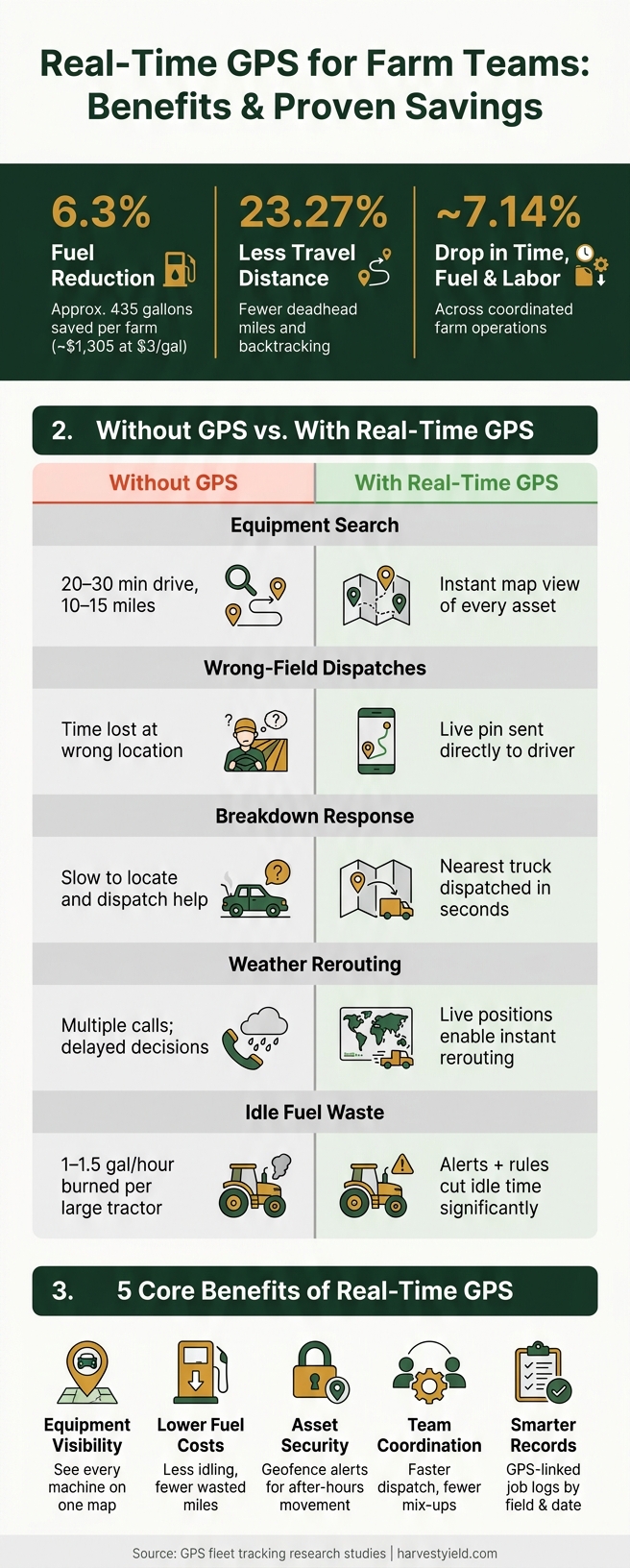
Real-Time GPS for Farms: Key Benefits & Proven Cost Savings
Why Real-Time GPS Matters on U.S. Farms
On U.S. farms, live location data isn't just a nice extra. It's a day-to-day tool that helps managers make fast calls when time, weather, and field access are all working against them.
Large Acreage Makes Equipment Hard to Find
When tractors, sprayers, and combines are spread across several field roads and entrances, a quick phone call usually isn't enough. Someone may know the last place a machine was seen, but that's not the same as knowing where it is right now.
Without live location data, a manager can spend 20–30 minutes driving 10–15 miles just to check whether a sprayer finished a 160-acre field or already moved to the next one. On a long day, that kind of search eats into the little time a crew has left to get work done.
Crew Delays Add Up During Tight Work Windows
Planting and spraying don't leave much room for mistakes. If one machine is late, the whole schedule can start to slide.
Spraying windows are especially short. Even a small delay can mean a field has to wait. Herbicide labels often require application during specific crop growth stages, with low wind speeds and cooler temperatures. So if a sprayer gets sent to the wrong field entrance and shows up 45 minutes late, that one mistake can push the job past those conditions. At that point, the crew may need to reschedule or spray under less-than-ideal conditions.
And when those delays keep piling up, the costs show up fast: more fuel burned, more idle time, and fewer acres covered.
Extra Miles and Idling Drive Up Costs
Poor coordination doesn't just waste time. It also adds fuel use and engine hours.
Research on GPS guidance adoption found that farms using GPS-based systems reduced fuel consumption by about 6.3%, which worked out to roughly 435 gallons saved per farm. At $3.00 per gallon, that's about $1,305 in fuel savings.
That kind of savings can matter a lot when weather shifts midday or a machine issue forces the plan to change on the fly.
Weather and Breakdowns Demand Fast Decisions
When a storm line shows up on radar or a machine breaks down in a remote field, there isn't much time to debate the next move. Managers need to know where equipment is, who is closest, and how fast they can respond.
Live GPS helps with that. A manager can send the nearest truck, redirect a crew, or move equipment before rain shuts down the field.
| Challenge | Without GPS | With Real-Time GPS |
|---|---|---|
| Search time | Long drive to locate equipment | Instant map view of every asset |
| Wrong-field dispatches | Time lost at wrong location | Live pin sent to driver |
| Breakdown response | Slow to locate and dispatch | Nearest truck dispatched quickly |
| Weather-based rerouting | Multiple calls; delayed decisions | Live positions enable instant rerouting |
| Fuel waste | High from idling and backtracking | Lower fuel use and idle time |
Transform Your Agricultural Team
Streamline job management, field mapping, and machine tracking with HarvestYield. Simplify your operations and eliminate paper job sheets.
Continue1. Improved Equipment Visibility
A live map gives managers immediate control over every machine in the field. If a farm is running several machines across multiple fields, a live GPS map puts every tractor, sprayer, truck, and harvester on one screen and updates it often. That means managers can spot equipment right away.
The main win is simple: you can see both location and status at a glance. Modern GPS tracking also shows speed, engine status, and whether a machine is working, idling, or stopped. That difference matters. A sprayer sitting idle at the edge of a field is in a very different situation than one actively applying product. When a manager can see that right away, it's much easier to decide what to move and where to send it. It also cuts the time needed to confirm status and dispatch the nearest unit.
Dispatching gets much faster too. Instead of guessing which grain cart is closest to a combine that's nearly full, a manager can check the map, find the nearest unit, and send it. That kind of call used to take several phone calls and plenty of guesswork. With live visibility, it takes seconds.
2. Lower Fuel and Operating Costs
That same visibility cuts the miles and minutes that burn fuel for no good reason. Live GPS helps trim deadhead miles, idle time, and extra trips. When managers can see where each machine is and whether it’s working in real time, they can tighten schedules and track their teams and stop engines from running when they shouldn’t.
One study found that GPS tracking cut travel distance by 23.27% and reduced time, fuel consumption, and labor hours by about 7.14% each.
Idle time is a quiet budget killer. When machines wait on each other, fuel gets burned without producing acres. Large tractors can use 1 to 1.5 gallons of diesel per idle hour. GPS logs bring that waste into plain view, which makes it easier to set simple rules, like shutting down after 10 minutes of waiting, and spacing truck arrivals so lines don’t build up.
The result is pretty straightforward: less driving, less waiting, and less fuel burned. It also frees up labor and helps teams get more out of the equipment they already own. In many cases, that can push back new equipment purchases and ease some of the pressure that hits during peak season.
3. Stronger Asset Security and Theft Prevention
Saving time and fuel matters. But real-time GPS also helps protect the equipment that keeps a farm moving. And that matters just as much.
Farm equipment is expensive. Lose one machine, and planting or harvest can grind to a stop.
Live Location and Status Visibility
Real-time GPS can flag equipment that leaves its assigned area or starts moving after hours. On a large farm, that kind of visibility can make all the difference. If a manager sees a combine leaving the yard at 2:00 a.m., they can step in right away.
That same visibility does more than show where equipment is. It also works as a simple but powerful security check when a machine moves outside approved hours.
Security and Response Capability
Geofencing turns GPS into an alert system. Managers can set virtual boundaries around barns, yards, fuel storage, and fields. The moment a machine crosses one of those lines outside approved hours, an alert goes out by text, email, or app push notification - as soon as the boundary is crossed.
That head start matters. With live coordinates and route history, farm owners can call law enforcement right away and share where the machine is heading, how fast it’s moving, and its direction of travel. Some systems switch to higher-frequency tracking after a theft alert, which gives law enforcement a clearer route history.
Location logs can also help with insurance claims. If a loader appears in an area that has nothing to do with a scheduled job, or equipment moves on a Sunday when no work is planned, managers have a time-stamped record they can review.
For farm teams, live GPS turns every machine into a tracked asset instead of an easy target.
4. Better Team Coordination, Accountability, and Safety
Real-time GPS helps crews stay on the same page and lets managers react fast when plans shift. It does more than show where equipment is. It helps the whole team work in sync.
Live Location and Status Visibility
During planting or harvest, a manager might see that one combine is wrapping up a 120-acre field while another is still only halfway done. From there, they can reroute a grain cart to cut down on waiting time, all without making a single phone call. That matters in the middle of a busy day, when every delay adds up.
Live location and machine status cut out a lot of those repeated check-in calls. When a sprayer enters a field, the system logs the arrival on its own. When it leaves, that departure is logged too. Managers can check job start and finish times on a dashboard without stopping operators who are out in a remote field.
If an operator stops responding and a machine is sitting idle late at night, a manager can pull up the exact coordinates and send help right away. In a remote field, those coordinates aren't just helpful. They save time when time matters most.
Job Records and Field-Level Decision Support
GPS job records show both when work happened and where it happened. If a client questions whether a 60-acre field got a second spray pass, a manager can pull up the GPS track and show the exact field boundary, the time the sprayer crossed into it, and how long it worked there. That makes it much easier to settle disputes fast.
HarvestYield links each job to a mapped field and client record, so passes are organized by field, date, and operation. Those same records also support the planning and reporting covered next.
5. Smarter Planning and Record Keeping
Live tracking helps during the workday. The stored data helps shape the next day’s plan. Over time, it shows how your farm runs in practice - which fields slow work down, which machines sit idle, and where equipment keeps showing up late.
Scheduling, Sequencing, and Machine Allocation
When a manager can see live machine locations next to the job schedule, dispatching gets much simpler. There’s no need to call around just to figure out who’s free. You can send the closest suitable tractor or sprayer to the next job as soon as a field is done.
GPS history also makes recurring slowdowns easier to spot. If records keep showing that one field takes longer to harvest than other fields of a similar size, that points to a bottleneck, such as poor access or not enough support equipment. That data helps managers assign the closest machine, spot bottlenecks, and fix weak field layouts before next season.
Those patterns also make next season’s machine allocation faster and more accurate.
Job Records and Field-Level Decision Support
The same data gives managers cleaner records by field, machine, and job. A GPS-linked job record captures the field, machine, time, weather, and output - the kind of detail that’s hard to match with paper job sheets and almost impossible to piece together later.
HarvestYield logs job times, GPS coverage, weather, field maps, client records, and machine costs in one place. That helps you go paperless on your farm and makes field-level reporting faster.
Benefit Summary at a Glance
Put these five gains together, and the result is pretty simple: faster decisions and less waste.
Real-time GPS helps turn location data into day-to-day results like faster dispatch, lower waste, tighter security, and cleaner records.
It also helps cut wear, reduce extra miles, and shrink crew downtime.
Here’s how each benefit connects to a clear management outcome:
| Benefit | Main Outcome |
|---|---|
| Improved Equipment Visibility | Less time locating machines; faster dispatch |
| Lower Fuel and Operating Costs | Fewer unnecessary miles; lower fuel bills |
| Stronger Asset Security | Faster detection of unauthorized movement |
| Better Team Coordination and Safety | Quicker breakdown response; fewer coordination errors |
| Smarter Planning and Record Keeping | Cleaner records by field, machine, and date |
Conclusion
Real-time GPS has become a core part of field work management. It helps farm teams move faster, stay organized, and spend less time chasing down updates or sorting out where equipment should be.
That kind of visibility can also hit the budget in a good way. Farms using GPS-based fleet tracking have reported 15–25% lower fuel costs and up to 20% lower maintenance costs by cutting idle time and spotting issues sooner.
For teams that want all of that data in one place, a job management platform can tie the workflow together. Real-time GPS paired with a digital job management tool like HarvestYield - which combines GPS job tracking with field maps, weather data, and machine cost tracking - can give teams a clearer view of daily work without forcing a major process change.
The simplest way to see the effect is to start small. Pilot GPS on two or three of your most-used machines during your next busy season. Then watch the day-to-day details: how often you need location updates, how many mix-ups go away, and how much cleaner your job records get. In many cases, equipping a few core machines costs less than losing even one day of productivity during planting or harvest.
If delays, equipment mix-ups, or paper-based records are part of the routine, real-time GPS offers a direct path to better efficiency and control.
FAQs
How does real-time GPS reduce farm fuel costs?
Real-time GPS helps cut fuel costs because it trims the extra driving that adds up fast. Managers can see where crews and equipment are during active jobs, send the right machine right away, and skip the usual back-and-forth of driving out to check on work or moving equipment to the wrong field.
It also helps plan better routes and cut downtime and idle time. That means fewer wasted miles, less extra driving, and less fuel burned for no good reason.
What farm equipment should I track first?
Start with the equipment linked to your biggest pain points, like coordination issues or high operating costs. One smart first move is to track key seasonal jobs, such as planting or spraying, across your main fields with the smartphones your team already has in their pockets.
It also makes sense to focus on your highest-value assets first, like combines worth $100,000 or more, so you can help keep them secure and running. HarvestYield helps with this through job scheduling, field mapping, and automatic GPS logging.
Can GPS tracking improve farm security?
Yes. GPS tracking improves farm security by showing real-time locations and sending geofencing alerts if equipment moves when it shouldn't.
It also helps with insurance claims, gives law enforcement a better shot at recovering stolen assets, and lets managers find workers fast during an emergency. That kind of visibility, along with automatic records, helps protect daily operations and equipment from unauthorized activity.