Top APIs for Farm Data Compatibility
Farming generates massive amounts of data, but much of it remains underutilized due to siloed systems. APIs (Application Programming Interfaces) solve this by enabling seamless data exchange between equipment, sensors, and software, helping farmers make better decisions and improve productivity. Here’s a quick look at some of the leading APIs transforming farm data management:
- John Deere Operations Center API: Facilitates two-way data transfer for mixed fleets, supporting real-time monitoring and compatibility across various equipment.
- FarmTRX API: Connects older equipment to modern systems, offering yield mapping and moisture data even for aging machinery.
- CropX API: Links soil and weather data with irrigation platforms, optimizing water use and improving farm management.
- Telstra DataHub API: Provides secure data sharing with full farmer control using token-based security and standardized schemas.
- GoFormz Open API: Automates field data entry, integrating mobile forms into centralized platforms for better analysis.
- Field Operations API by John Deere: Offers detailed agronomic data across tillage, seeding, application, and harvest, with U.S.-specific measurement support.
These APIs help break down data silos, enabling farmers to integrate and analyze data from various sources for smarter, more efficient farming. For those ready to begin, learning how to track your work is the first step toward integration.
Quick Comparison:
| API Provider | Key Features | Equipment Compatibility | U.S. Units Supported |
|---|---|---|---|
| John Deere Operations Center API | Mixed fleet support, real-time monitoring | John Deere, mixed fleets | Yes |
| FarmTRX API | Works with older equipment, yield mapping | Any combine with grain elevator | Yes |
| CropX API | Soil/weather data integration with irrigation | Reinke irrigation systems | Yes |
| Telstra DataHub API | Secure data sharing, OAuth-based control | Brand agnostic | Yes |
| GoFormz Open API | Automates field data entry | Hardware independent | Yes |
| Field Operations API | Agronomic data with spatial analysis | John Deere | Yes |
APIs like these empower farmers to connect their tools, streamline operations, and make data-driven decisions.
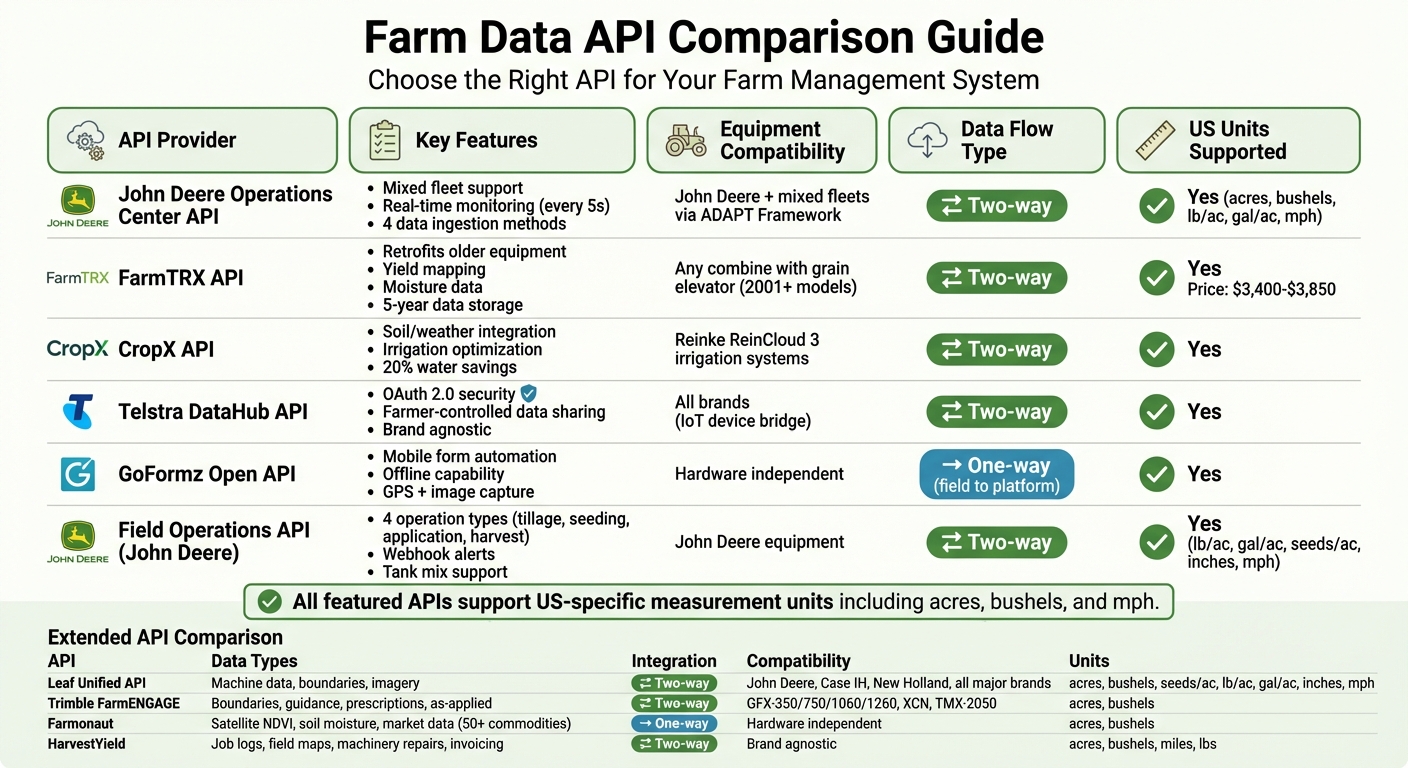
Farm Data API Comparison: Features, Compatibility, and Data Types
TELUS Agriculture: Enabling More Efficient Production with EDA
John Deere Operations Center API
The John Deere Operations Center API streamlines data management for farm operations by enabling two-way data transfer. Developers can send work plans directly to machinery and track sensor readings or work results within the Operations Center itself. This automated data flow between equipment and management software eliminates the need for manual uploads, creating a more efficient workflow.
One standout feature is its ability to work with mixed fleets. The Precision Tech APIs allow access to a grower's entire fleet, no matter the make or model. This is made possible through the ADAPT Framework (Agricultural Data Application Programming Toolkit), an open-source standard overseen by AgGateway. ADAPT uses a plugin-based system to convert proprietary data formats from various manufacturers into a unified format, ensuring compatibility across different systems.
To handle diverse data input, the system offers four ingestion methods: Data Sync (for Generation 4 Displays), Wireless Data Transfer (via JDLink), the MyTransfer app, and USB upload. For real-time monitoring, the API streams equipment data every five seconds, including metrics like speed, fuel levels, and engine utilization. This frequent data update helps managers identify and resolve potential issues before they lead to downtime.
John Deere is also modernizing its API suite. It is phasing out the older Machine and Implement APIs in favor of the new Equipment APIs, with deprecation of the older versions starting in January 2025. Developers are encouraged to begin testing the updated APIs now. Additionally, the Field Operations API received an update in November 2023, consolidating application product details into a single "product" field. This API now handles detailed yield data, application maps, and tank mix information.
Setting up and using a John Deere Operations Center account is free, and the mobile app is available at no cost for both Apple and Google devices. While advanced tools like Data Sync and Wireless Data Transfer require an active JDLink service, the JDLink connected service itself is free for compatible equipment. For farms using non-Deere equipment, compatibility can be checked through a dedicated portal at JohnDeere.com/OpsCenterCompatibility.
FarmTRX API Integration
FarmTRX bridges the gap between older farming equipment and modern data systems by offering a two-way API connection through integration with the John Deere Operations Center. Using John Deere API Services and the ADAPT Framework, this setup allows data to flow effortlessly between various software and hardware platforms. Farmers can directly import client, farm, field, and boundary details into the FarmTRX Web App, eliminating the need for manual entry. Additionally, it enables the export of automatically corrected yield data and moisture maps back to the Operations Center, streamlining operations and improving efficiency.
One of the standout features of this API is its compatibility with mixed and aging fleets. FarmTRX can be retrofitted onto any combine that has a clean grain elevator, regardless of its make, model, or year. Installation is straightforward, typically taking just 2 to 3 hours. The system can store up to five years of harvest data, meaning even a 2001 combine can produce high-quality, agronomy-ready data comparable to the latest machines.
Kyryll Druzhynin, Senior Technical Product Manager at FarmTRX, highlights the value of this solution:
"FarmTRX offers the solution of enabling older combines for yield mapping without the substantial investment. The product exemplifies simplicity, a quality increasingly demanded by farmers."
The API doesn’t just handle basic yield data - it goes further by transferring a full suite of harvest metrics to the Operations Center. This includes grain moisture, combine speed, elevation, and productivity (measured as harvested area per hour). Raw data is cleaned and transformed into agronomy-ready yield maps within minutes. For those who forget to calibrate before harvesting, the Post-Calibration feature steps in, using weighbridge data to create accurate maps after the fact. Bennie Dunhin, Senior Ag Innovation Lead at Simplot Agribusiness, praised this capability:
"As long as I know the total bushels, we can look at calibration factors after the fact and we can make the field look exactly as it's supposed to. That is, to me, industry-leading."
A practical example of FarmTRX’s impact comes from farmer Thomas Greene in Castledermot, Co Kildare. In July 2024, he retrofitted his 2001 Claas Medion combine with the FarmTRX yield monitor and moisture meter. By analyzing yield data through the Farmplan platform, he was able to implement variable rate fertilizer applications and pinpoint areas for soil sampling - all at a fraction of the cost of a factory-installed system. The FarmTRX Base Kit is priced at $3,400 plus tax, while the Plus+ Kit, which offers GPS accuracy down to 8 inches in RTK mode, is available for $3,850 plus tax.
CropX API for ReinCloud Integration
The CropX API connects directly with Reinke's ReinCloud 3 system, creating a seamless platform for farmers. With this integration, growers can access data like soil moisture, evapotranspiration (ET), rain gauge measurements, and weather station readings from CropX sensors - all displayed on a single map with accurate GPS coordinates.
This collaboration goes beyond data visualization. The API enables a two-way exchange of information: CropX provides soil and weather insights to ReinCloud 3, while Reinke shares "as-applied" irrigation data back to CropX. This dynamic flow of data supports critical farming decisions, including irrigation scheduling, disease prevention, nutrient management, and yield forecasting. It also simplifies record-keeping by automatically logging irrigation events and their impact on soil conditions.
The partnership between Reinke and CropX started in 2021, with the integrated platform officially launched on November 17, 2025. Early results from field tests have shown water savings of up to 20%.
"We're building technology that works together seamlessly because that's what modern farming demands. This partnership demonstrates our commitment to making growers' lives easier through smart innovation."
- Chris Roth, President of Reinke Manufacturing
"Now, farmers can access this complete agronomic intelligence directly where they're already working, making better decisions faster."
- Tomer Tzach, CEO of CropX Technologies
To make the technology more accessible, Reinke offers a free CropX sensor with every new irrigation system purchase. This allows farmers to start collecting field data immediately. Even those without previous experience in data analytics can use CropX insights to make smarter irrigation choices based on real-time field conditions.
Telstra Farm Data Services API (DataHub)
The Telstra DataHub API puts farmers in the driver’s seat when it comes to sharing their data. By using OAuth 2.0 token-based security, it ensures that farmers have complete control over who can access their data and why.
DataHub relies on standardized JSON schemas and API specifications to streamline data exchange between various players in the agricultural sector. This approach minimizes the need for manual data entry, freeing up farmers to focus on using the data to make smarter decisions. These standards also pave the way for advanced capabilities that set DataHub apart from other APIs.
One standout feature is the inclusion of electronic data access agreements. This OAuth extension allows data providers to clearly define and confirm the terms of access. The result? A transparent system where farmers are fully aware of what data is being shared, who is receiving it, and the exact conditions of the exchange.
The API also acts as a bridge, connecting IoT devices and operational workflows across different providers , much like how mobile apps are transforming agricultural operations through real-time coordination. This compatibility, regardless of brand, strengthens support for regional farming and local advisors. It highlights the growing interconnectedness of farm data solutions, building on the ecosystem discussed earlier.
Transform Your Agricultural Team
Streamline job management, field mapping, and machine tracking with HarvestYield. Simplify your operations and eliminate paper job sheets.
ContinueGoFormz Open API
The GoFormz Open API streamlines how field data flows from mobile forms into farm management platforms. Picture this: a harvest crew finishes a yield report or records fertilizer application rates. Instead of manually entering that data into multiple systems, the API seamlessly routes it to centralized databases, Google Sheets, or platforms like monday.com - all without the need for repetitive data entry. This automation helps eliminate delays by learning how to schedule and track your agricultural team during critical planting and harvesting seasons.
One standout feature of GoFormz is its ability to perfectly replicate paper documents. For instance, if you're tracking corn yields (measured in bushels per acre) or monitoring diesel fuel usage (in gallons), the forms retain their familiar layout. This consistency minimizes the learning curve for field crews, allowing them to stick with formats they already understand while the API handles the heavy lifting of exporting data for analysis. It’s a practical way to ensure smooth data capture while keeping things familiar.
The platform doesn’t stop at just numbers. It captures detailed numeric, visual, and geographic data. GPS coordinates precisely mark where yield samples are collected, while image fields let crews document crop health issues or equipment damage directly in the form. Once this data syncs through the API, agronomists and farm managers get a comprehensive view - combining numbers with visuals and location details for better problem-solving.
"Farm teams leveraging digital agriculture forms can run and schedule real-time reports to better understand their operation's opportunities and trends." - GoFormz Editorial Team
Even in areas without cellular coverage, GoFormz keeps things running. Crews can log input usage and soil test results offline, with data syncing automatically once connectivity is restored. For farms managing precision agriculture across vast acreages, this reliability ensures data is always available when decisions need to be made.
Field Operations API by John Deere
The Field Operations API offers a wealth of agronomic data across four key categories: tillage, seeding, application, and harvest. Alongside this, it provides metadata like operation ID, crop season, start and end dates, and details about the machine and operator. Additionally, it delivers aggregated totals, such as the area worked and the amount of material planted, applied, or harvested, making it a powerful tool for in-depth spatial and unit-specific analysis.
To enhance usability, the API generates map visuals complete with legends and geotagged boundaries. It also supports exporting point-level data in widely used formats like shapefiles (.dbf, .prj, .shp, .shx) and .json files, ensuring seamless integration with GIS platforms. These features make it an excellent fit for precision agriculture tools, enabling more sophisticated analysis.
Using US-Specific Units
For users in the United States, setting the Accept-UOM-System header to "ENGLISH" adjusts the data to US-specific measurement units. Here's how the data is presented:
- Harvest data: Includes wet and dry mass in pounds per acre (lb/ac).
- Application data: Displays rates in gallons or fluid ounces per acre, with speed in miles per hour (mph), and distance and elevation in feet.
- Planting rates: Measured in seeds per acre.
- Tillage depth: Expressed in inches.
Application Data: Capturing Tank Mixes
One notable feature is the "products" list for application operations, introduced in July 2024. Unlike a single product field, this list accounts for tank mixes, where multiple products are applied in a single pass. When working with application data, referencing this list ensures a complete understanding of all products used on each field.
Real-Time Data Alerts
The Data Subscription Service uses webhooks to notify users when new field operation data becomes available. This eliminates the need for constant manual checks and ensures your farm management platform always has up-to-date information. For farms handling multiple operations daily during busy planting or harvest seasons, this real-time alert system ensures everyone stays informed and aligned with the latest field activities.
API Feature Comparison
When choosing an API, it’s important to consider the type of data you need and how you plan to interact with it. Some APIs provide one-way data streams, like satellite imagery or weather updates, while others enable two-way communication, allowing you to both send instructions and receive responses. For instance, Farmonaut offers real-time market data on over 50 agricultural commodities, making it ideal for market analysis. On the other hand, two-way APIs, like Trimble's FarmENGAGE, allow you to send prescriptions to field displays and retrieve as-applied data from them. This bidirectional data flow is particularly valuable when working with mixed-brand equipment or collaborating with advisors, ensuring smooth data exchange across platforms. Such integration is key when evaluating equipment compatibility and ensuring all units work together seamlessly.
Another critical factor is hardware compatibility. Your chosen API should work effortlessly with your equipment. The Leaf Unified API, for example, standardizes data from major brands such as John Deere, Case IH, and New Holland, ensuring broad compatibility. Similarly, Trimble FarmENGAGE supports its GFX and XCN display series - including models like the GFX-350, GFX-750, and TMX-2050 - and connects non-Trimble applications to in-field devices, making it a flexible option for mixed-brand setups.
For farmers in the U.S., unit support is another essential consideration. APIs like the Leaf Unified API explicitly support U.S.-specific units, including acres, bushels, bushels per acre, pounds per acre, gallons per acre, inches, and miles per hour. This ensures that the data aligns with the measurement systems commonly used in American agriculture.
Here’s a quick comparison of key features across popular API providers:
| API Provider | Data Types | Integration Method | Equipment Compatibility | US Units Supported |
|---|---|---|---|---|
| Leaf Unified API | Machine data, boundaries, imagery | Two-way | John Deere, Case IH, New Holland, all major brands | acres, bushels, seeds/ac, lb/ac, gal/ac, inches, mph |
| Trimble FarmENGAGE | Boundaries, guidance lines, prescriptions, as-applied data | Two-way | GFX-350/750/1060/1260, XCN series, TMX-2050 | acres, bushels |
| Farmonaut | Satellite NDVI, soil moisture, market data, weather | One-way | Hardware independent (satellite/IoT) | acres, bushels |
| HarvestYield | Job logs, field maps, machinery repairs, refueling, invoicing | Two-way | Brand agnostic (John Deere, Claas, JCB, etc.) | acres, bushels, miles, lbs |
Conclusion
Picking the right API is a game-changer when it comes to breaking down data silos and ensuring your farm management systems work in harmony. APIs make it possible to exchange data effortlessly between field displays and management platforms, regardless of hardware differences. This means you can send prescriptions straight to field devices, pull as-applied data for analysis, and sync important reference data, like field boundaries and guidance lines. These features create the foundation for a more streamlined and connected operation.
Unified APIs take the hassle out of complex data integration. By standardizing data across various providers, they eliminate the need for multiple connectors. This standardization becomes especially valuable during critical times like planting and harvesting, where smooth data flow can significantly impact operational efficiency.
"Ag data is messy. With Leaf you'll get support from our experts to resolve the many grower data issues common across all providers and file formats." - Leaf
To maximize these integration benefits, focus on key factors when evaluating APIs. Interoperability and data ownership should be top priorities. Opt for certified platforms that uphold privacy and security standards. A guiding principle here is straightforward: "each farmer owns data generated or entered by the farmer, their employees, or by machines performing activities on their farm". This ensures you retain full control over your data while enjoying the advantages of seamless integration.
Offline functionality is another must-have for field operations. The best APIs come equipped with local data caching and background synchronization, so you don’t lose data even in areas with poor cellular coverage. Combine this with high uptime guarantees - like Leaf's 99.5% uptime during heavy processing periods - and you’ve got a system that keeps your operations running smoothly, no matter the connectivity challenges.
Ultimately, choose an API that aligns with your equipment, data needs, and communication requirements. This kind of integrated approach, emphasized throughout this review, is crucial for effective farm management. By prioritizing compatibility, security, and reliability, you’ll not only support your current operations but also build a data infrastructure that can grow alongside your business.
FAQs
How do APIs improve farm data compatibility?
APIs serve as the "connective tissue" between various farming software, devices, and systems, allowing them to share data effortlessly. They create a standardized way to exchange information - like field boundaries, equipment logs, weather updates, and sensor readings - ensuring everything integrates smoothly.
Take platforms like HarvestYield, for example. With interoperable APIs, teams can sync GPS coordinates, weather data, and machine information straight to the cloud, eliminating the need for manual entry. These APIs also make it easy to cater to U.S. preferences, such as displaying measurements in acres, miles, and temperatures in °F. This streamlined flow of data minimizes errors, saves valuable time, and keeps everyone informed, bringing greater efficiency and connectivity to farm operations.
What does the John Deere Operations Center API offer for farm data management?
The John Deere Operations Center API offers tools designed to simplify farm management. With this API, developers can send work plans directly to farmers, share live data with machinery, and track sensor readings in real time. It also brings together precision technology, supply chain insights, and financial information, providing a complete solution for managing farming operations.
By connecting data across devices and systems, this API helps farmers manage their operations more smoothly and efficiently.
How does the CropX API help improve irrigation efficiency?
The CropX API connects real-time data - like soil moisture, temperature, and weather conditions - with irrigation systems to provide accurate, data-backed recommendations. By fine-tuning water usage, it minimizes waste and promotes healthier crop development, leading to better yields. This smooth integration between data and equipment allows for smarter and more efficient irrigation management.