Ultimate Guide to Farm Equipment Depreciation
Farm equipment depreciation is a critical financial tool for farmers to manage costs, reduce taxable income, and plan for long-term investments. Understanding how equipment loses value over time can help you make informed decisions about tax deductions and cash flow. Here’s what you need to know:
- Depreciation Basics: Depreciation measures the loss in value of equipment due to wear and tear or obsolescence. It reduces taxable income without requiring cash outlay.
- Key Tax Incentives: Section 179 allows immediate deductions for equipment costs (up to $2,560,000 in 2026), while bonus depreciation enables 100% cost recovery for qualifying assets with no spending cap.
- Depreciation Methods:
- Straight-Line: Spreads deductions evenly over the asset's useful life.
- Declining Balance (150% or 200%): Front-loads larger deductions in early years for faster tax relief.
- Planning Tips: Use tools like depreciation schedules and software to track costs, and consult tax professionals to align deductions with your farm's financial goals.
The right depreciation strategy can help you balance immediate tax savings with long-term financial planning. Whether you opt for accelerated methods or steady deductions, understanding these options is essential for effective farm management.
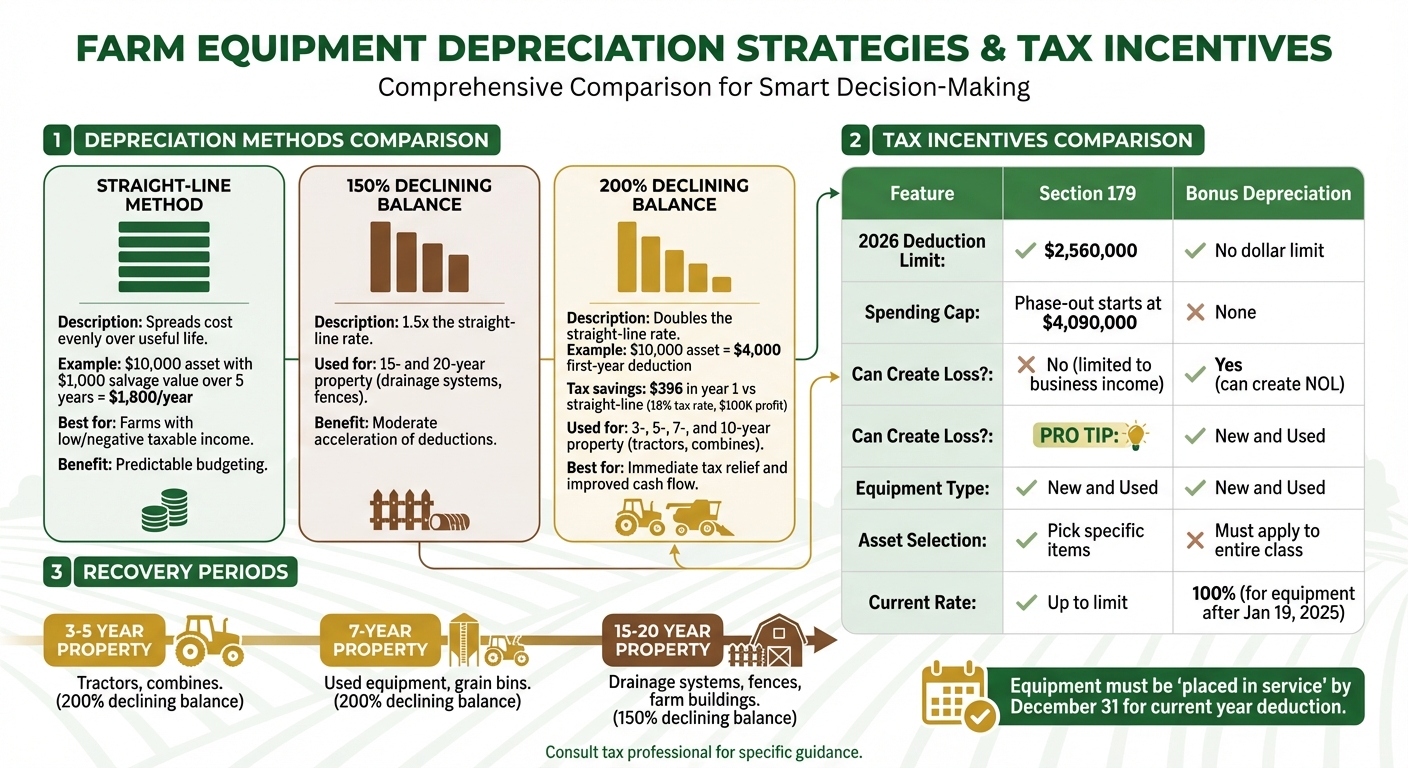
Farm Equipment Depreciation Methods and Tax Incentives Comparison Chart
Navigating New Depreciation Rules To Avoid Surprises for Farm Taxpayers
Transform Your Agricultural Team
Streamline job management, field mapping, and machine tracking with HarvestYield. Simplify your operations and eliminate paper job sheets.
ContinueDepreciation Methods for Farm Equipment
For farm equipment placed into service after 2017, the default depreciation methods are the 200% declining balance for 3-, 5-, 7-, and 10-year property (like tractors and combines) and the 150% declining balance for 15- and 20-year property (such as drainage systems or fences). Alternatively, you can choose the straight-line method. Below, we break down the most common methods to help you decide which one aligns best with your farm's tax strategy.
Straight-Line Depreciation
The straight-line method spreads the cost of your equipment evenly over its useful life. To calculate, subtract the salvage value from the purchase price, then divide by the recovery period. For instance, a $10,000 asset with a 5-year life and a $1,000 salvage value results in an annual deduction of $1,800.
This method is particularly suited for farms with low or negative taxable income. By slowing down depreciation, you can save deductions for future years when your income - and tax rate - might be higher. Additionally, the consistent expense makes budgeting more predictable. Using tools like the HarvestYield Hub can further streamline this process. Unlike accelerated methods, which front-load deductions, straight-line depreciation provides steady, equal deductions year after year.
Declining Balance Methods (150% and 200%)
Declining balance methods accelerate depreciation, allowing you to take larger deductions in the early years of an asset's life. The 200% declining balance (commonly known as double declining balance) doubles the straight-line rate and applies it to the remaining book value each year. The 150% declining balance uses 1.5 times the straight-line rate.
For example, a $10,000 asset depreciated using the 200% declining balance method offers a $4,000 first-year deduction, significantly more than the $1,800 from the straight-line method. If you're a farmer with an 18% tax rate and $100,000 in profit, this approach results in a $396 tax savings in the first year compared to straight-line depreciation. These accelerated methods are especially helpful when you need immediate tax relief to improve cash flow after making a big purchase.
"The declining balance approach can be particularly helpful when making a significant purchase, reducing tax burdens in the early years of ownership."
- Kevin Kim, PhD, Assistant Professor, Mississippi State University
While the timing of deductions differs, both declining balance and straight-line methods ultimately allow the same total depreciation over the asset’s life. If you decide to switch methods (for example, from 200% declining balance to straight-line), the change must apply to all similar property placed in service during the same tax year.
Tax Incentives for Farm Equipment Depreciation
The IRS provides two key tax incentives that allow farmers to deduct the full cost of equipment in the year of purchase: Section 179 expensing and bonus depreciation. By understanding and strategically combining these options, you can significantly reduce your tax burden and keep more money in your operation. Here's how Section 179 and bonus depreciation work - and how they can work together.
Section 179 Expensing
Section 179 allows you to deduct the full cost of qualifying equipment in the same tax year, up to $2,560,000 for 2026. This applies to a variety of assets, including tractors, combines, off-the-shelf software, and other tangible personal property. Both new and used equipment qualify, but there’s a catch: your total equipment spending for the year must not exceed $4,090,000. Once you go over that threshold, your deduction begins to phase out dollar-for-dollar. If your spending hits $6,650,000, Section 179 deductions are no longer available.
One important limitation is that Section 179 deductions can’t exceed your taxable business income. If your farm isn’t profitable or breaks even, you can’t use Section 179 to create a net operating loss (NOL). This makes it most effective during years when your business is generating strong income. On the plus side, you can choose which specific equipment to expense, giving you precise control over your deductions. There’s also a separate cap for heavy SUVs weighing between 6,000 and 14,000 pounds.
Bonus Depreciation
When your equipment purchases exceed Section 179 limits, bonus depreciation steps in as another way to recover costs. Thanks to the One Big Beautiful Bill Act passed in early 2025, farms can now deduct 100% of the cost of qualifying equipment purchased and placed in service after January 19, 2025. Unlike Section 179, bonus depreciation has no spending cap or phase-out threshold, making it ideal for large-scale investments.
One standout feature of bonus depreciation is its ability to create a net operating loss (NOL), which can be carried forward to offset future income. However, it comes with less flexibility: you must apply it to all assets within a specific class, rather than selecting individual items like with Section 179. Eligible equipment must also have a recovery period of 20 years or less, which includes nearly all farm machinery.
"While each deduction can help businesses deduct purchasing costs for their property, combining them can offer the greatest possible benefits." - U.S. Bank
To maximize your tax savings, apply Section 179 first to control your taxable income, then use bonus depreciation to deduct any remaining balance. Remember, equipment must be "placed in service" - ready and available for use - by December 31st to qualify for that tax year's deductions. By integrating these incentives with your overall depreciation strategy, you can better manage your cash flow and equipment costs. You can also track your work to ensure every hour of equipment use is accounted for.
| Feature | Section 179 | Bonus Depreciation |
|---|---|---|
| 2026 Deduction Limit | $2,560,000 | No dollar limit |
| Spending Cap | Phase-out starts at $4,090,000 | None |
| Can Create Loss? | No (limited to business income) | Yes (can create NOL) |
| Equipment Type | New and Used | New and Used |
| Asset Selection | Pick specific items | Must apply to entire class |
When paired with traditional depreciation methods, these tax incentives can help you streamline your farm’s financial management and make the most of your equipment investments.
How to Manage Depreciation Effectively
Managing depreciation well can lead to more accurate records and smarter decisions about your equipment. By keeping consistent tabs on depreciation and using the right tools, you can simplify tax prep and get a clearer picture of your machinery costs. A structured depreciation schedule plays a big role in achieving these outcomes.
Creating a Depreciation Schedule
Start by identifying assets that meet the IRS's qualifying criteria. Determine the cost basis, which includes the purchase price and any related costs like sales tax, delivery fees, assembly, and installation. Next, use IRS tables to figure out the recovery period: new farm machinery typically has a 5-year recovery period under the General Depreciation System (GDS), while used equipment falls into the 7-year category. Grain bins also have a 7-year recovery period, while farm buildings stretch out to 20 years. Then, choose a depreciation method - Straight-Line for steady deductions or Declining Balance (150% or 200%) for higher deductions in the early years.
Timing is everything when it comes to depreciation. Equipment must be "placed in service" - ready and available for use - before depreciation can begin. Simply having it delivered isn’t enough if it’s not yet in use. Keep detailed records of purchase dates, how often the equipment is used, and its maintenance history. These records are critical for defending your depreciation schedules during audits.
"Depreciation is an annual income tax deduction that allows you to recover the cost or other basis of certain property over the time you use the property. It is an allowance for the wear and tear, deterioration, or obsolescence of the property." - IRS Publication 946
It’s also worth noting that even if you don’t claim depreciation, it still reduces your cost basis, which can impact future deductions. Typically, depreciation expenses are reported on Item 14 of Schedule F (Form 1040) to help calculate net farm profit or loss.
Tracking Equipment Costs with HarvestYield
To make tracking and analysis easier, consider using tools like HarvestYield. You can manually add machinery details - such as the type, make, model year, and purchase or lease date - or save time by importing data directly from the John Deere Operation Center.
HarvestYield provides a Cost Analysis Table that projects equipment costs over 10, 15, or 20 years, helping you plan for replacements. The software creates a depreciation schedule based on the machine's price and your chosen depreciation rate, while also calculating total cost per hour based on estimated annual usage. This level of detail helps reveal the true operating cost of each machine.
The platform goes further by integrating operational data, allowing you to assign equipment costs to specific inputs and applications. This ensures that expenses are reflected accurately on your Profit & Loss page. Regularly updating starting hours and annual usage estimates keeps your cost-per-hour calculations accurate as your equipment ages. To get a full financial picture, include repair costs and other expenses for each machine, and use the Inputs page to assign machines to specific tasks. For example, the depreciation of a high-value tractor can be tied directly to the crop it’s used for, aligning with the broader strategy of precise depreciation management.
While HarvestYield simplifies tracking, always consult a tax professional for filing with the IRS.
Conclusion
Depreciation isn’t just a box to check on your tax forms - it’s a powerful financial tool that can shape your farm’s cash flow and overall financial health. Whether you choose Straight-Line depreciation for consistent deductions or Declining Balance methods (150% or 200%) to front-load tax benefits, the right approach depends on your financial goals.
Taking advantage of Section 179 expensing and bonus depreciation can provide immediate tax relief. For example, the Section 179 expense election limit will rise to $2,560,000 in 2026, and bonus depreciation remains at 100% for qualifying equipment bought after January 19, 2025. These provisions allow you to reduce taxable income in the purchase year, freeing up capital when it’s most needed. However, as Paul Neiffer, Tax Principal at CliftonLarsonAllen, cautions:
"Farmers try to use a depreciation method to match up the expense with the principal payments on the debt for buying the asset. Too many farmers simply try to deduct all of the asset up front without realizing extra taxable income is needed in future years to pay the principal".
Neiffer’s insight underscores the importance of balancing immediate deductions with long-term financial planning. Instead of maximizing upfront benefits, align your depreciation strategy with your farm’s broader financial picture.
"As bonus depreciation phases out, tax planning becomes critical." - Bradley Zwilling, Illinois FBFM Association and Department of Agricultural and Consumer Economics
As tax laws continue to shift, having a strategic plan in place becomes even more essential. Keep detailed records of purchase dates, costs, and business use percentages to support your claims. Be mindful of deadlines - equipment must be placed in service by December 31 - and avoid exceeding 40% of annual purchases in the final quarter to sidestep mid-quarter convention rules. Lastly, always consult a tax professional to navigate state-specific regulations and ensure your farm’s financial strategy stays on track.
FAQs
Should I use Section 179 or bonus depreciation?
Section 179 lets you deduct the full cost of qualifying equipment - like tractors - in the year you buy it. This can be a great choice if you’re making a big purchase. Bonus depreciation, meanwhile, offers another way to take accelerated deductions. Deciding which is better depends on your tax situation and long-term financial goals. Talk to a tax professional to figure out which approach works best for your strategy.
When is equipment considered “placed in service”?
Equipment is considered placed in service when it’s ready and available for use in your business operations. This is the moment depreciation starts, even if the equipment isn’t actively being used yet.
How do I choose between straight-line and 200% declining balance?
When deciding, think about your tax planning objectives. The straight-line method spreads depreciation evenly across the asset's useful life, offering consistency. On the other hand, the 200% declining balance method front-loads depreciation, reducing taxable income more in the initial years. Choose the method that best supports your financial strategy.